
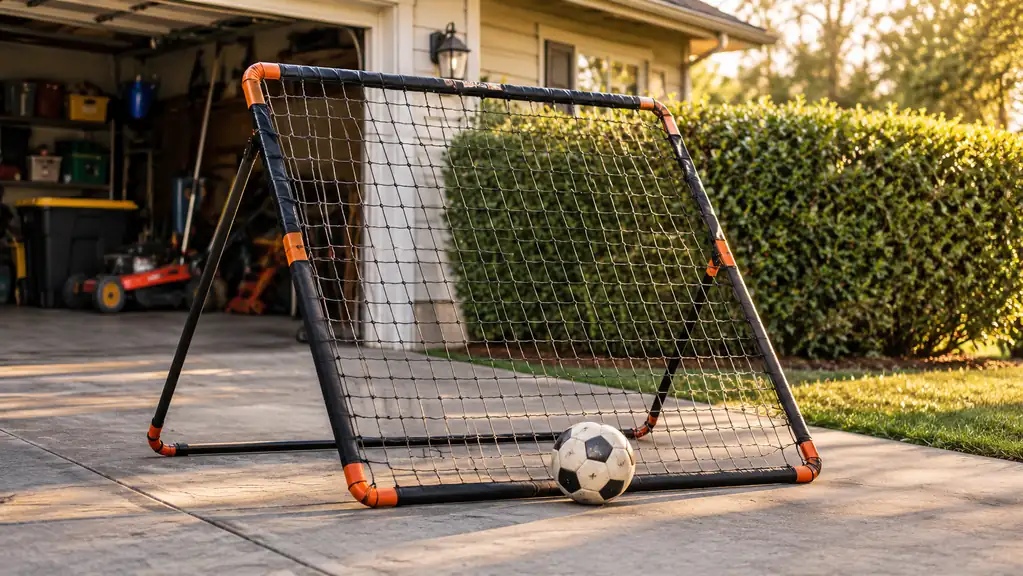
A father stopped me on the walking path behind the park in March and asked which soccer rebounder he should buy for his daughter. I gave him the short answer before I had time to soften it. If she trains alone in a driveway most days, get the SKLZ Quickster. If the rebounder lives in the trunk and comes out twice a week, get the Franklin. He nodded and walked on. I spent the next three blocks wishing I had said the rest of it.
Here is the rest of it. The SKLZ Quickster is a 6 x 4 foot dual-sided rebounder, so the net returns the ball from either side and a player can work receiving, trapping and first touch without being told to spin the frame around between reps. It goes up on adjustable poles that extend and lock in place, which matters more than it sounds like it should when the person setting it up is ten years old. The Franklin Soccer Rebounder is the angled single-face net most of us picture when we hear the word rebounder. One direction of return, a smaller target, and the easiest yes for a family still finding out whether the kid actually likes this sport.
| SKLZ Quickster | Franklin Soccer Rebounder | |
|---|---|---|
| Return surface | 6 x 4 foot face, a target a beginner can actually hit | Smaller angled face, less room to miss |
| Return direction | Both sides, so receiving and turning get worked from either foot | One angled face with one predictable return |
| Setup | Adjustable poles extend and lock in place, a child can handle it alone | Poles and stakes, slower the first few times |
| Return speed for a true beginner | Firm and quick off the net, which can rattle a young player | Slower and much easier to read |
| Living with it | Takes a corner of the garage and tends to stay there | Breaks down faster and travels without a plan |
| What it asks of the player | Volume and variety, both feet, real repetitions | One skill at a time in short sessions |
| Best for | A player with a driveway and a weekly routine | A family that trains at the park in bursts |
I have run both of these in my driveway and hauled both to the grass field three blocks from my house. Two rows in that table are the whole argument. The SKLZ gives you a bigger face and a return from both sides. The Franklin gives you a smaller, slower, more predictable return and a much easier thing to carry to the park. Everything below is detail on top of that.
How I Compared Them
I am not a lab. I am a retired PE teacher with a one-car garage I converted into a gym, a driveway with a crack down the middle, and a neighborhood park that gets mowed on Thursdays. I ran both rebounders with my granddaughter Sofia, who was ten the first summer and is twelve now, and my grandson Mateo, who is seven and would rather be shooting baskets. Between the two of them I got a fair read on what a true beginner needs versus what a player with a routine needs.
The test was simple. Which one got used without me nagging. Which one a child could set up and put away alone. Which one survived a summer in a garage that gets hot enough to make the door handle uncomfortable. And which one produced better first touches by the end of a session, measured the only way I know how, which is whether the ball stayed close or bounced off into the grass.
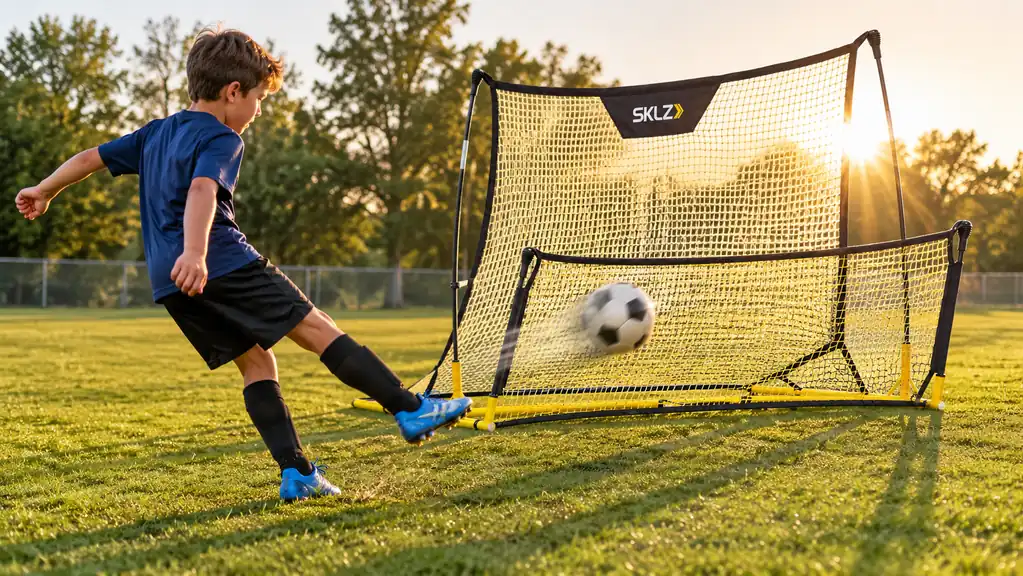
Where the SKLZ Quickster Wins
The dual-sided net is the reason to spend the extra. When a kid is learning to receive, the hard part is not the technique, it is the repetition. A single-face rebounder sends the ball back the same way every time and the player's body starts cheating toward that one angle without her knowing it. With the SKLZ, I can put a girl on one side and have her play the ball in, then move her across and take the return on the other side. Left foot, right foot, cushioning, turning. She gets twice the touches in the same twenty minutes and never notices she is working harder.
The adjustable poles that extend and lock are the second real advantage, and it is the one I would not have predicted. I have watched a lot of training gear die in the setup phase. If a rebounder takes two adults and a wrestling match to put up, it stays folded from October to March. Sofia put the SKLZ up by herself the third time she used it, and she was ten that summer. That is the whole test. Gear a child can deploy alone is gear that gets used on the nights nobody feels like driving to practice.
The build has held up. Metal frame, nylon net, two Florida summers in a garage with no ventilation. Nothing has rusted through and the net has not gone slack. The listed weight is 5.99 kg, which is not something you tuck under one arm, but it also means a hard shot does not walk the frame across the driveway.
Where the Franklin Soccer Rebounder Wins
The Franklin is the better choice for a beginner, and I will argue that with anyone who disagrees. A smaller angled face sends the ball back at a pace a seven-year-old can read. Mateo spent a spring flinching at the harder returns off the bigger net. The Franklin's shorter, softer return let him get his foot on the ball and, more to the point, let him stop being afraid of it. Fear is what kills a young player's first touch, not bad technique.
It is also the easier object to live with. It breaks down quicker, it moves from the yard to the car without a plan, and it does not eat a corner of the garage the way the SKLZ does. On a rainy Saturday when the field is shut, the Franklin goes in the trunk and comes back out at the indoor court at the community center. The SKLZ, honestly, mostly stays where I put it. That is not a knock on how it is built. It is a knock on how often I feel like moving it.
The dual-sided net is the reason to pay for the SKLZ
A 6 x 4 foot face, a return from both sides, and adjustable poles that lock in place so a player can set it up alone. Check the current listing and today's price on Amazon.
Amazon Check Today's Price on Amazon →What a Tuesday Practice Actually Looks Like With Each
A real session at my house starts around 6:15, after the dishes, in the twenty minutes before the light goes. With the SKLZ, Sofia works two-touch receiving on one side, then crosses over and does the same thing with the other foot. Then we run a round where she has to call out which foot she is using before she plays the ball, which is as close to a game as a rebounder drill gets. It is repetitive and a little dull and it is exactly the work that shows up on Saturday morning.
With the Franklin, the session is shorter. The ball comes back at one angle, so we work one skill, which is the first touch into space. Mateo stands at that angle, plays the ball in, and tries to kill it dead at his feet. Twenty reps and he is done, and at seven, twenty reps is a win.
Neither session is better than the other. They belong to different ages. A ten-year-old who has decided she wants to make the school team needs volume and variety, and that is the SKLZ. A seven-year-old who needs to stop flinching needs a soft return and a short session, and that is the Franklin.
One more thing from the old man in the driveway. I warm up before any of this. My left knee has been cranky since my playing days, so I do ten minutes of walking and a few easy stretches before I start pinging balls at a net, and I make the kids do the same. A rebounder is a tool for repetitions, and repetitions on cold legs are how a forty-minute session turns into a week of limping.
What I Liked
- The dual-sided net roughly doubles the touches in the same session
- Adjustable poles extend and lock, so a child can put it up alone
- A 6 x 4 foot face gives a beginner a target she can actually hit
- Metal frame and nylon net held up through two hot Florida summers in a closed garage
Where It Falls Short
- At 5.99 kg and awkward once folded, it tends to stay where you put it
- The bigger face sends a firmer return, which can rattle a young beginner
- It wants a real corner of a one-car garage
- More machine than a player who trains twice a week needs
Sofia put the SKLZ up by herself the third time she used it, and she was ten that summer. Gear a child can deploy alone is gear that gets used.
The Details That Decide It After a Month
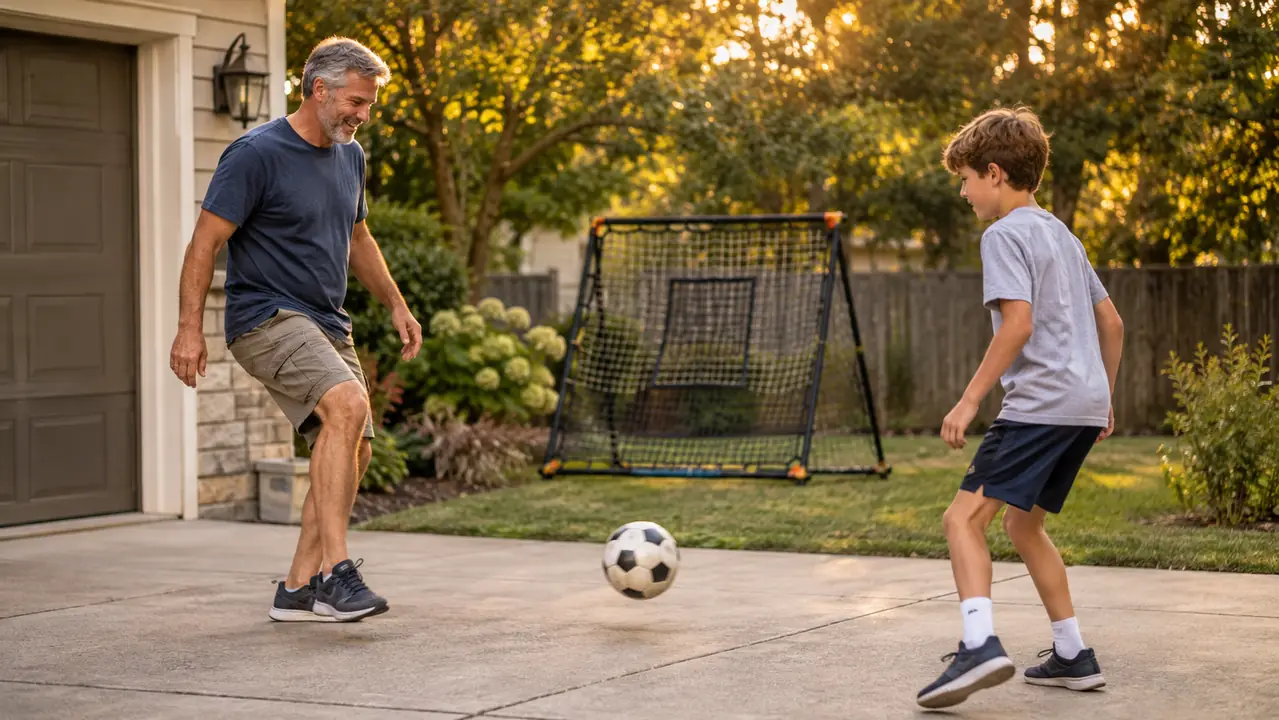
Setup is where most gear dies. If a rebounder takes five minutes and two people, it gets used twice in the first week and then becomes an obstacle you walk around in the garage. Both of these go up faster than that once you have done it a few times, but only the SKLZ can be handled by the player alone, and that comes down to how the poles extend and lock. That single detail decided which one my granddaughter kept using after the new wore off.
The second detail is the return itself. A bigger face and a tighter net give a sharper, faster ball back. That is good for a player with a decent first touch and hard on a player still learning where the ball is going to land. If your kid is under nine, the slower return off the Franklin is worth more than the extra surface on the SKLZ.
The third is wind. A 6 x 4 foot net is a sail, and on a gusty Jacksonville afternoon I have had to lay the SKLZ flat to keep it from going over. That is true of any rebounder that size and it is worth knowing before you leave one standing in an open field. In a driveway with a house to break the wind, it is a non-issue.
What I Tell Parents at the Park
Most parents ask me some version of the same question and the answer is nearly always about age, not about the equipment. If the player is ten or older and has told you she wants to be good at this, the SKLZ is the right buy. She will use the second side, she will put it up herself, and she will get more touches per week than she would at a twice-weekly practice.
If the player is seven or eight and you are still finding out whether this is a soccer kid or a basketball kid, the Franklin is the right buy. It travels, it stores small, and its slower return will not teach him to flinch. The worst purchase either way is the expensive one that stays folded in the garage, and that is a storage decision more than a training decision.
Who Should Buy Which
Buy the SKLZ Quickster if the player has a driveway or a patch of grass she can get to four or five days a week, is nine or older, and you are tired of driving to a field for twenty minutes of touches. The dual-sided net, the big face and the poles that extend and lock make it a piece of training equipment rather than a toy. It is also what I would buy for a player whose coach has said her first touch is the thing holding her back.
Buy the Franklin if the player is young, if the rebounder has to live in the car, or if the family is still testing whether this sport sticks. Some seasons are tight for a family budget, and in those I would hand a parent the Franklin without hesitation and tell them to put the rest toward a decent ball and a pair of boots.
Skip both if the player has a brick wall, a ball and a friend. Rebounders exist to manufacture repetitions when nobody is around to serve the ball. If she has somebody to pass with three times a week, she needs the friend more than either net.
If she has a driveway and a routine, this is the one I would buy
Dual-sided return, a 6 x 4 foot face, and adjustable poles that lock so the player can run the session without you. Check today's price and the current listing on Amazon.
Amazon Check Today's Price on Amazon →