
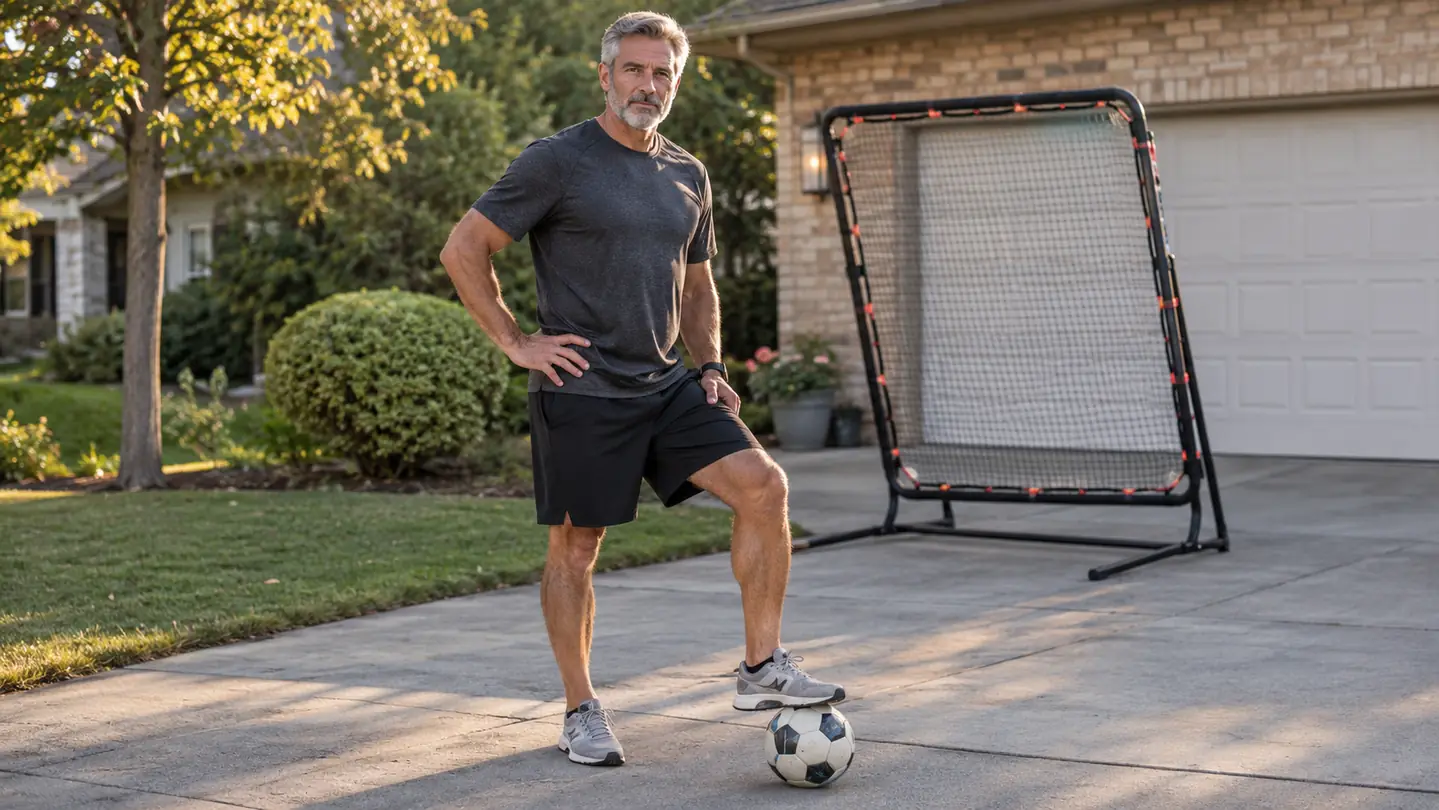
I taught high school PE for thirty-one years, and for about twenty of those I coached soccer on the side. When I retired I figured I was done watching kids chase balls into the street. Then my grandson Mateo turned seven, asked me to teach him how to trap a ball, and I remembered the real problem with solo practice: the ball only comes back if somebody sends it.
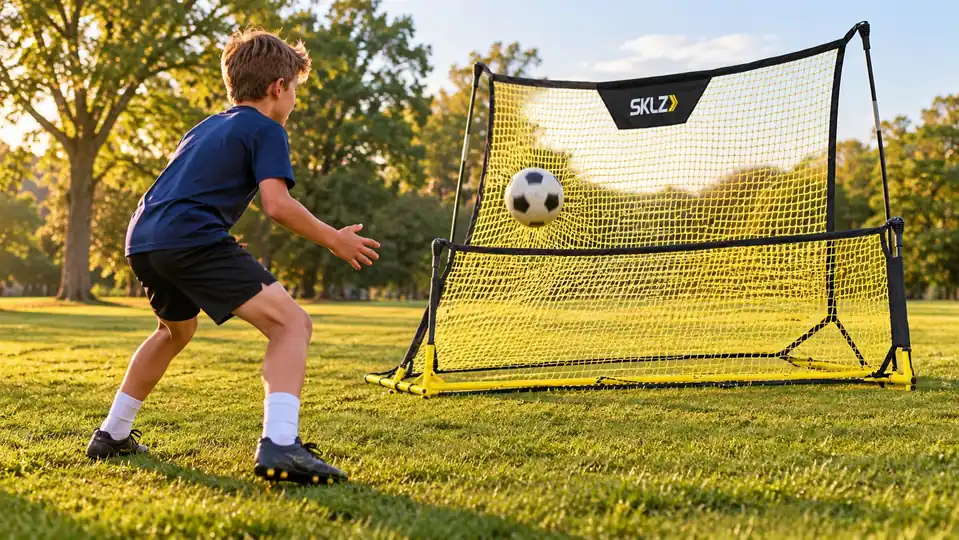
For two weeks we kicked at the garage door. The door did not care. Balls came back flat and dead, or skipped off the hinge at ankle height, and Mateo spent more time retrieving than touching. Then a coach friend lent us a SKLZ Quickster, and the difference was not subtle. The SKLZ Quickster is a dual-sided rebounder with a 6 by 4 foot net stretched on a metal frame, and it sends the ball back with enough life that a young player has to actually control it. We have used it in the driveway, on the grass at the park three blocks from my house, and once in the garage when it rained for four days straight.
Here is what changed, in the order I noticed it, plus the two habits I would tell you to skip.
The ball only comes back if somebody sends it
The SKLZ Quickster is a dual-sided rebounder with a 6 by 4 foot net on a metal frame. The poles extend and lock in place, so it stands up in a couple of minutes without tools or a second set of hands.
Amazon Check Today's Price on Amazon →It gives you a partner who never gets tired
A partner passes when they feel like it and quits when their legs do. A rebounder returns every ball you send it, at the speed you sent it, for as long as you are willing to stand there. That consistency is the whole point. When Mateo and I worked together he got maybe twenty real touches in half an hour, because most of that half hour was chasing. With the net he gets a touch every four or five seconds. Thirty minutes turns into hundreds of reps instead of a handful.
The return has pace you have to handle
A garage door absorbs almost everything. The ball arrives slow and flat, and you can kill it with a dead leg and no consequences. A tensioned net pushes back. The return still carries some speed, and a sloppy first touch sends the ball running off into the grass. That is the feedback you want. You find out right away whether the touch was genuinely good or whether you were getting away with something. Honest feedback beats encouragement at this stage of learning.
Two faces, so the weaker foot has to work
The Quickster is dual-sided, so you can strike into one face and receive off the other, or angle it so the rebound comes back to the foot you have been avoiding. I set it up that way and made Mateo's left side do the work. He hated it for about a week. Then he stopped noticing, which is how weak foot work always goes. It is miserable right up until it is simply normal, and then it is a skill he keeps.
Setup is minutes, not an afternoon
The poles extend and lock in place, so the frame goes up without tools and without a second set of hands. I have had it standing in the driveway in under three minutes, alone, with coffee in one hand. That matters more than it sounds. The gear that gets used is the gear that is easy to put out. If setup is a project, you skip it on a tired Tuesday, and then you skip it Thursday too, and by the weekend it lives in the garage permanently.
It fits in a driveway, not just a field
The net face is 6 by 4 feet, big enough to catch a struck ball and small enough that you are not building a pitch in your front yard. The whole thing weighs about thirteen pounds, so moving it from the garage to the driveway, or folding it into the trunk, is not an event. I have carried it to the park three blocks away with one hand while holding a coffee in the other. Gear you can move by yourself is gear that gets used on a random Wednesday.
Mateo gets a touch every four or five seconds. Thirty minutes becomes hundreds of reps instead of a handful.
Receiving finally gets trained, not just striking
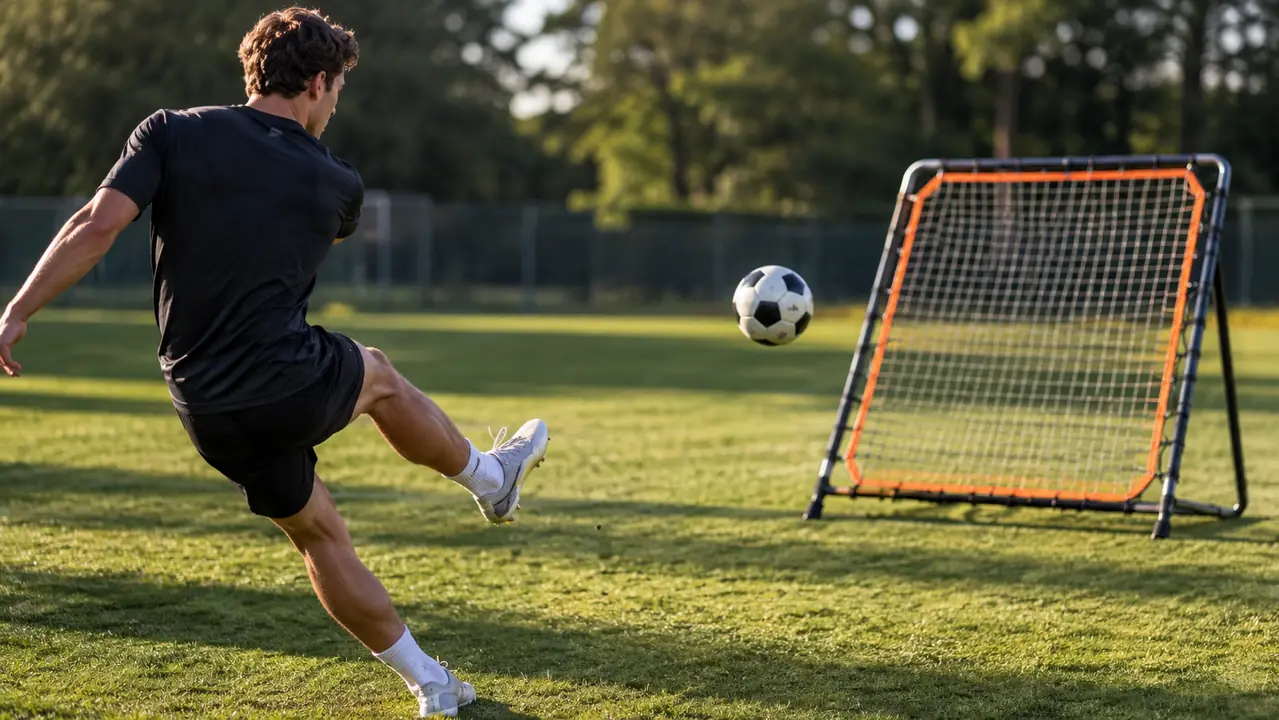
Most solo work is striking, because striking is fun and receiving is not. A rebounder forces the second half. You strike, the ball comes back, and now you have to do something with it before it dies at your feet. Trapping, cushioning, turning, all of it gets reps instead of theory. That is the line between a kid who can kick a ball hard and a kid who can actually play when the ball arrives at an awkward height.
Angle the frame and you have a new drill
Straight on, the return is flat and simple, which is exactly what you want for first touch work. Turn the frame or set it at an angle and the ball comes back across your body, closer to what a game actually throws at you. One piece of gear, a dozen different drills, and none of them require a second person to show up and volunteer their afternoon. That variety is what keeps a kid coming back to it.
Sessions stay short and stay useful
The knock on solo training is that it turns into twenty minutes of jogging after a ball. A rebounder keeps the session dense. I time Mateo at fifteen minutes and he finishes sweaty and sharp instead of bored and drifting. Short and dense beats long and loose, for a seven year old and for most adults I know. You can get real work done before dinner, which means it actually happens on a school night.
It holds up to sun, rain and being dragged around
Ours has spent plenty of afternoons in Florida sun and sat through two thunderstorms. The frame is metal and the net is nylon, and after a full season nothing has stretched out or rusted through. I would not leave it out for a month at a time, but I would not baby it either. That is about the right balance for something that lives in a garage and gets hauled onto the grass whenever the weather cooperates.
It works for three kids as well as one
Eventually Mateo's friends started showing up and the net became a station: one striking, one receiving, one collecting. It has been around long enough to carry more than eighteen hundred reviews, which says something about how many households are trying to give a kid real touches without a full team around them. You buy it for solo practice and you end up using it with whoever is in the yard.
What I'd Skip
Two things. First, I would skip any solo session where you only strike and never receive. If you hammer the ball into the net and let it roll away, you are practicing kicking, not playing. Set up so that every return has to be dealt with, even the awkward ones at shin height. Second, I would skip the idea that a rebounder replaces a team. It does not, and it is not meant to. It fills the gaps between practices, and it fills them better than anything else I have had in my garage.
What the SKLZ net does better than a wall is give you a return with life on it, instead of a ball dying at the base of the door or skipping off a hinge at your ankles. My garage door has dents in it from two decades of this. A face built to send the ball back turns the same twenty minutes into a different exercise entirely, and the kid can feel the difference in the first five touches.
Fifteen dense minutes beats an hour of chasing
The SKLZ Quickster is a dual-sided rebounder with a 6 by 4 foot net and a metal frame that weighs about thirteen pounds. It goes up in a couple of minutes, comes down just as fast, and fits in the trunk.
Amazon See the SKLZ Quickster on Amazon →