
Mateo is seven. He is also, at this moment in his life, completely obsessed with soccer. Every weekend he comes over to our house in Jacksonville with a ball under one arm and a question I have heard about forty times now. Grandpa, will you play with me.
Here is the problem with that question. I am fifty-four with a left knee that has been complaining at me since my playing days. I can jog a little and I can walk a lot, but I cannot spend ninety minutes chasing a seven-year-old around a field. I tried. The knee discussed it with me for three days afterward. Which is roughly how the SKLZ Quickster ended up living in my garage.
Before that, the answer was a half-hearted version of yes. Kicking the ball back to him while I sat on a cooler. That is not practice, that is fetch. I taught PE for close to thirty years and I know the difference between a kid touching a ball and a kid actually training. He was touching the ball. Worse, I could see him starting to lose interest, because the game had turned into a chore for the adults around him.
His father, Luis, works Saturdays. Elena and I are the weekend crew. So I went looking for something that would let Mateo get real repetitions without needing a body to feed him the ball. What I bought was the SKLZ Quickster Soccer Trainer, a dual-sided rebounder net, six feet by four feet on the large side, that you set up and let do the returning for you.
Give the kid a rebounder that returns the ball as fast as he can hit it
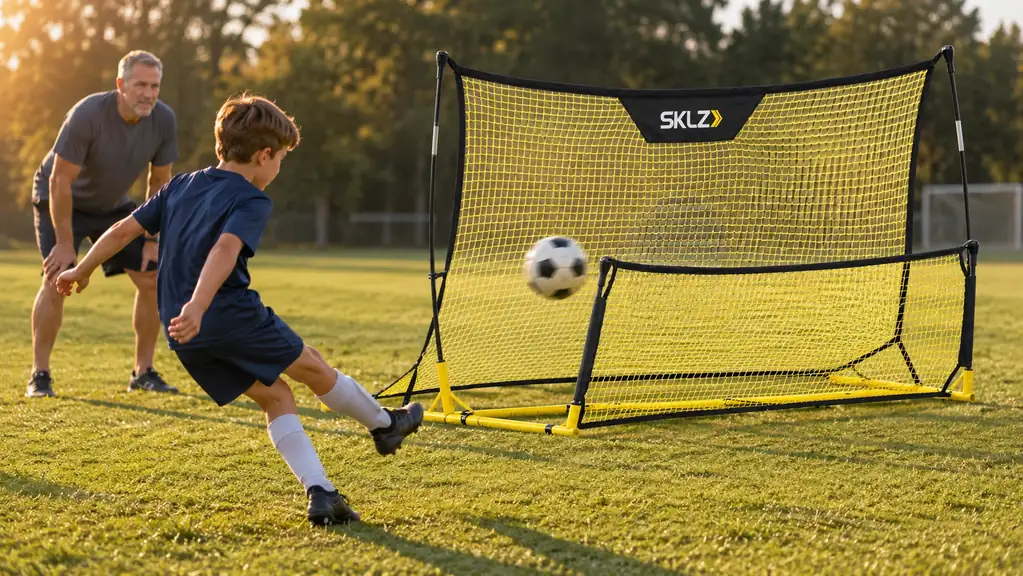
The SKLZ Quickster is a dual-sided six-foot by four-foot net on adjustable poles. You set the angle, lock it, and practice starts.
Amazon Check Today's Price on Amazon →What It Actually Is and What It Does
The Quickster is a rebounder, which means it is not a coach and it is not a target. It is a surface that throws the ball back at you. The net is six feet by four feet on the large side, mounted on a metal frame with nylon netting, and the whole thing weighs somewhere around thirteen pounds, so I can carry it from the garage to the driveway with one hand while holding a coffee in the other.
The part that sold me is the adjustable poles. They extend and lock in place, and that is how you change the angle of the face. A flat angle sends the ball back low and fast, which is what you want for one-touch passing and trapping. A steeper angle pops it up in the air, which is what you want for receiving out of the air. Mateo figured this out on his own in about an afternoon, and now he changes the angle between drills without being told.
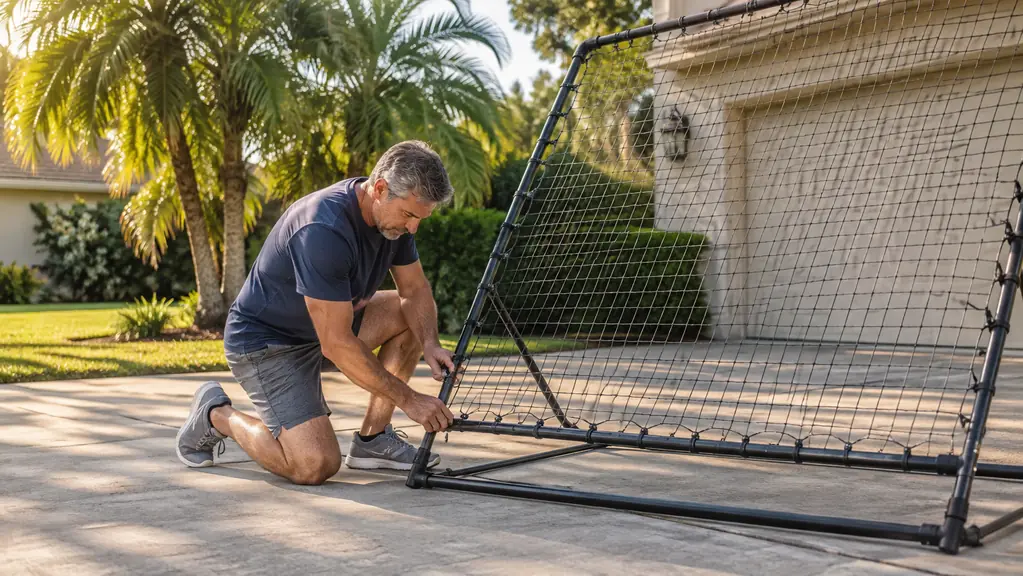
Setup is the first thing I tested, because I have wasted plenty of weekends on gear that takes twenty minutes to build. The Quickster takes me about two minutes from the garage to the first pass. The poles extend and lock, so there are no loose pieces to hunt for in the grass. That single detail is why it gets used. Gear that is annoying to set up stays in the garage.
He did not need a coach that weekend. He needed something that would return the ball as many times as he could hit it, and it did, for two hours.
The First Saturday
I set it up in the driveway on a Saturday morning in October while Mateo was eating breakfast. I did not tell him what it was. He came out, stopped dead, and asked what it was for. I told him to kick the ball at it and find out. He did, and the ball came back at him, and he laughed out loud.
He stayed out there for two hours. I did not have to kick anything. I sat in a lawn chair with my knee stretched out and watched him work through every version of a pass he could think of, sometimes with his right foot, sometimes his left, sometimes the inside of the foot, sometimes taking it out of the air. The net kept returning it. He kept going.
One thing I will say plainly: it does not teach technique by itself. The rebounder will return a bad pass just as happily as a good one. What it does is give a kid a volume of repetitions no adult can match, and volume is what makes a seven-year-old's touch improve. If you want the technical breakdown of how the angles line up with specific drills, I wrote that up separately in my long-term review, and the side-by-side against the Franklin unit made the differences clearer than anything I could say here.
What I Do Not Love About It
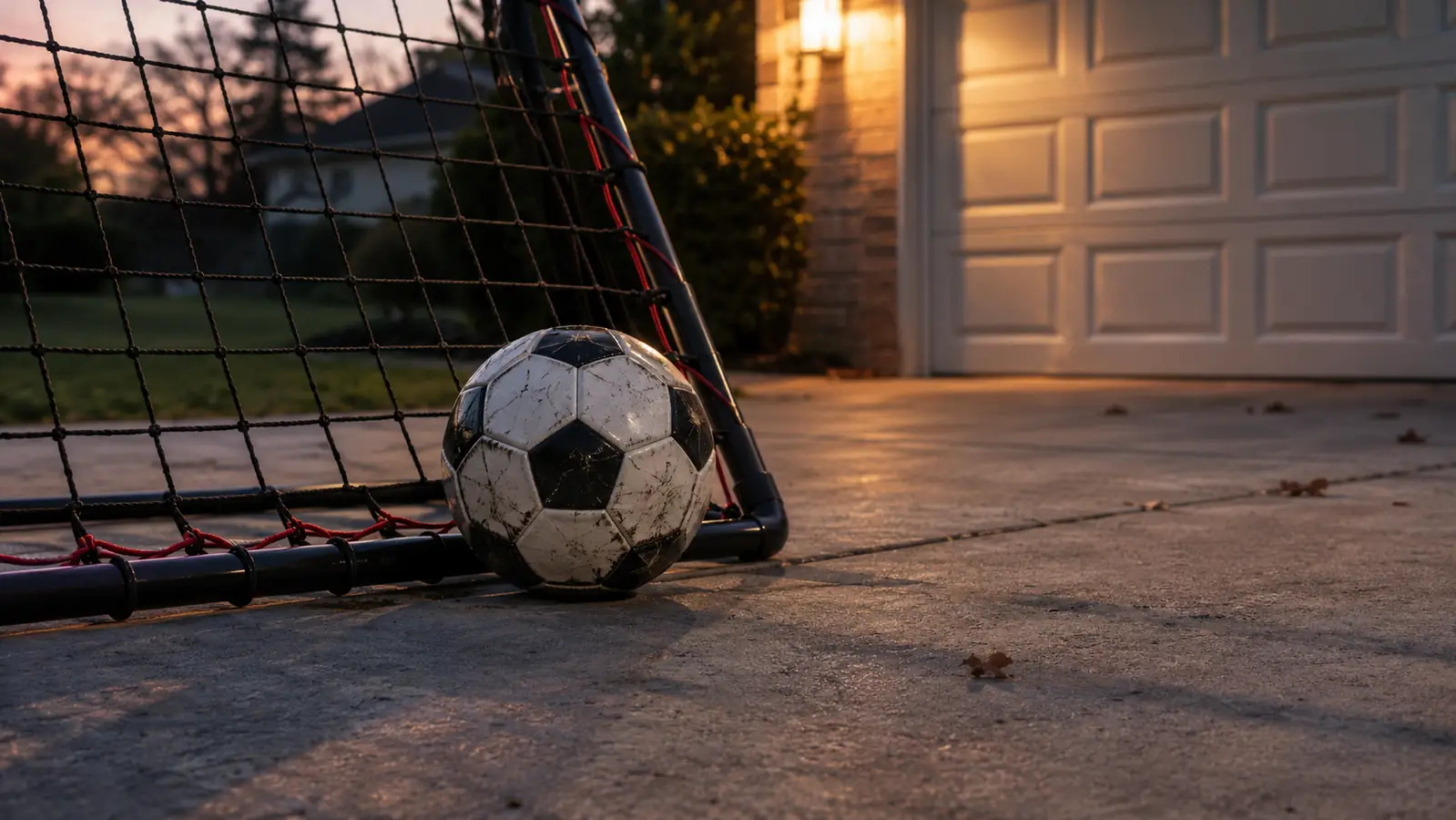
The frame is metal and the netting is nylon, and on a windy day in an open field the whole thing will go over if you do not weight the base. On the driveway it is fine. At the park three blocks away, which is where we take it on Sundays, I set a sandbag on the base before Mateo starts. That is not a knock on the SKLZ design so much as a reality of anything tall and light standing in Florida wind.
The other honest note is that a rebounder is a solo tool. It teaches a kid to pass and receive and trap, but it does not teach him to read a defender or make a run. Those need other children. The Quickster bought Mateo repetitions. It did not buy him a team, and I would not want anyone to think it did.
Last thing: when the ball hits the frame instead of the net, you hear it. A loud metallic ring that carries down the block. Mateo thinks it is funny. I do not.
What I'd Tell You If We Were Sitting at My Kitchen Table
I would tell you that the reason this worked in my house is not the net. It is that the net removed me from the equation. Mateo can walk out the back door and start practicing without needing an adult to be available, and kids practice the things they can do alone. That is the whole mechanism. Remove the waiting.
I would also tell you not to buy it expecting a coach. If your kid is young and just learning the game, this gets him touches, and touches matter more than drills at that age. If your kid is twelve and playing club soccer, he needs a wall and a partner and a real coach. This is a supplement, not the thing.
And I would tell you to check the current price rather than take my word for what it is worth. What I can tell you is that this is the piece of gear in my garage that gets used most weekends without me having to ask, and Mateo is still asking to practice. After two years of that question wearing me down, that is a genuine change. The knee is grateful. So, honestly, am I.
The gear that gets used is the gear that is easy to take out
Dual-sided rebounder with adjustable locking poles, six feet by four feet. Set the angle, lock the poles, and practice starts.
Amazon Check Today's Price on Amazon →