
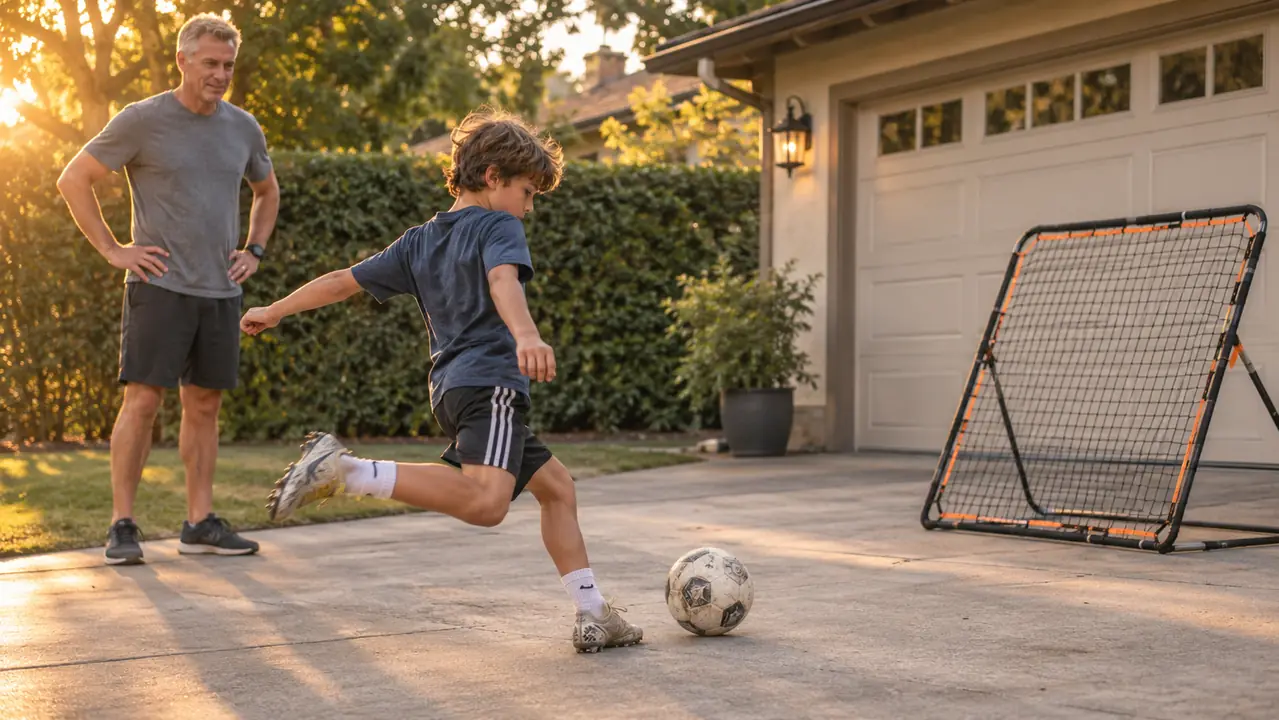
My grandson Mateo is seven, and last spring his entire method for stopping a soccer ball was to stab at it with his toe and then chase it into the neighbor's yard. I watched him do that maybe forty times in one afternoon. Somewhere around the thirty-fifth time I started looking at rebounders.
I taught high school PE for twenty-nine years in Jacksonville and coached youth basketball and soccer as a volunteer for much of that. I am not running a skills academy out of my driveway. I have a converted one-car garage, a slab of concrete out front, and a park three blocks away with a grass field. Two grandkids come over most weekends. What I wanted was a way for Sofia, who is ten and already has a decent left foot, to get real repetitions without me playing goalkeeper for an hour, and a way for Mateo to learn what a ball does when it comes back at him instead of sitting still. The SKLZ Quickster is what I ended up with, and it has been out on the slab and at the park since early spring.
The Quick Verdict
It does one job well: it gives a kid a wall to play off when there is no wall. Setup is about two minutes, the frame and net have held up outdoors, and it will not teach technique on its own.
Amazon Check Today's Price →The wall your driveway does not have
Six feet by four feet of nylon on a metal frame, up in about two minutes, so a kid stops chasing the ball into the street after every third pass.
Amazon Check Today's Price on Amazon →How I've Used It
The Quickster lives in the garage next to the chest freezer, and it comes out most Saturday mornings and usually again on Sunday. Setup is the part I did not expect to care about and now care about most. The poles extend and lock in place, so once I set them that first weekend I have not had to fiddle with them again. I carry it out by the frame, set it on the slab or on the grass, and we are playing inside of two minutes. If it took ten minutes it would stay in the garage, and I know that about myself.
A typical session is not a training block. Sofia gets about twenty minutes before she loses interest, Mateo gets fifteen, and the two overlap. I stand off to the side and give one instruction at a time, mostly about getting the plant foot down and keeping the ankle locked. Sofia works on receiving across her body and turning out. Mateo works on the same thing, badly, and then a little less badly. When they are done they kick at it for five more minutes with no instruction from me at all, and that is fine, because they are still touching a ball.
Here is a specific Tuesday, because I think specifics are worth more than adjectives. Early June, already hot by nine in the morning. I carried it out, leaned the face forward a touch, and put a chalk mark on the slab about twelve feet in front of the net. That mark was Mateo's passing spot. The rule was simple: pass from behind the mark, then receive whatever comes back. First ten minutes, four balls went past him and out toward the yard and I did the walking. By minute twenty he was stopping most of them, mostly by getting his body in front instead of stabbing with the toe. That is one session, and one session means nothing. Twenty of those across a summer means something.
At the park I set the SKLZ net on the grass at the edge of the field while I walk a lap. It weighs a little over thirteen pounds, so I can carry it from the car in one hand, but it is not something I would ask a ten-year-old to lug half a mile. The metal frame has stayed square through a full season. The nylon net has taken Florida sun and direct hits from a ten-year-old who strikes harder than she realizes, and it has not stretched out or torn.
What the Dual-Sided Net Actually Gives You
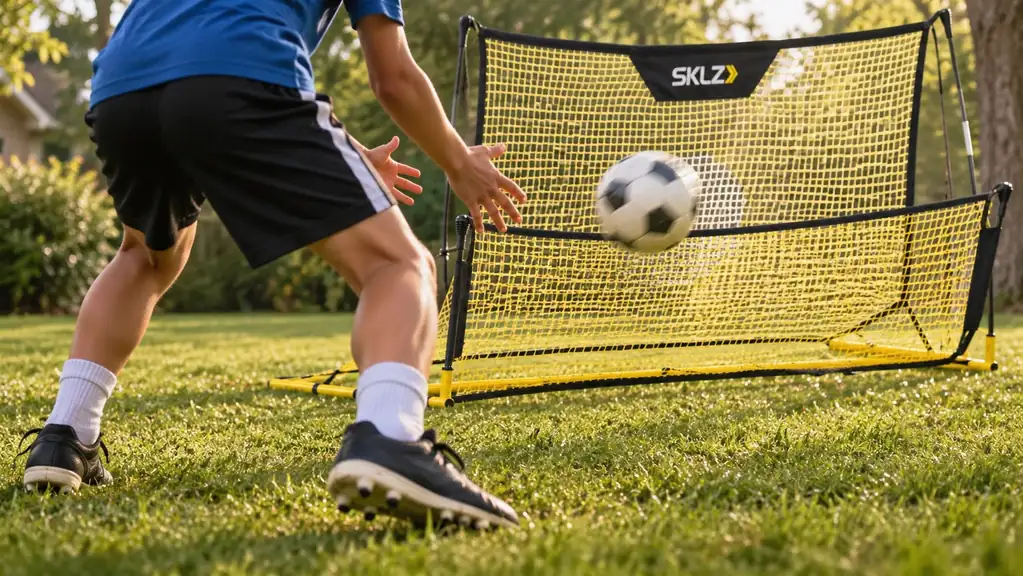
The net is six feet by four feet, and the size does more work than any of the marketing language around it. A small rebounder demands accuracy that a seven-year-old does not have yet, so every third pass becomes a chase down the driveway. A surface this wide means Mateo can miss his target by two feet and still get a ball back at him. That is the difference between a game he will play for twenty minutes and one he quits after four.
The angle of the face is set by the poles. Nose the top of the net forward and a firm pass comes back low and quick, which is what Sofia wants when she is working on her first touch. Stand it up straighter and the ball comes back slower and higher, which gives Mateo the extra beat he needs to see it and get his foot behind it. I change it between their turns and it takes a few seconds. Because the net is dual-sided, Mateo can work one face while Sofia works the other, and neither of them spends the session waiting on the other one.
Before this net, we used the garage door. It works, sort of. A ball off a garage door comes back hard and flat, it echoes down the whole block, and Elena did not love hearing it at seven in the morning on a Saturday. The door also gives you no angle, so every rebound is the same rebound, and the ball keeps going until something stops it. A ball off the net dies when the pass dies and stays low when the pass stays low, and that turns out to be the more useful feedback for a kid who is learning what his own foot just did.
Nothing here is a machine. It is a taut piece of nylon on a metal frame, and what it returns is exactly what you put into it. Strike it with a firm, clean pass and you get a firm, clean pass back. Strike it with a toe stab and you get a ball that squirts off sideways, which is a lesson all by itself if a kid is paying attention. That is the honest trade with any rebounder: it is a mirror, not a coach.
The Number That Changed My Mind
I kept a rough count one Saturday in April because I wanted to know whether this thing was earning its space in the garage. With me standing in as his passer and chasing balls, Mateo got somewhere around thirty real touches in twenty minutes. Most of that time was me walking to retrieve, not him playing. Against the net, in the same twenty minutes, he got well over a hundred, because the ball comes back to him and he does not have to go get it.
I counted out loud, which is tedious, and I did it twice because the first count was worthless. The first Saturday I counted every contact, including the ones where he just stood there and let the ball hit him in the shin. The second Saturday I only counted contacts where he actually did something with the ball, a pass back or a controlled first touch. That number was about a hundred and ten in twenty minutes. The same honest count with me as his passer was thirty-one, and I was the one who needed to sit down afterward.
You can argue about whether a hundred sloppy touches beat thirty coached ones. I have had that argument with myself on more than one walk to the neighbor's yard. My answer after a season is that at seven the sloppy ones come first and the coaching lands later, and you cannot coach a kid who has lost interest because the ball is in the street again.
For Sofia the math is different. She does not need volume as much as she needs a repeatable rep. She is working on the same touch, over and over, without a defender and without me narrating. Ten minutes of that is worth more to her than a half hour of me telling her where her plant foot should be, and she would tell you the same thing if you asked her.
In twenty minutes against the net, Mateo got well over a hundred touches. In twenty minutes with me as his passer, he got about thirty and I got the workout.
How It Has Held Up
It has been outside on the slab and on grass since April. The SKLZ frame is metal and it still sits flat on uneven concrete, no wobble, and no rust that I can find. The net is nylon and it has a little more give to it now than it did in week one, which I think is normal for netting that gets hit a few hundred times a week, but nothing has torn and no seam has opened up.
The real test came in late July, during a stretch of afternoon storms we get here every summer. I left it out on the slab one Thursday, drove to the store, and came back to it on its side with a puddle pooled in the netting. I dumped the water out, stood it back up, and it was fine. No bent pole, no split seam, no tear where the net meets the frame. The nylon has faded a shade or two from the sun, which I expected in April and would have been surprised not to see by August. If you plan to leave yours out permanently, put it where it gets afternoon shade, mostly for the sake of the net.
The one thing I watch is wind. A six-by-four sail catches an afternoon breeze here in Jacksonville, and I had it tip once on a gusty day when I left it out and walked back inside for water. Now it goes in the garage when we are done, which takes the same two minutes as setting it up. That is not a knock on how it is built. It is a note about physics and about my own laziness.
Where It Comes Up Short
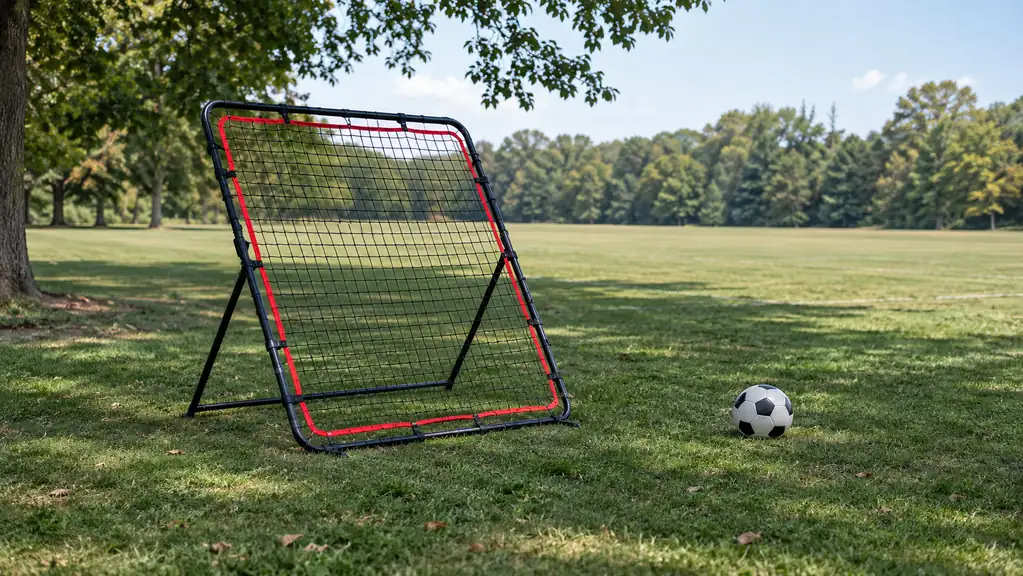
The biggest limitation is that it has no idea what your kid is doing. A rebounder rewards whatever technique you bring to it, including bad technique, and it will let a child repeat a mistake two hundred times without a word of complaint. If nobody is watching the plant foot and the ankle, the net becomes a very efficient way to groove a bad habit. I say that as a man who spent twenty-nine years watching teenagers groove bad habits.
The other limit is height. A ten-year-old striking a ball with any real pace will put it over the top of a four-foot net if she is not careful, and then you are walking again. Sofia learned to keep it down because she got tired of fetching, which is a legitimate way to learn. An older kid, say fourteen or fifteen, will want something taller and heavier, and there is a whole category of those. This one is sized for the ages my grandkids are, and I would not pretend otherwise.
It also is not a goal, and kids want to score. Mateo will play against the net for a while and then ask to shoot at the garage door, which is his stand-in for a real goal. If you have the space and a kid who is goal-motivated, a small goal plus this net is a better pair than either one on its own, and I would budget for both if I were starting over.
And the ball still gets past it. The net is six feet wide and a seven-year-old can put one around the edge of it without much effort. In my driveway that means the street, so I stand where I can cut it off before it gets there. If your setup has a fence or a slope behind the net, you will chase a lot less than I do. What comes back at you is also only as fast as what you hit into it, so it never really simulates live pressure from a defender.
What I Liked
- Setup takes about two minutes, and the poles stay where you lock them
- Six-by-four net is forgiving enough that a young kid keeps playing instead of chasing
- Metal frame and nylon net held up to a full spring and summer outdoors
- Dual-sided, so two kids can work at once without taking turns
- Angle adjustment switches between a fast low rebound and a slower, higher one
Where It Falls Short
- It cannot correct technique, so bad habits repeat as easily as good ones
- A wide net catches wind and will tip on a gust if you leave it out
- At about thirteen pounds it is easy for an adult to move and awkward for a child
- It is not a goal, and goal-motivated kids lose interest in it faster
- It never simulates a defender or live game pressure
Who This Is For
The Quickster makes sense for a household like mine. A flat piece of concrete or a patch of grass, one or two kids somewhere between seven and thirteen, and an adult who is around but not always available to play. It is at its best when a kid already likes soccer and just needs reps, or when a kid is learning to receive a ball and needs to see a few hundred of them come at him. It also works for an adult who wants twenty minutes of passing after work without driving anywhere. The SKLZ build is simple enough that there is not much to break, which matters when the thing lives outdoors half the year.
Who Should Skip It
Skip it if you need something that teaches. A rebounder is a wall, and a wall does not coach. Skip it if your kid is goal-driven and loses interest without a net to shoot into, because you will end up buying a small goal anyway and this will sit in the garage next to mine. Skip it if you do not have a flat, enclosed place to set it up, since chasing balls into a street ends sessions faster than boredom ever will. And skip it if you are expecting game-speed returns. What comes back at you is what you hit into it, and that is the entire mechanism.
Buy it for the reps, not for the results
It will not coach your kid. It will give them a few hundred more touches a week than they are getting now, and that is the part that compounds by October.
Amazon Check Today's Price on Amazon →