
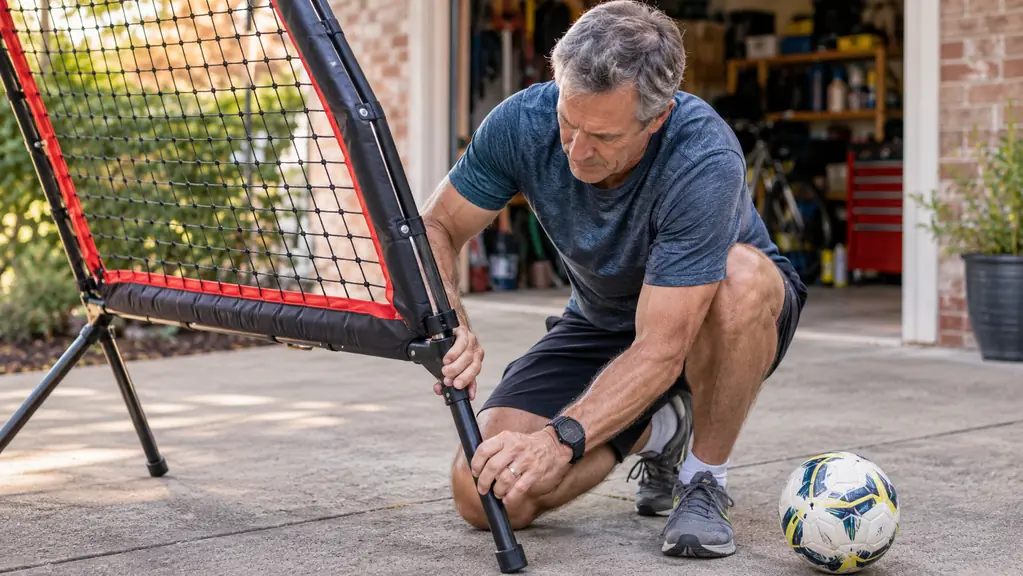
The first thing I noticed about the SKLZ Quickster was not the net. It was how long I stood in my driveway fiddling with the poles before either of us did anything useful. I am 54, I taught high school PE for most of my working life, and I have set up more training gear on a blacktop at seven in the morning than I care to remember. When something takes me twelve minutes to figure out in my own driveway, I notice. When it then keeps working for two years, I notice that too.
So here is the honest version, the one I would give a neighbor over the fence. The SKLZ Quickster is a good rebounder with a stubborn setup and a return that is quicker than most people expect. It does not coach you. It does not correct your form. It will not turn a kid who has never trapped a ball into one who can. What it does is give you a wall that answers back, in your own driveway, for as long as you are willing to stand there. Whether that is worth your money depends almost entirely on how often you drag it out.
The Quick Verdict
A dual-sided 6 by 4 foot rebounder that rewards clean technique and punishes a lazy setup. Buy it if you will actually use it twice a week.
Amazon Check Today's Price →The driveway wall that answers back when nobody else will
A dual-sided 6 by 4 foot net on a metal frame, with adjustable poles that extend and lock at the height you set. Solo passing, receiving, and trapping, no partner required.
Amazon Check Today's Price on Amazon →How I've Used It
The Quickster lives in the one-car garage I converted into a small gym. That garage holds a rubber mat, a bench, a rack of basketballs, and about four feet of clear space at the front, which is where the rebounder sits when it is not out in the driveway. Twice a week I carry it out. On Saturdays my grandson Mateo, who is seven, uses it while I shoot on the driveway hoop, and on Sunday afternoons my granddaughter Sofia, who is ten and plays rec ball, takes it over and does not share.
My left knee has been sore since my own playing days, so I do not run much anymore. That is part of why a rebounder suits me now. Twenty minutes of one-touch passing at a slow jog is a real workout for the legs without the pounding, and it is easy to stop when the knee has had enough. I start with ten minutes of easy two-touch work and only add pace if the knee stays quiet. On a bad day I do the whole session sitting on a folding chair, passing with the inside of both feet. It still counts.
The park three blocks from the house has a grass field, and I have taken the net there maybe a dozen times. Most of what this review is about, I learned on that grass.
The Rebound Comes Back Faster Than You Think
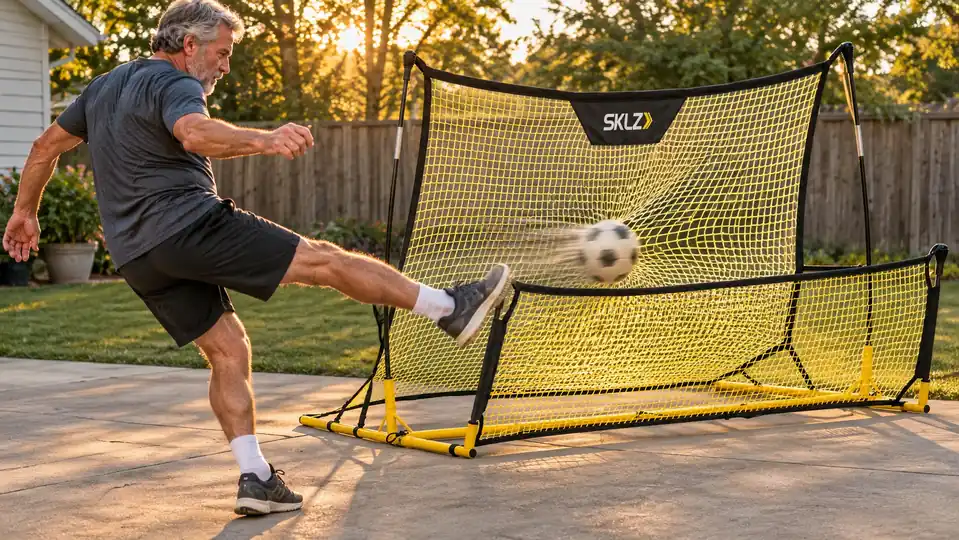
The Quickster is dual-sided, so there is a net face on both sides of the frame. Most of the time I use the near face for passing and receiving and leave it at that. The second face earns its keep when someone else wants to work at the same time. On Sundays Sofia takes one side and I take the other, and neither of us has to move anything or wait for a turn. For one frame sitting in a garage, that is a lot of use.
The net is taut and the return is quick. Quicker than the old rebounder we had at the school, and quicker than most kids expect the first time they step up to it. Strike the ball firmly and it comes back firmly, which is either the point or the problem depending on the drill. For first-touch work it is honest. A heavy pass returns heavy, and you find out in about a second whether your touch can kill it. With a beginner I start closer and use a softer ball until the flinching stops.
The 6 by 4 foot face is big enough that a young kid does not have to be accurate to get a rebound, which is the right call for a training aid. A smaller target would punish a seven-year-old into quitting by the second week. The tradeoff is that a large forgiving face is not a defender. So I still make Mateo do the same drill against the garage door with a taped square on it, where the target is small and the ball does not come back for free.
Setup: What the Listing Leaves Out
The adjustable poles extend and lock in place, and once you have the height where you want it, that is genuinely useful. The first time is the slow part. You extend a pole, test the lock, find the height slightly off, collapse it, and try again. Mine took about twelve minutes that first afternoon. Now it takes closer to two, because I put a strip of tape on each pole at my preferred height and stopped re-deciding it every session.
The frame is metal, the net is nylon, and the whole thing weighs just under six kilograms, about thirteen pounds. That is light enough for me to move alone at 54 with a sore knee, and heavy enough that it does not skate across the driveway when a shot hits it high. Grass is the exception. A breezy afternoon at the park had the frame walking a few inches across the field, and I ended up bracing the base with my gear bag. That is not a defect in the product. It is what a light frame does in wind.
Amazon lists the item dimensions at 15 by 20 by 6 inches, which describes the bundle you handle, not the face you shoot at. Opened, the face is the full 6 by 4 feet. Between sessions it leans against the garage wall behind the door, in the spot where nothing else fits.
It will not make you a better passer. It will tell you, about a second after every touch, whether you already are one.
Balls, Distances, and Surfaces
I have used it with a size 5 match ball, a size 4, and the soft size 3 that Mateo started on. The face handles all three without complaint. The difference is in what comes back. A size 5 struck with pace returns with pace a small kid will not enjoy, which is why Mateo uses the size 3 up close and moves to the size 4 at about six yards.
Distance matters more than the ball. At three or four yards you are working on touch, and the return arrives before your foot is back on the ground. At eight to ten yards you have time to move, and the session turns into receiving on the half turn and playing away. I do most of my work at six yards, because that is where the pace is honest without turning into a fight.
Surface changes everything else. The driveway is fast and predictable and the frame stays where you put it. Grass is slower, kinder to the ball, and harder on your patience with the frame. I have not used it on turf or on a gym floor, and I will not guess about either one, because a metal frame on a polished floor is a question for someone with better insurance than mine.
Three Drills That Use the Second Face
Two-touch passing with a turn. Strike into the near face, take the return with the inside of the far foot, and play it back with the near foot. Ten minutes of that at six yards does more for a first touch than an hour of juggling, and nobody has to run.
Close-range volleys. Stand about four yards out and volley the return back in without letting it bounce. This is where the dual face matters most, because a partner can take the other side and neither of you waits. Sofia volleys, I pass, and the ball never stops moving.
Angled receiving. Play the ball in at an angle, let the rebound come across your body, and take the first touch away from the defender who is not there. This is the drill that showed me how heavy my first touch gets when nobody is pressuring me, which is a humbling thing to learn in your own driveway at 54.
The Kid Test
Sofia is ten and plays rec ball, and she likes the Quickster because it lets her run the drills her coach gives her without asking me to chase balls for an hour. Her complaint is fair: the rebound is faster than most of her teammates' passes, so the drill feels harder at home than at practice. I do not think that is a flaw. Easy practice does not build much.
Mateo is seven and mostly wanted to kick the ball as hard as he could and watch it come back. That lasted about three weeks. Then he started trying to stop it, which is the whole point of the thing arriving on its own. He now plays a game where he gets a point for every trap that stays within a stride of his feet. He is not good at it yet. He keeps score anyway.
What It Replaced, and What I Still Keep
Before the Quickster I used a plywood board propped against the garage wall. It worked, in the sense that a ball came back off it, but it also took paint off the wall and taught me nothing about pace. The board returned the ball at whatever speed I sent it and stayed low the whole time. The net returns it in the air at a height you can actually volley, and it does not damage the garage.
I still keep the board, because for one specific drill where I want the ball skidding back low off the concrete, wood is better. The rebounder handles everything else. If you already own something that returns a ball and you like it, this does not replace it so much as give you a second option for work that needs a livelier return.
Where the Quickster Falls Short
The setup is the honest complaint. It is not difficult, but it is fiddly, and fiddly gear stays in the garage. If you need a training aid that is ready in fifteen seconds or it never gets used, this one will sit against the wall. The net also has to be seated properly or the rebound goes soft and strange on one side, and that takes a session or two to learn. I have made peace with it. A busier person might not.
The second complaint is that the ball comes back the way you sent it. There is no correction and no feedback beyond the obvious. Strike the ball with the wrong part of the foot and it returns at an angle that tells you something went wrong without telling you what. That is a coach's job. If you do not have a coach, you need to know what you are looking at. This is a tool for repetition, not for instruction.
The third is weather. Nylon and a metal frame are fine in light weather, and mine has never been left out through a Jacksonville summer storm, so it has stayed tight and straight. If you plan to leave yours in the yard year round, expect the net to stretch and the frame to age faster than mine has. That is true of every net in this category, and it is worth saying out loud.
What I Liked
- Dual-sided 6 by 4 foot face, so two people can work at once
- Adjustable poles extend and lock at the height you set
- Return is fast and honest, which speeds up first-touch work
- Just under six kilograms, light enough for one person to move
- Large target keeps young kids from quitting in week two
Where It Falls Short
- First setup is fiddly and takes ten to fifteen minutes
- The frame walks on grass in wind unless you brace it
- No correction and no feedback beyond the rebound itself
- Net must be seated properly or one side goes soft
- Not something to leave outside through a Florida summer
What Two Years Has and Has Not Done
The net has stretched a little. Not enough to change the rebound on the near face, but enough that I noticed it one afternoon when I turned the frame around. The poles still lock, the frame is still square, and nothing has rusted through because nothing has been left out in the rain. What has not happened is the thing I quietly wanted, which is that my touch got dramatically better. It got better the way a driveway gets clean: slowly, and only on the days I showed up.
Who This Is For
This is for the parent or the player who will use a rebounder two or three times a week in a driveway, a garage, or a flat patch of grass. It is for the kid who wants extra touches without a partner, and for the adult whose knees have opinions about running. It is also for the coach who wants a second station at practice without finding a second coach. If you fit any of those, the SKLZ Quickster will do the job and keep doing it.
Who Should Skip It
Skip it if the setup will defeat you, because it will. Skip it if you want something that lives permanently in the yard, because nylon and metal in Florida weather is a slow losing fight. Skip it if you are looking for instruction, since it gives you none. And skip it if you only practice when someone makes you, because a rebounder is a mirror. It shows you exactly how much you put in, and some people would rather not see the number.
If it gets dragged out twice a week, it earns its corner
Dual-sided 6 by 4 foot net, adjustable poles that lock where you set them, and light enough for one person to handle alone.
Amazon Check Today's Price on Amazon →