
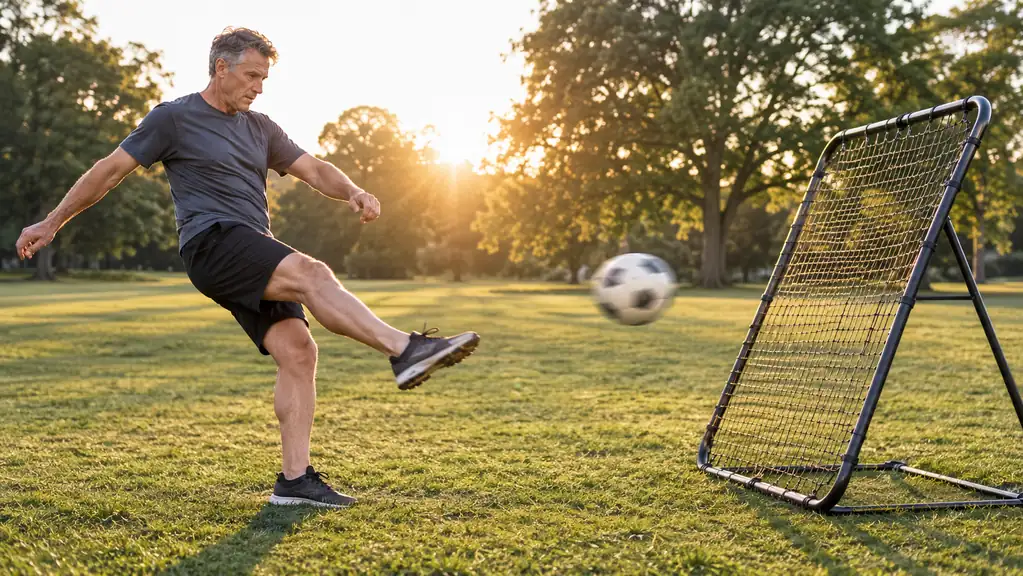
Passing is the one soccer skill you can improve entirely on your own, but only if the ball comes back to you. That is the whole problem. A wall works until you find one without windows, a slope, or a neighbor who minds the thump at seven in the evening. A partner works until they have homework, a shift, or a sore ankle. So most players I know end up doing what I did for years. They juggle, they dribble in a straight line, and they tell themselves that counts as passing practice. It does not.
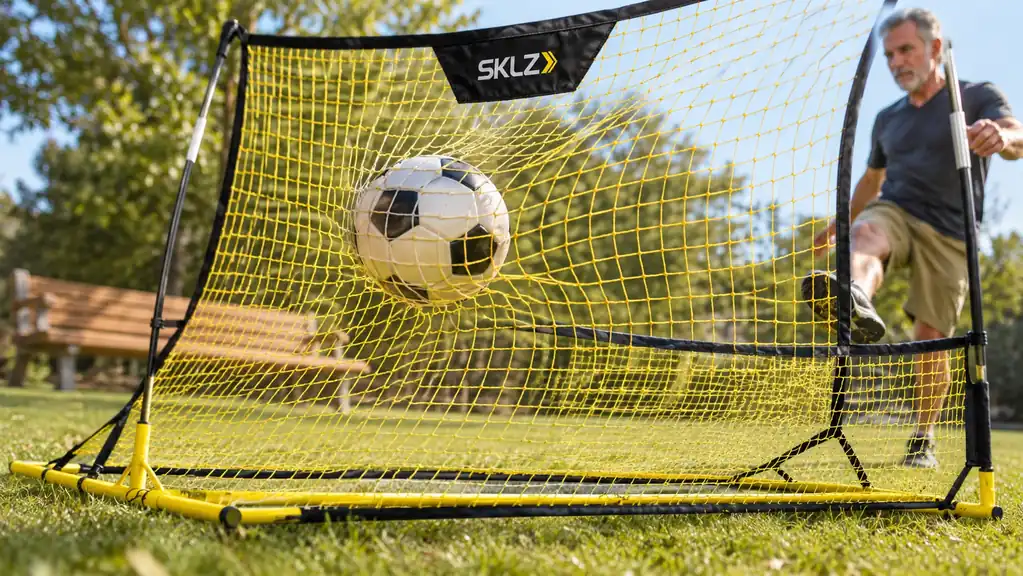
A rebounder solves the partner problem. The SKLZ Quickster is the one I have used most: a dual-sided net with a 6 x 4 foot face, a metal frame, a nylon net, and adjustable poles that extend and lock in place. It weighs 5.99 kg, so one person can move it without help. It is not a coach and it will not repair a bad first touch on its own. What it gives you is a repeatable wall that fits in a trunk and goes up in a couple of minutes. Here is how I use mine, step by step, and what I would tell anyone who just pulled one out of the box.
A wall you can carry in one hand
The SKLZ Quickster gives you a 6 x 4 foot face to pass into, any afternoon, in the driveway or at the park. Setup takes minutes and it comes apart the same way.
Amazon Check Today's Price on Amazon →Step 1: Set It Up So the Return Lands at Your Feet
A rebounder is not a wall, and the sooner you stop treating it like one the better your sessions get. A concrete wall sends the ball back at the angle you sent it, hard, at roughly the same height. A net absorbs some of that pace and drops the ball down toward the ground. That single difference decides where you stand and how hard you strike the ball. Set up the way you would for a wall and you will spend half the session chasing balls over your head or past your shoulder.
I set mine on the flat grass behind the basketball court at the park, or in the driveway when the weather is doing what Florida weather does. The poles extend and lock, so I check both of them with a hand before the first pass. The listed weight is 5.99 kg, heavy enough to stay put in a normal breeze and light enough that I can carry it from the car with one hand. Flat ground matters more than people think. On a slope, every return drifts downhill from you and you end up reaching instead of passing.
Start about six yards away and hit five passes with the inside of your right foot. Watch where the ball comes back. If it is arriving at your chest, you are too close or the face is standing too upright. If it is dying at your feet before it reaches you, back off a step or strike it firmer. The sweet spot is a return that arrives at shin or knee height, rolling, so you can take a touch and pass again without lunging. Adjust the face angle a little at a time. You are tuning the net to your body, not the other way around.
Step 2: Learn Two-Touch Before One-Touch
Every player I have coached wants to start with one-touch volleys into the net. It looks like real training and it feels fast. It also falls apart in about ninety seconds, because one-touch passing into a rebounder requires a first touch you do not have yet. Two-touch is the version that builds the skill. The ball comes back, you control it with the inside of your foot, you push it a half step ahead, and you pass it back into the net.
Stand at your six yards and count consecutive clean two-touch reps. A rep only counts if the control touch stays within a stride of you and the return pass hits the net below shoulder height. Twenty in a row with the right foot, then twenty with the left. When I started with the SKLZ net, twelve with my left was a good set. That number tells you more about your touch than any drill that lets you swing away at the ball and call it work.
The common mistake here is rushing the control touch. Players stab at the ball to kill it dead, it bounces off their toe, and the next pass becomes a rescue job. You are not stopping the ball, you are redirecting it. Cushion it half a step to the side, then pass. When twenty clean reps start to feel boring, that is your signal to move to the next step, not to skip ahead early.
Step 3: Move Your Feet Between Every Pass
Static passing looks like practice and trains almost nothing. In a game you almost never pass from a standstill with your feet set. You pass while moving, then you move again. The rebounder makes this easy to rehearse because the ball comes back to roughly the same place every time, so you can practice arriving at it instead of waiting for it.
Set a marker three steps to one side, a water bottle or a cone, and use it. Pass into the net, shuffle three steps to the marker, receive the return on the move, pass again, shuffle back. The 6 x 4 foot face is what makes this work. A smaller target would punish every slightly off pass and you would spend the session fetching the ball from the fence. The bigger face forgives a pass that is a foot wide, so you can keep your feet moving and still get a usable return.
Once the lateral shuffle feels natural, change the movement. Pass, jog forward two steps, receive, pass, back up. Or pass, turn your shoulders as if checking for a defender, then receive on the half turn. The point is not cardio. The point is that your feet are doing something when the ball arrives, which is the condition you will actually be passing under.
Step 4: Use Both Faces and Both Feet
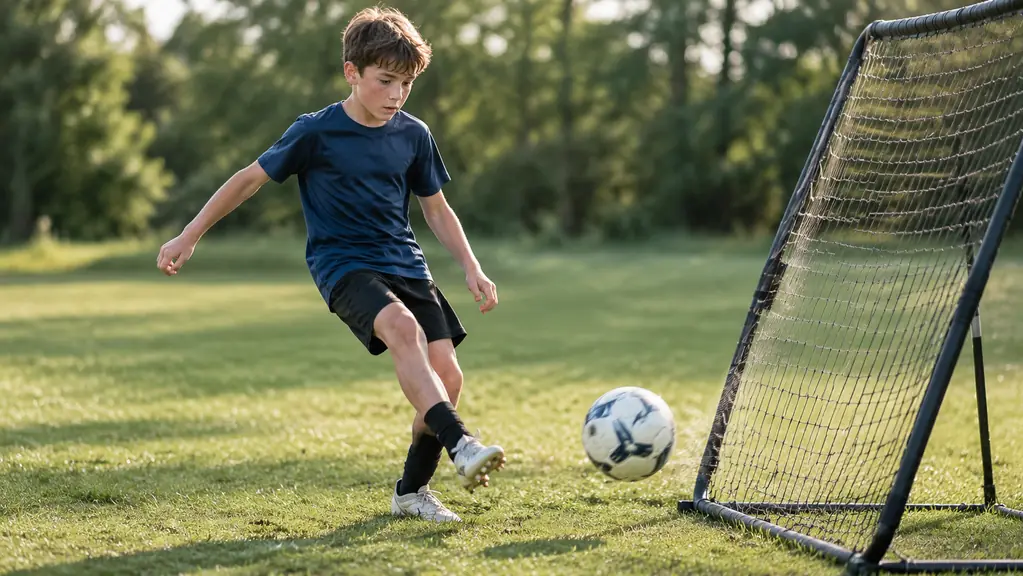
The Quickster is dual-sided, so I set it up once and use both faces in the same session. One face for straight-on passing and receiving, the other for turning out. It saves the fiddling and it splits the work into two different jobs.
The turning drill is simple. Pass into the net, let the return come, take your first touch across your body away from the net, and turn out. Then work the other face and do it the other way. This is the closest thing to a real receiving session you can get on your own, and it exposes the thing most players avoid, which is the weak foot. My left foot was a place where good intentions went to die. Twenty minutes a few times a week against the net did more for it than a decade of telling myself I would work on it.
Alternate feet on purpose. Right pass, left control, left pass, right control. It will feel clumsy for a week and then it will not. Keep the same standard as before: the return pass has to land on the net below shoulder height, or the rep does not count. Do not let a sloppy rep slide because the movement felt good.
Step 5: Build a 20-Minute Session You Will Actually Repeat
The best drill on paper is worthless if you will not do it on a Tuesday when you are tired. Twenty minutes is the number that works for me, and it fits in the gap between dinner and dark. Warm up for three minutes, jogging and moving the ball between your feet. Then five minutes of two-touch at six yards. Five minutes of passing with movement. Four minutes of receiving and turning into both faces. Three minutes of whatever you feel like, usually long driven passes with the laces.
Keep score of something. I keep a scrap of paper in the garage with the date and my best left-foot streak on it. Nothing motivates a second session like a number from the first one. When twenty clean two-touch reps gets easy, move the distance out two yards, or require the return pass to arrive below knee height, or add a rule that every rep has to be preceded by a look over the shoulder. Change one variable at a time so you know what caused the improvement.
Two practical warnings. First, my left knee has been sore since my playing days, so I do not do this on concrete two days in a row and I keep the sessions short. Grass is kinder and the park is three blocks away. Second, do not let the rebounder become your only practice. It cannot teach you to read a defender or to weight a pass into a running teammate. What it can do is make your first touch and your passing mechanics boringly reliable, which makes every team session worth more.
What Else Helps
Check the ball before you blame your touch. A soft ball off a net behaves nothing like a properly inflated one, and a ball that has been sitting in a garage all winter will feel dead in your first ten reps. Shoes matter too. Cleats on grass give you a consistent surface, and flat shoes on the driveway are fine for control work but will punish you if you try to strike the ball hard. I also film thirty seconds on my phone once a week. The camera catches the thing you cannot feel, usually a plant foot that is too far from the ball.
If you want a second look at the equipment itself, there is a long-term review of this rebounder after a couple of seasons of use, plus a straight comparison against the Franklin model for anyone deciding between the two. Both are honest write-ups of what holds up and what does not. The short version is that the net and the frame are the parts that matter, and the weight of 5.99 kg is the reason the SKLZ stays where you put it. Buy once, set it up properly, and put in the twenty minutes.
Twelve clean two-touch passes with my left foot in week one. Forty by the end of the month. The only thing that changed in my week was twenty minutes in the driveway.
Twenty minutes beats an hour of juggling
No partner, no schedule, no wall without windows. Set it up, run the five steps above, and keep your own score. Twenty minutes three times a week is enough to feel it in a month.
Amazon Check Today's Price on Amazon →