
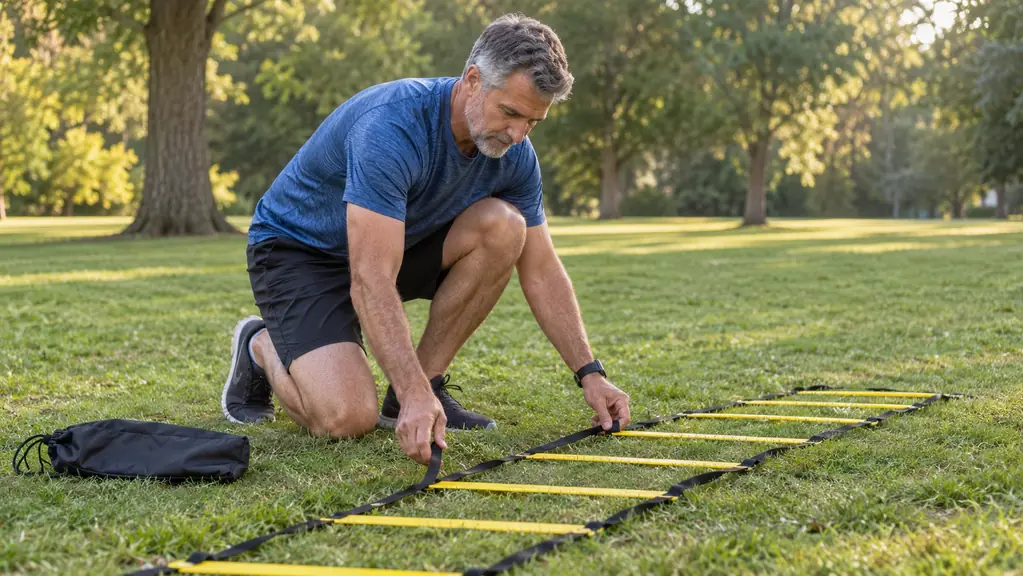
I have a soft spot for training tools that do not pretend to be complicated. The GHB Pro Agility Ladder 12 Rung 20ft is about as plain as gear gets: a long set of plastic rungs, a carrying bag, and a drills guide. I have used it in my garage, on the driveway, and at the park three blocks from my house in Jacksonville. It has held up. It has also shown me exactly where a simple ladder stops being enough. That is the honest version.
This is not a review that will tell you the GHB ladder will make you faster, sharper, or younger. It will not. What it will do is give you a clear, portable way to practice footwork, warm up a sore knee, and keep a pair of grandkids busy for twenty minutes before they lose interest. For the job, that is a fair trade. For a serious speed program, you may want more.
The Quick Verdict
A simple, light, adjustable 20-foot ladder that works for warm-ups and basic footwork. The plastic rungs and light build are the tradeoff.
Amazon Check Today's Price →The ladder that gets used is the one that is easy to set down
The GHB Agility Ladder is light, rolls out in seconds, and comes with a bag and a drills guide. It is a good first ladder for a garage or a park bag.
Amazon Check current availability on Amazon →What the GHB Agility Ladder Actually Is
The listing is refreshingly short on fantasy. You get 12 plastic rungs, a 20-foot ladder, a carrying bag, and a drills guide. Each rung is 16.5 inches long. The space between rungs adjusts up to 15 inches. The whole thing weighs 4.8 ounces. It comes with a lifetime manufacturer warranty. Those are the facts I could verify. Everything else in this review is what happened when I used it.
The ladder is not a fixed frame. You roll it out, set the rung spacing, and go. That adjustability is the most useful part. For a retired PE teacher with a left knee that complains after too many Saturdays of pickup basketball, a shorter spacing forces small, controlled steps. A longer spacing asks for more reach. I can set it easy for a warm-up and open it up for a footwork drill without changing equipment.
How I've Used It
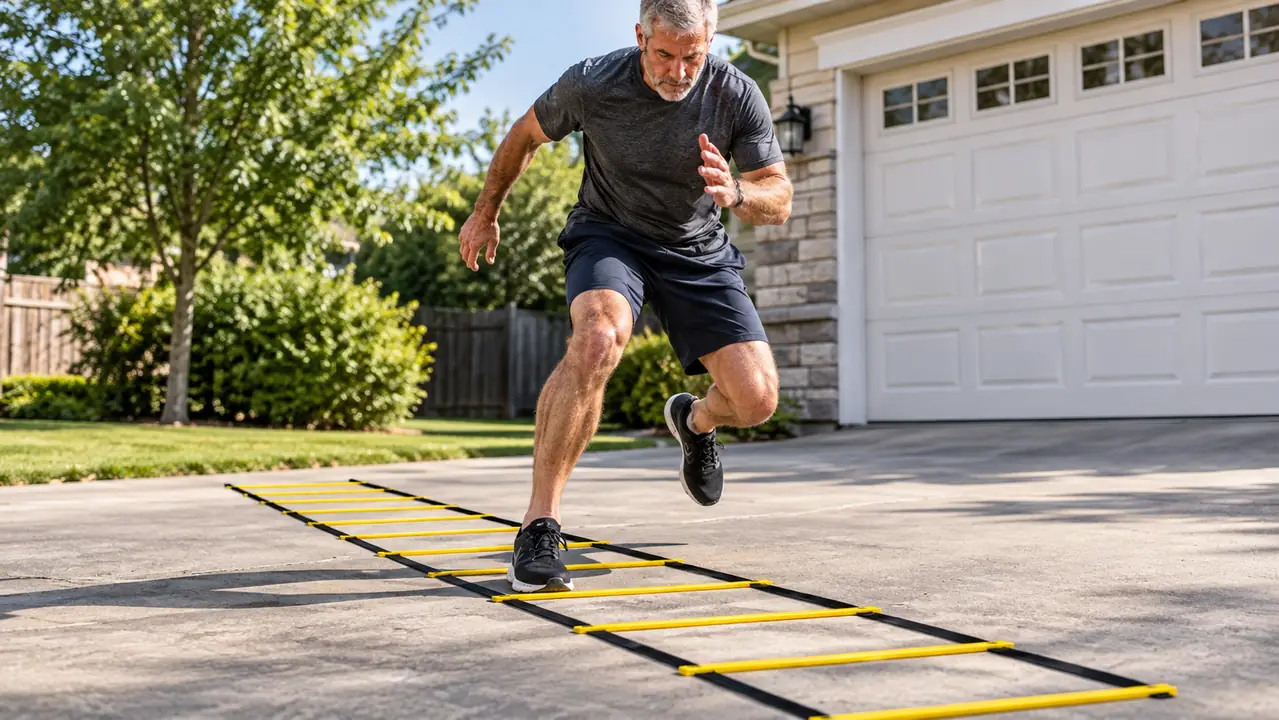
Most mornings I walk. Twice a week I do a short session in the garage before the Florida heat gets serious. The ladder goes down the center of the one-car garage, between the shelf of old basketballs and the door to the laundry room. I do two passes with short spacing, two with longer spacing, then a few lateral steps. It takes eight minutes. My knee feels better after than before. That is not a medical claim. It is a warm-up that gets me moving in a straight line and side to side without pounding.
On Saturdays, the grandkids come over. Sofia is 10 and Mateo is 7. They treat the ladder like a game, which is exactly what it should be. I set it on the grass at the park and let them race through it. The rungs are light enough that when Mateo catches a toe, the ladder moves instead of tripping him hard. That is a small thing that matters with kids.
I use it before Saturday basketball, too. Not as a performance tool. As a way to wake up my feet before I start moving in directions my knee does not like. Five minutes of easy rungs, then a few shots. I am 54. The warm-up is not optional anymore. The ladder makes it simple.
I also used it for a youth soccer warm-up at the park last fall, before a rec game. Twelve kids, one ladder, a lot of waiting. That is the real limit of a single 20-foot ladder. It is a station, not a circuit. If you coach a group, you need two or three or a different plan. I knew that going in. A parent watching might not.
What the Listing Does Not Tell You
The carrying bag is not a gym bag. It is a simple sleeve. The ladder folds or rolls into a small package, and the bag keeps it from turning into a pile of plastic in the trunk. The package dimensions listed are 17.04 by 4.61 by 1.73 inches. That is small enough to live in a closet or under a car seat. The 4.8-ounce weight is the number that surprised me. It is light. That is good for portability and less good for staying put.
The drills guide is a starting point, not a coaching course. It gave me a few patterns I had not used in years: one foot in each rung, two feet in, lateral step, in-in-out. If you have never used a ladder, it is useful. If you have coached, you will glance at it once. I am glad it is included. I would not choose this ladder over another just because of the guide.
The plastic rungs are the whole story. They are sturdy enough for bodyweight footwork and light enough to carry. They are not padded. They are not going to feel like a premium piece of equipment. If you catch one with a cleat, it will let you know. After months of use, mine have scuffs but no cracks. I cannot tell you it will last ten years. I can tell you it has lasted through a Florida summer in a garage, which is a real test.
The best thing I can say about the GHB ladder is that I stopped thinking about it. It went down, I used it, and it went back in the bag.
Where It Surprised Me
The adjustable spacing did more for my knee than I expected. I started with the rungs close together, maybe 12 inches, and worked up. The ladder did not force me into a range I was not ready for. That sounds small. For anyone coming back from an injury or just getting older, small is the whole game.
The second surprise was how often I used it. Because it is light and the bag is small, I stopped treating it like a special workout. It became a five-minute thing before a walk. Gear that is easy to set up gets used. Gear that needs a production does not. I have a shelf of the second kind.
The third surprise was the kids. I thought they would ignore it. They did not. A ladder on grass is a racetrack to a 7-year-old. That alone has made it worth the space in the garage. I did not expect a piece of footwork gear to earn its keep as a toy, but here we are.
Where It Falls Short
It slides on smooth concrete. My garage floor is sealed, and when I push hard through a lateral drill, the ladder shifts an inch or two. On grass it stays better. On a rubber gym mat it stays better. If you are doing high-effort change-of-direction work on a slick surface, you will adjust it back into place. That is not a defect. It is what a light ladder does.
It is not a coaching system. There is no app, no timer, no sensor, no auto program. You have to know what you want to practice or be willing to follow the guide. If you need structure, you will have to bring it. I like that. Some people will not.
The rungs are plastic and the ladder is light. That is the trade. It will not feel like a weighted sled or a professional setup. It will not replace cones, a speed coach, or a real strength program. It is one tool. I have seen people buy a ladder and expect a whole program. That is not this.
The 20-foot length is great outdoors and awkward indoors. In my one-car garage, I can fit it, but I have to clear space. In a living room, forget it. Measure your space before you buy. That sounds obvious. People still skip it. I have skipped it with other gear and regretted it.
One more: the single ladder is a bottleneck for groups. If you are coaching a team, one 20-foot ladder means a line. Two ladders or a different station design is better. I would not buy one for a full team and expect it to run a practice.
What I Liked
- 12 rungs across 20 feet gives enough length for multiple drills
- Rung spacing adjusts up to 15 inches
- Light at 4.8 ounces and small enough to store in the included bag
- Simple enough to set up in under a minute
- Includes a drills guide and a lifetime manufacturer warranty
Where It Falls Short
- Plastic rungs and a light build mean it can slide on smooth concrete
- Not a full coaching program, no app or timer
- One ladder creates a line for group training
- 20-foot length needs real space
How It Compares to Cone Drills
Cone drills and ladder drills are different jobs. Cones are for space, turns, reaction, and cutting. A ladder is for rhythm, foot placement, and keeping your steps clean. You can build a decent session with either. You do not need both on day one. If you already have cones, the ladder adds a different constraint. If you have neither, start with the one that matches the space you actually have.
The GHB ladder is easier to carry than a stack of cones and easier to store. Cones are more flexible for open-space work and easier to set up in a strange field. I use both. The ladder is the warm-up tool. The cones are the change-of-direction tool. If you are choosing one, choose based on what you avoid doing. The best tool is the one you will actually put down on a Tuesday.

What I Would Change
I would print the rung spacing marks on the sides. Right now I set the distance by eye, and I am not precise. A few marks would let me repeat a session without pacing it out. That is a small manufacturing change, not a deal breaker. I would also make the bag a little wider so it is easier to get the ladder back in after a muddy day. These are nitpicks. They come from using the thing, not from reading the listing.
I would not change the weight or the plastic. Making it heavier would help it stay on the garage floor, but I would carry it less. The light build is the reason it goes to the park. The plastic is the reason it comes back. If you want a heavier ladder for a permanent gym floor, this is not that. If you want one that lives in a bag, the trade makes sense.
Care and Storage
I shake it out after use, wipe the rungs with a damp rag when they get muddy, and put it back in the bag. That is the whole routine. I do not leave it in the sun for days. I do not fold it wet. The plastic has stayed straight. The bag has stayed intact. The lifetime manufacturer warranty is there, but I have not needed it.
The small package size is the reason it lives by the garage door instead of on a shelf. If it were bulky, I would not use it. That is true of most home training gear. The GHB ladder is not a display piece. It is a tool that fits in a corner. That is the point.
Who This Is For
The GHB ladder is for the person who wants a simple footwork station at home. A parent who wants a screen-free activity for kids. A weekend athlete who needs a warm-up before a run. A coach who wants a portable ladder for a small group and already knows the drills. A retired teacher with a sore knee who wants to move side to side without a lot of equipment. If that sounds like you, it will earn its place.
Who Should Skip It
Skip it if you need a structured speed program with timers and progressions. Skip it if you train on a smooth surface and need something that will not move at all. Skip it if you coach a large group and need multiple stations. Skip it if you want a heavy-duty ladder that feels like commercial gym equipment. This is a light, simple, plastic tool. It does not pretend otherwise. The people who will be unhappy are the ones who expected it to be more.
The Honest Bottom Line
I have a garage full of gear that promised more than it delivered. The GHB ladder is not one of them. It promised a portable ladder and a bag. It delivered that. The fact that my grandkids use it and my knee tolerates it is a bonus. The fact that it slides on the garage floor is the cost of it being light enough to carry. That is a fair trade for the way I use it.
I would not buy this expecting it to fix a bad warm-up. A ladder is a tool. It does not make you consistent. You do. The best thing about this one is that it is easy enough to use that consistency is possible. That is not a small thing. Most home gear fails at the setup step. This one does not.
After a few months, I still keep it in the bag by the garage door. That is the highest compliment I can give a piece of training equipment. It is not on a shelf. It is not under a pile. It is right there, and I use it. If you want a simple ladder for warm-ups, footwork, and kid games, this is a reasonable one. Measure your space and know what you are buying.
The simple ladder I keep by the garage door
If you want a portable 20-foot ladder for warm-ups, footwork, and park games, the GHB Pro Agility Ladder 12 Rung 20ft is a fair place to start. Check the current listing and measure your space first.
Amazon Check current availability on Amazon →