

I own a shelf full of cones. Some are stacked in the garage, some live in the trunk of the car, and at least four have been lost to the park behind my house over the years. For most of my career as a PE teacher and a volunteer coach, cones were the entire toolkit. Put four out, run a zigzag, move them, run it again. So when I unrolled the GHB agility ladder on my driveway to run footwork with my granddaughter Sofia and my grandson Mateo, I was not looking for a replacement. I was looking to see whether a 20 foot ladder with 12 plastic rungs did anything the cones could not.
Here is the short answer, and everything after it is just the reasoning. If the goal is footwork, meaning quick, precise, repeated foot contacts in a straight line, the GHB ladder is the better tool and it is not particularly close. If the goal is change of direction, reaction time, or moving a group of kids through a session without half of them standing around, cones win and no ladder fixes that. I use both. Most weeks I reach for the ladder more, and I will tell you exactly why.
| GHB Agility Ladder | Cone Drills | |
|---|---|---|
| Precision of foot placement | Fixed rungs give every step a target, and you know the moment you clip one | Cones mark a path, not a footfall, so nothing tells you that you were sloppy |
| Change of direction | Straight line only, so turning means picking it up and repositioning | Plant, cut and accelerate around a cone, which is what a game actually asks for |
| Repeatable spacing | Set the gap once, up to 15 inches, and every session matches the last one | Paced out by eye each time, and it drifts without you noticing |
| Setup and carry | 4.8 ounces, rolls into the included bag, one hand free for a water bottle | A stack of cones and a bending-over job, usually two trips |
| Group sessions | One lane, one athlete at a time | Run four lines at once with a class or a team |
| Space needed | A straight run of about 20 feet that lies flat | Any shape, any patch of ground, including curves |
| Durability | Plastic rungs, a lifetime manufacturer warranty, and I have dragged it over concrete all summer | Cones crack, fade in the sun and blow away, and you replace them |
| Best for | Footwork and warm-up speed | Agility, reaction and conditioning |
How I Ran the Comparison
I ran the same six week block twice, once in spring with cones only, once in summer with the ladder. Same driveway, same park field three blocks away, same warm-up of a walk around the block, leg swings and ten easy bodyweight squats. Same session length, about 25 minutes. The only thing that changed was what sat on the ground.
With cones I built a slalom, a box and a sprint gate. With the ladder I unrolled it and used the drills guide that came in the bag as my menu. I did not time the drills. I timed the setup and the teardown, because after three weeks that turned out to be the thing that decided which tool I picked up on a Tuesday when I had 35 minutes and a left knee that has been sore since my playing days.
I also watched the kids, which tells you more about a training tool than any adult session. Sofia is 10 and Mateo is 7, and both of them treat anything lying on the ground as a personal challenge. Mateo clipped the rungs on his first three passes and was clean by the fifth. He could feel his own mistake without me saying a word. That is the whole case for the ladder in one small story.
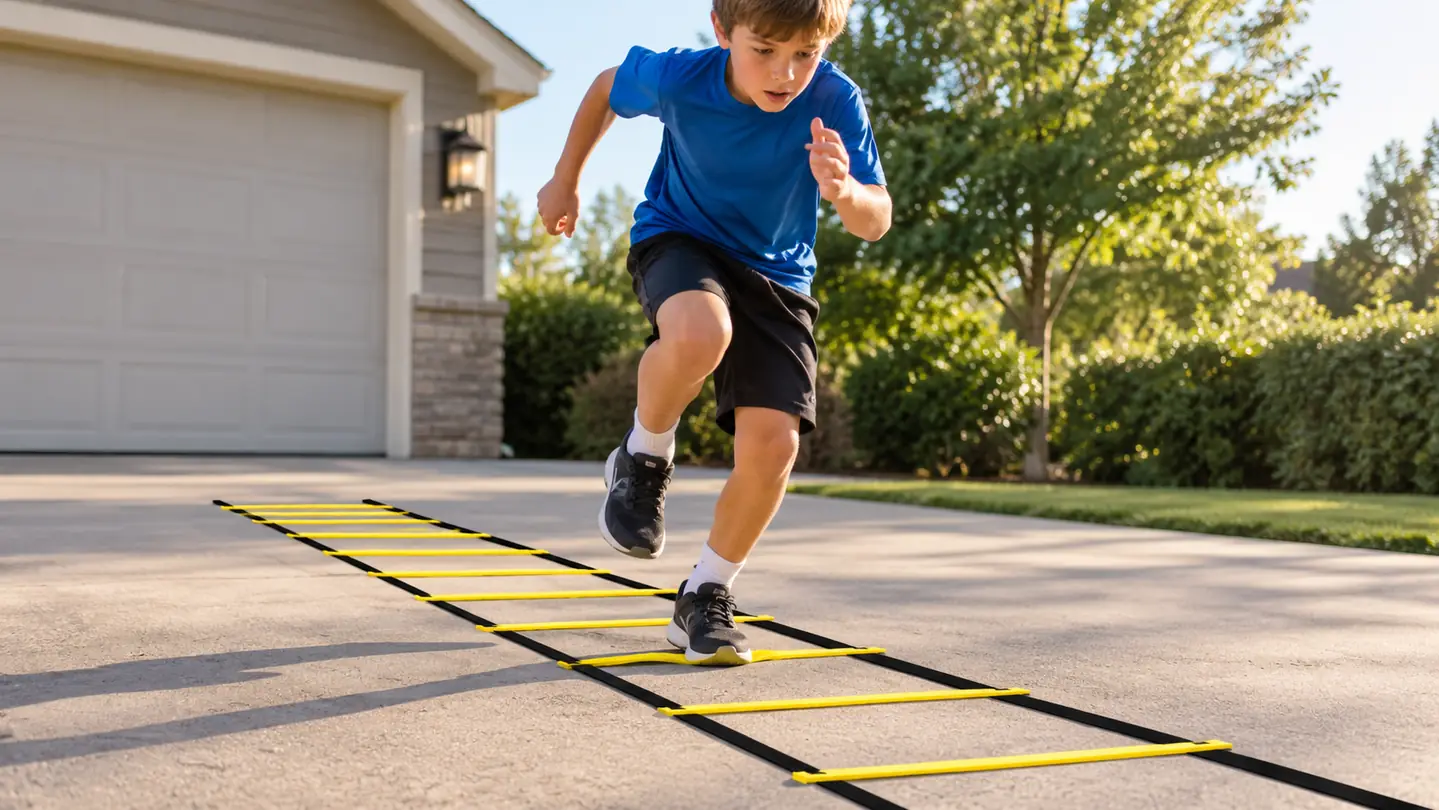
Where the GHB Agility Ladder Wins
Precision. A cone tells you where to go. A rung tells you where to put your foot. When the gap between rungs is fixed, each step has a target, and if you clip the rung you know it right away because the ladder shifts or your foot catches. That feedback is what builds quick feet. A cone cannot give it to you, because a cone has no edge to miss.
The GHB ladder makes fixed spacing easy. Each rung is 16.5 inches long and the gap between rungs adjusts up to 15 inches, so I can set a tight pattern for fast feet or open it up for longer strides. Once I set it, it stays set. Every session is the same session, which is the entire point of a drill. With my cones I pace the distance out by eye every time, and by eye drifts. Two weeks in, my slalom is a different length than it was on day one and I cannot tell you when that happened.
Repeatability matters more as you get older, not less. My left knee complains if I jump into anything cold, so I like knowing that the warm-up ladder is exactly the same length and exactly the same spacing as last week. There is no guesswork to blame when something feels off. I know it was me.
Setup and carry is the quiet win. The whole ladder weighs 4.8 ounces and rolls into the bag it ships with. I carry it to the park in one hand with a water bottle in the other. Twelve cones is a bending-over job and usually two trips, and on a stiff morning that is the difference between doing the session and skipping it. I have skipped plenty of sessions in my life. I know exactly how that trade gets made, and I know which side of it a heavy bag sits on.
A cone tells you where to go. A rung tells you where to put your foot, and if you miss, you find out immediately.
What the Ladder Does Not Do
It will not make you agile in the way a game asks for agility. A ladder teaches your feet to fire quickly and land accurately in a pattern you already know. A defender does not run a pattern. He reacts. If all you ever do is run the ladder, you get very good at running the ladder. I have watched kids do exactly that, quick and clean in the driveway, flat-footed the moment a ball is involved.
The ladder also does not replace a warm-up or a strength program. It is a piece of plastic on the ground. What it does is give you a place to put your attention for ten minutes, and attention is the scarce thing in most training sessions. I pair it with the cone work now: five minutes of ladder to wake the feet up, then three or four cone cuts at the end of the session when the legs are already warm.
Where Cone Drills Win
Change of direction, and this one is not close in the other direction. A ladder is a straight line. Footwork in a real game almost never is. If you want an athlete to plant, cut and accelerate out of the cut, you need something to run around, and that something is a cone. I set three cones in a triangle for Sofia, had her sprint to one, backpedal to the next and cut to the third. You cannot run that drill on a ladder without stopping to drag it into a new position.
Groups. When I had a full gym class, cones let me run four lines at once. The ladder is one lane. If you have two kids and one ladder, one kid is always standing still, and a kid who is standing still has already lost interest and is now poking his brother. Cones scale to a crowd. A single ladder does not.
Space and shape. The GHB ladder is 20 feet long and wants a straight run to lie flat. A driveway is fine. The grass field at the park is fine if nobody is playing on it. A small backyard is not, and a school gym works only if you clear the lane. Cones fit anywhere and make any shape you want, including curves, which a straight ladder cannot do at all.
And cones are what most people already own. If you are starting from zero, four cones and a set of bodyweight drills will get an adult moving and are more versatile for the first month. I would not tell anybody their cones are wasted money. Mine are staying on the shelf, and they come out every Saturday for pickup basketball.
If footwork is the goal, get the tool that puts a target under every step
The GHB Pro Agility Ladder is 20 feet with 12 plastic rungs, spacing adjustable up to 15 inches, and it rolls into the included bag at 4.8 ounces. It comes with a drills guide and a lifetime manufacturer warranty. 4.5 stars across 8,555 ratings.
Amazon Check Today's Price on Amazon →
The Drill That Made Me Keep the Ladder
The drill that sold me is the simplest one in the guide. One foot in every square, walking pace, no arm swing, eyes up. Then again with a high knee. Then in-in-out, both feet into one square, both feet back outside. Mateo got it in a week. I got it in about ten days, and I have been moving on my feet for 40 years, which tells you something about how much of this is habit rather than talent.
By the third week I was doing it without looking down. That is the moment a footwork drill starts paying. When your eyes come up, the drill stops being a drill and starts being something your body knows. Cones never did that for me, because there is nothing to feel with a cone. There is a lot to feel with a rung.
The Details That Hold Up After a Season
The rungs are plastic and they have survived a Florida summer on concrete, which is a fair test. The ladder runs 20 feet end to end with 12 rungs, and the spacing adjustment is the part I use most. Tight for a quick-feet set, wider for high knees, widest when Mateo wants to run through it as fast as he can, which is a completely different drill. Packed down it measures 17.04 by 4.61 by 1.73 inches, so it stores on a shelf about as wide as a shoebox and sits there until I need it.
Two things I would tell a friend before they buy. On lumpy grass the ladder does not lie perfectly flat, and a rung that sits high will catch a foot in a way concrete never does, so start on a flat surface until you trust the pattern. And if you drag the ladder to move it, the rungs slide out of position. Pick it up and set it back down instead. Neither of those is a defect. Both are things you learn in the first week and then never think about again.
What I Liked
- Fixed rung spacing takes the guesswork out of every drill
- 16.5 inch rungs with spacing adjustable up to 15 inches
- 4.8 ounces, rolls into the included bag for one-hand carry
- Plastic rungs held up through a summer on concrete
- Drills guide in the box and a lifetime manufacturer warranty
Where It Falls Short
- Straight line only, so change-of-direction work still needs cones
- Does not lie flat on uneven grass
- Rungs slide out of position if you drag it instead of lifting it
Who Should Buy Which
Buy the GHB ladder if the goal is footwork, warm-up speed, or a repeatable drill you can set up in under a minute. That covers most parents of kids between about 8 and 14, most adults who want to keep their feet quick as they age, and anyone with a flat driveway and 20 feet of clear space. Buy the cones if you are coaching a group, if your training space is small or curved, or if change of direction is the entire point of your session.
Most people who get serious about this end up owning both, and the honest way to sequence it is cones first if you are coaching other people and ladder first if you are training yourself or one kid. The ladder is the piece I would keep if I could only keep one, because it is the one that tells me the truth about my feet. But I would not want to run a Saturday morning with a dozen kids and a single ladder. I have tried that. It does not go well for anyone, least of all the kid in the back of the line.
One last thing, and it is the thing that matters most. Neither tool does anything if it stays in the bag. The ladder wins on the days I am tired, because it takes 30 seconds to get out and 30 seconds to put away, and a low bar is the only kind of bar that gets cleared on a Wednesday. That is not a training insight. It is just what happens when you get older and the couch is close.
Twenty feet of ladder fits in a shoebox, and it beats pacing out cone spacing by eye
12 rungs at 16.5 inches each, spacing adjustable up to 15 inches, 4.8 ounces with the carrying bag and drills guide included. Backed by a lifetime manufacturer warranty.
Amazon Check Today's Price on Amazon →