
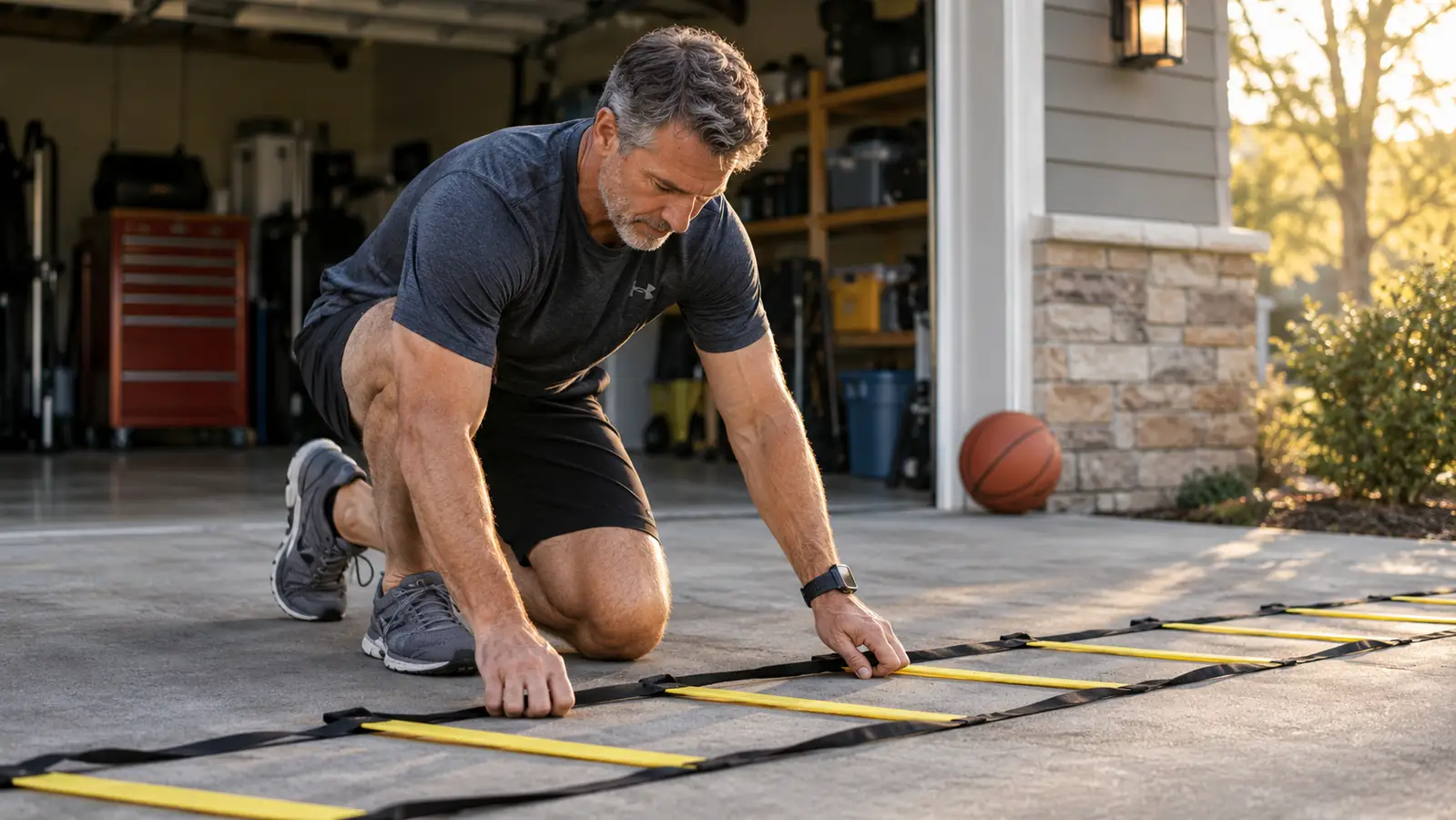
For most of my career teaching high school PE, the agility ladder lived in a storage closet next to the mesh bags and the broken whistles. It came out twice a year, the kids hopped through it, and back it went. I assumed it was a toy for teenagers with fresh cartilage and nothing to lose.
Then my left knee started talking to me on the three block walk to the park, and I bought the GHB Pro Agility Ladder 12 Rung 20ft for a reason I did not expect. Not speed. Not a faster first step. Coordination work, the low impact kind that makes a 54 year old man less likely to trip on a curb. It has been leaning against my garage wall for months now, and my granddaughter Sofia and grandson Mateo have run drills on it on weekend mornings. Here are ten reasons it stopped being a closet item and became a fixture.
The piece of gear that finally left the closet
Twelve rungs, twenty feet, adjustable spacing, and a bag that lives under the car seat. See what the current price looks like.
Amazon Check Today's Price on Amazon →It turns a ten minute warm-up into actual footwork
My old warm-up was a lap around the park and a few leg swings. That is not preparation, that is a formality I performed because someone told me to. Ten minutes of ladder work gets my ankles, calves and hips moving through real ranges before I ever touch a basketball. On the mornings my knee is stiff, I go through the rungs at half speed twice and stop there. I finish warmer than I used to, and I have actually kept doing it, which is the only test that counts.

Twelve rungs over twenty feet lets you settle into a rhythm
Short ladders are six or eight rungs. You find your cadence, you turn around, and the drill is over. This one runs twenty feet across twelve rungs, so a single pass takes long enough that the pattern has to be honest. I do four passes with a walk back between each one. The walk back is not a break in the session, it is part of the session, because at my age the recovery is where the whole thing gets truthful with you.
The rung spacing adjusts up to fifteen inches, so your stride sets the drill
Each rung is sixteen and a half inches across, and the gaps slide to as much as fifteen inches apart. That matters more than it sounds like it would. Wide spacing turns the drill into a bounding workout. Tight spacing makes it a quick feet drill. I keep mine near a foot for my own work and spread it wider for Mateo, who is seven and still working out where his feet end. Same ladder, two completely different sessions.
The whole thing is listed at under five ounces
The ladder is listed at 4.8 ounces. I have carried heavier water bottles to the park. That number is the entire reason it gets used. Gear that lives by the door gets used. Gear that lives in a closet because it is a hassle does not. I loop the carrying bag over one shoulder next to the ball and walk the three blocks to the court. Nothing about that walk changed. What changed is that I arrive with a warm-up already in the plan.
It rolls into a bag that fits under the car seat
The carrying bag ships with it, and rolled up the ladder slides under the passenger seat and stays there. That sounds like a small detail until you have owned equipment that only works when you plan ahead. I do not plan ahead. I decide at 7:40 in the morning whether I am doing footwork on the driveway. Since the ladder is already in the car with a handle on the bag, the answer is usually yes, and the yes is the hard part.

Plastic rungs do not bite when you clip one
I have watched a kid catch a rung on another ladder at full speed and come up with a mark on the shin. These rungs are plastic and they give slightly when a foot lands on the edge instead of between them. Not a lot, but enough. Sofia, who is ten and competitive about absolutely everything, has clipped a rung twice and laughed both times. If you train a kid, or you are an adult with a sore joint and slower reactions, that forgiveness is worth naming.
Grass, driveway, and gym floor all work
It is listed for outdoor sports, and I have used it on all three surfaces in a normal week. Grass at the park on Saturday. Concrete in the driveway on Tuesday. The rec center floor when it rains. Grass is kindest to my knee. Concrete is the fastest and least forgiving. Being able to switch surfaces without switching equipment is why it stays in rotation instead of turning into a Saturday only ritual that I quietly stop doing by October.
It gives you a number to chase instead of a feeling
Progress in your fifties is nearly invisible. You feel about the same on a Tuesday as you did in March, and that is a terrible way to judge whether anything is working. So I time it. Four passes, a walk back between each, watch sitting on the car bumper. I wrote the first number on a strip of tape. I have beaten it twice. That tape is a more honest coach than my memory, which flatters me constantly and has never once been right.
The drills guide means you are not standing there making it up
It ships with a drills guide, and I will be straight with you, I did not expect to open it. Then I ran out of ideas after about four patterns and stood in the driveway feeling foolish. The guide is not a coaching certification, but it handed me enough variations to fill fifteen minutes without repeating the same in and out until I got bored. Boredom is what kills home training. Not difficulty. Difficulty just makes you tired.
The listed lifetime manufacturer warranty matters for something you step on
A ladder gets stepped on by design, which is a strange thing to buy without a warranty behind it. GHB lists a lifetime manufacturer warranty on this one. I have not needed it, and after months of steady use the rungs and straps are still doing exactly what they did in week one. But it changes how I treat the thing. I do not baby it. I leave it on the driveway while I go get water. Gear you are not afraid of is gear you actually use.
What I'd Skip
Two things. First, this is not a speed program. If you want to cut your sprint time, a ladder is one small piece of a much bigger puzzle, and buying it alone will leave you disappointed. Second, skip the idea that you need a full session. My best weeks were four passes, three mornings, ten minutes each. Where I went wrong early was treating it like a workout and grinding for twenty minutes until my calves complained for two days. The GHB ladder rewards restraint. Use it short, use it often, and let the spacing do the work instead of your pride.
Four passes, a walk back between each, watch on the car bumper. I wrote the first number on a strip of tape and I have beaten it twice. That tape is a better coach than my memory.
Ten minutes, three mornings, one ladder against the wall
If the warm-up is the part you keep skipping, this is the cheapest fix I have found. Twelve rungs, twenty feet, a bag, and a drills guide.
Amazon Check Today's Price on Amazon →