
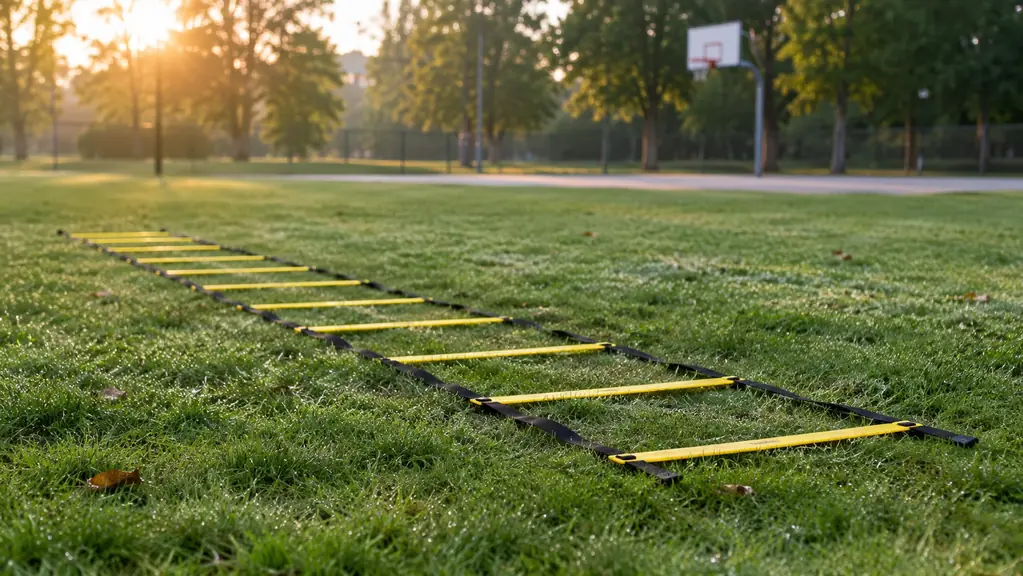
A ladder lying flat on the grass looks like the easiest piece of gear in the world. Then you try to run through it and find out what your feet have been getting away with for thirty years. I laid out the GHB Pro Agility Ladder on my driveway on a Saturday morning in October, ran through it once, and laughed at how badly I did. Nine seconds. Three trips, one stumble, and a left knee that reminded me, politely but firmly, that I am fifty-four and not twenty-two. That first pass is worth describing honestly, because it is probably what your first pass will look like too.
I did not get it to get faster at anything in particular. I got it because my granddaughter Sofia, who is ten, and my grandson Mateo, who is seven, spend weekends at our house, and the park three blocks from us has a basketball court and a wide grass field and nothing in between for them to do but chase each other. I wanted something that fits in a bag, sets up while they are still arguing about whose turn it is, and gives a ten year old something to win at. The GHB ladder has done that. It has also become part of my own Saturday warm-up, which I did not expect at all.
The Quick Verdict
Twenty feet of ladder that sets up in under a minute and adjusts down for a ten year old's stride. It creeps on smooth concrete and needs weighting on windy grass. For the shelf space it takes up, it earns its spot in the garage.
Amazon Check Today's Price →Twelve rungs, spacing that opens to 15 inches, and a bag that fits in the trunk
This is the exact version I use: 12 rungs, 20 feet end to end, rung spacing adjustable so a seven year old and a fifty-four year old can work the same ladder on the same morning.
Amazon See the GHB Ladder on Amazon →How I've Used It
The ladder lives in my garage, leaning against the wall beside the basketball. Three mornings a week I carry it out to the driveway around six, before the Florida heat turns the concrete into a griddle, and I work through it for about twelve minutes as part of a warm-up. That is the whole routine. No timer, no program, no app. I walk a lap to get loose, lay the ladder out, and go through four patterns twice each. By the time I am done my hips feel looser than they did when I woke up, which at fifty-four is the only result I am really chasing.
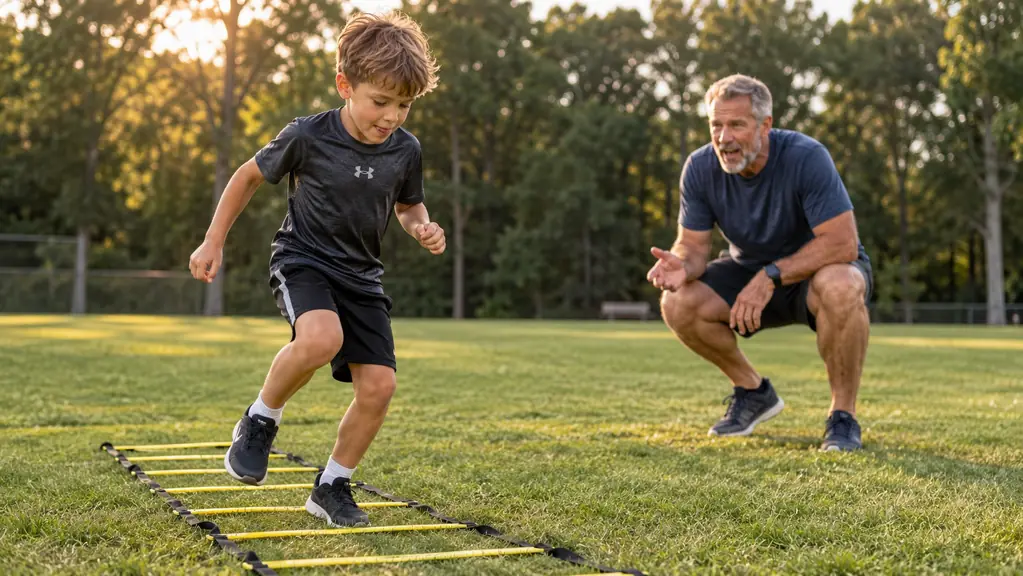
Weekends it goes to the park. Sofia and Mateo and I walk the three blocks, and the ladder goes in the carrying bag over my shoulder with a water bottle in the other hand. I set it up on the grass beside the basketball court while they argue about who goes first. Sofia, being ten, wants to race. Mateo, being seven, wants to win. I run it with them, which is funny for everyone, and then I set the rungs wider for me and closer for them and we all go again. The whole outing is maybe forty minutes and the ladder is in use for twenty of them.
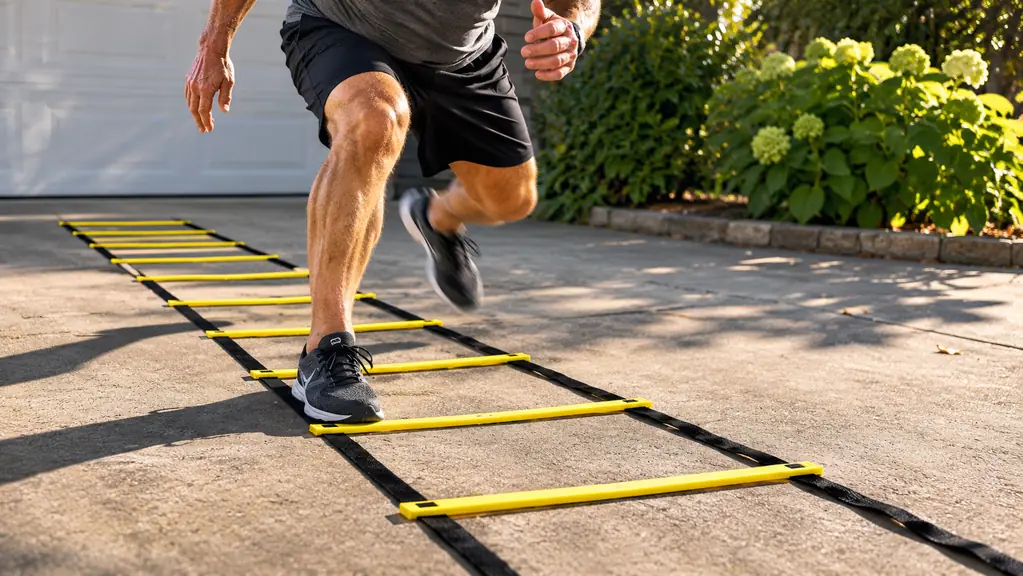
A Tuesday in early November is a fair example of the weekday version. It was sixty one degrees at six in the morning, still dark enough that I had the garage light on, and I had about twelve minutes before I needed to be back inside. I laid the GHB ladder down the length of the driveway, set the rungs somewhere near fourteen inches apart, and ran three patterns: straight through, lateral, and in-in-out-out. The lateral pass is the one that humbles me. My left foot wants to drag instead of lift, and by the third pass I could hear it scuffing the concrete. That scuff is the whole reason the ladder stays by the door.
The last thing I use it for is the least athletic. On Saturdays I play pickup basketball with men half my age, and the thing that gets me hurt is not the running, it is the stopping. Ten minutes of ladder work before I step on the court has been the cheapest insurance I have found. I am not claiming it made me quicker. I am claiming I come home with both knees feeling the same as when I left, and at this point in my life that is worth more to me than a faster first step.
What Twelve Rungs Actually Change
The version I have is the twelve rung, twenty foot ladder. That length matters more than it sounds like it does. A short ladder gives you four steps of a pattern and then you have to turn around, which breaks the rhythm and teaches you nothing about holding form while you are tired. At twenty feet I can run a full straight-line pattern, reset, and run a lateral pattern without dragging the ladder to a new spot. The rungs themselves are 16.5 inches long, wide enough that I am not aiming for a slot the width of a coin, and narrow enough that a wild step still counts as a miss.
The spacing is the part I did not expect to care about. The gap between rungs adjusts up to 15 inches, and that one adjustment is what makes a single ladder work for a ten year old and a fifty-four year old on the same morning. Sofia's natural stride wants the rungs close together. Mine wants them wide. Mateo wants them wherever his sister is not. We move the rungs between turns, which takes about a minute, and everybody gets a ladder that fits their legs instead of a ladder they have to fight.
The first week I owned it I ran every drill at whatever gap the rungs arrived at, and I could not work out why the patterns felt cramped. Then I opened the gaps out toward the fifteen inch maximum and the same drill suddenly made sense. My stride is long and my knees are not what they were, so a wide gap lets me step instead of shuffle. Sofia does better with the rungs pulled in close, maybe eight or nine inches, close enough that she has to pick her feet up on purpose. Mateo changes his spacing every ten minutes, because he is seven.
Before this I was doing the same drills between chalk marks on the driveway. I want to be fair to chalk: it works, it does not slide, and it does not cost anything. But chalk tells you nothing when you clip a line, and the ladder gives you a physical edge to clear. For a kid learning to pick their feet up, that edge is the entire lesson. Mateo will step on a chalk mark without noticing. He will not step on a rung without noticing, because there is something there to feel under his foot.
Twelve rungs at 16.5 inches each, spacing that opens to 15 inches. The difference between my clumsy first pass and my clean tenth one was mostly the spacing, not my feet.
Wind, Wet Grass, and the Things I Do Not Love
I have used this ladder on a concrete driveway, on a grass field, and once on the rubberized surface at the middle school where I used to teach. Concrete is where it behaves worst. The plastic rungs do not sit the way they do on grass, and after twenty minutes of lateral work the whole ladder had crept about four inches to the left. Nothing dangerous, just irritating, and I found myself resetting it between sets. On grass it stays where you put it. On the rubber surface it was fine.
There are no stakes in the box. The included components are the ladder and a drills guide, and that is the list. On a still morning that is a non issue. On the open grass at the park with a northeast breeze coming across the field, the first six feet of the ladder lifted and curled like a page turning. I solved it the way you solve most things at a park: water bottle on one end, shoe on the other. It has not bothered me since, but if you plan to train alone on windy ground, plan for it.
One Saturday in December the grass at the park was still wet when we got there at eight, and that changed the feel of the whole session. The GHB ladder sat fine, but the straps between the rungs held water and my shoes squeaked coming back through. Not a problem, just a thing to know. Wet grass means the ladder comes home damp, and damp means it gets shaken out and hung over the garage rail before it goes back in the bag, or the bag smells like a wet dog by Wednesday. I learned that the ordinary way.
The drills guide is thin. It is a folded sheet with a handful of patterns on it, useful if you have never seen a ladder drill in your life and close to useless if you coached anything for thirty years. I did not mind, but do not expect a program. The other honest limitation is length. Twenty feet does not fit straight across a one-car garage with a car parked in it. I lay out what fits, work that section, then reposition. It is a small hassle that comes with a longer ladder instead of a shorter one, and I would make the same choice again.
Drills That Held Up for Two Generations
For Sofia and Mateo, the pattern that stuck is one foot in each space, then two feet in each space, then one in and two out. It is simple enough that a seven year old can hold it in his head and hard enough that he trips on it when he gets excited, which is rather the point. Ten minutes of that and they are breathing hard and laughing, which is about all the structured training I want for kids those ages. I set the spacing close, stand at the end, and call the pattern out loud.
Sofia started keeping a count of her clean passes in a notebook she brought to the park, which is the most ten year old thing I have ever seen and also the reason she improved. The first weekend she logged four clean passes out of ten. By the end of the month she was at eight, mostly because she stopped looking down at her feet. I never told her to stop looking down. The rungs taught her that on their own, because a foot that lands on a rung stops the whole run, and she did not like stopping.
For me the useful ones are the boring ones. Straight through with a high knee, back through with a lateral step, then in-in-out-out, which is the pattern that found the weakness in my left hip inside a single pass. I do two rounds of each pattern, not more. The whole thing takes twelve minutes and I stop while I still feel good, because the fastest way to injure a fifty-four year old knee is to keep going for one more round to prove something to a ten year old.
Where it has helped most is not on the ladder at all. It is in the first five minutes of pickup basketball, when the game is sloppy and everyone is cold. I move better in those minutes than I used to, and I think it is because I have spent three mornings a week asking my feet to do something specific and quick instead of just running in a straight line. That is not a transformation. It is a small, repeatable thing, and small repeatable things are the only kind that have ever stuck for me.
Who This Is For
This ladder makes sense for a household that wants one piece of gear for several people. If you have kids somewhere between six and fourteen and you want something that tires them out in ten minutes at a park, the twelve rung version is right. If you are an adult who plays a sport on weekends and you want a warm-up that actually warms something up, it works for that too. The adjustable spacing is the reason it can do both jobs without buying twice.
It is also the right pick if you are short on storage. It packs down into the included bag, which measures about 17 by 4.6 by 1.7 inches, the whole package is listed at 4.8 ounces, and it will live on a garage shelf or in a trunk without you noticing it is there. I have carried it three blocks to the park with a water bottle in the other hand and it was not a burden. There is also a lifetime manufacturer warranty on it, which is an odd and welcome thing to find on plastic training gear.
Who Should Skip It
Skip it if you train indoors on hardwood or smooth concrete and you need something that will not move at all. That is not this. Between the creeping on slick surfaces and the lack of stakes, you would spend more time resetting than training. A painted line or a mat based system will serve you better in a gym, and you will stop being annoyed at your gear.
Skip it too if you want a program. There is a drills guide in the box, but it is a sheet of patterns, not a plan, and if you have never structured footwork work before you will want a coach or a video series to go with it. And if your space is genuinely small, measure before you order. Twenty feet is longer than it sounds, and a one-car garage will only take part of it at a time.
What I Liked
- Twenty feet and twelve rungs, long enough to run a full pattern without turning around
- Rung spacing adjusts up to 15 inches, so kids and adults can share one ladder
- Packs into the included carrying bag at roughly 17 by 4.6 by 1.7 inches
- Listed at 4.8 ounces, light enough to walk to the park with one hand
- Lifetime manufacturer warranty, which is unusual on plastic training gear
Where It Falls Short
- Creeps a few inches over a long set on smooth concrete
- No stakes included, so open windy grass needs a water bottle or shoe to hold it down
- The included drills guide is thin if you already know the patterns
- Twenty feet will not fit straight across a one-car garage with a car in it
If the park is three blocks away and the kids need somewhere to put that energy
Same ladder I keep leaning against the garage wall: 12 rungs, 20 feet, spacing that moves with whoever is running through it, and a bag small enough to forget you packed it.
Amazon Check the GHB Agility Ladder on Amazon →