
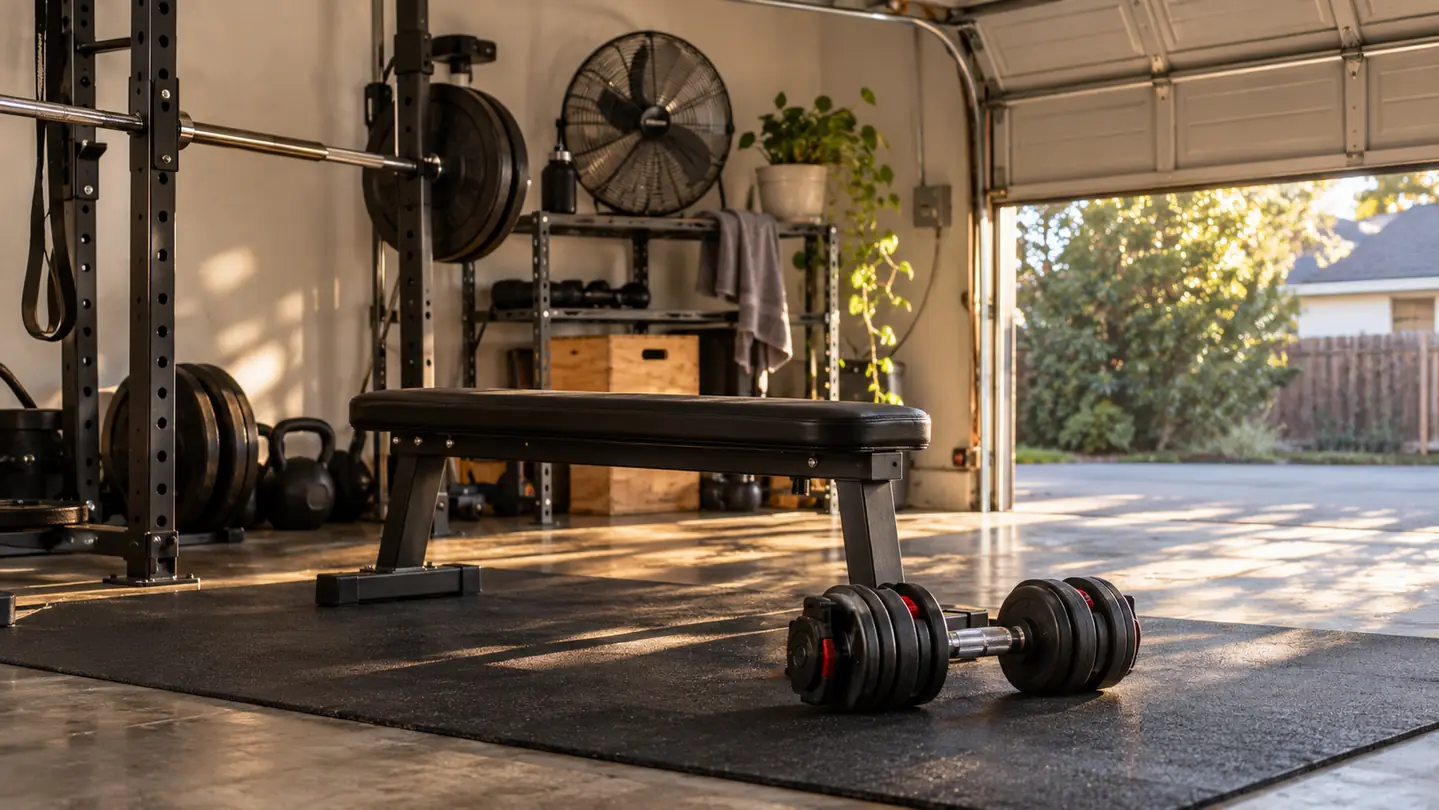
Nobody warns you that the hard part of buying adjustable dumbbells is not the shopping. It is the first week of training with them. I bought the PowerBlock Elite EXP 90 set because my one-car garage already holds a truck, a lawn mower, and a flat bench, and a rack of hex dumbbells was never going to fit in the space that was left. I am 54, I taught high school PE for 27 years, and my left knee has been complaining since my own playing days. So this is not a review assembled from a product page. It is what I noticed after months of Tuesdays in that garage.
What nobody tells you is that quick is not the same as instant, that seven inches of dumbbell is a lot of dumbbell next to your thigh, and that the weight jumps get wider as you climb toward the top. None of those are dealbreakers. All of them change how you plan a session. The set does what the listing says it does, which is why I still reach for it most mornings. It just does a few things differently than the product photos suggest, and those differences are the reason a review like this one is worth reading.
The Quick Verdict
A compact set that replaces a rack and changes weight in seconds between sets. The honest catches are real: the weight jumps widen near the top of the range, and each dumbbell sits wider in your hand than a hex head.
Amazon Check Today's Price →See the current PowerBlock Elite EXP 90 listing and the full weight ladder
Sixteen settings from 5 to 50 pounds per hand, selected with a magnetic polypropylene pin, backed by a 5 year limited warranty. Check the current price and the exact increment chart before you commit.
Amazon Check Today's Price on Amazon →What It Replaced, and What That Was Worth
For years my garage gym was three pairs of hex dumbbells and a lot of wishful thinking. I had 15s, 20s, and 25s. Anything heavier meant a drive to a gym I stopped belonging to when I retired, and anything lighter meant holding two dumbbells in one hand, which is exactly as safe as it sounds. The gap between what my program asked for and what my shelf could hold was the real problem, and no amount of creativity closed it.
The set replaced all of that with one pair, 12 inches long each, stored under the bench. Sixteen settings cover 5 to 50 pounds per hand. I did what everyone does and tested the adjustment in the first ten minutes: pull the magnetic pin, move the handle to a new setting, let the pin seat, lift. It works the way the listing says it works. What the listing does not say is how much a small footprint changes the mood of a workout. When the weight is already there and already adjustable, you stop negotiating with yourself about whether the next set is worth the setup.
How I've Used It, and What I Stopped Doing
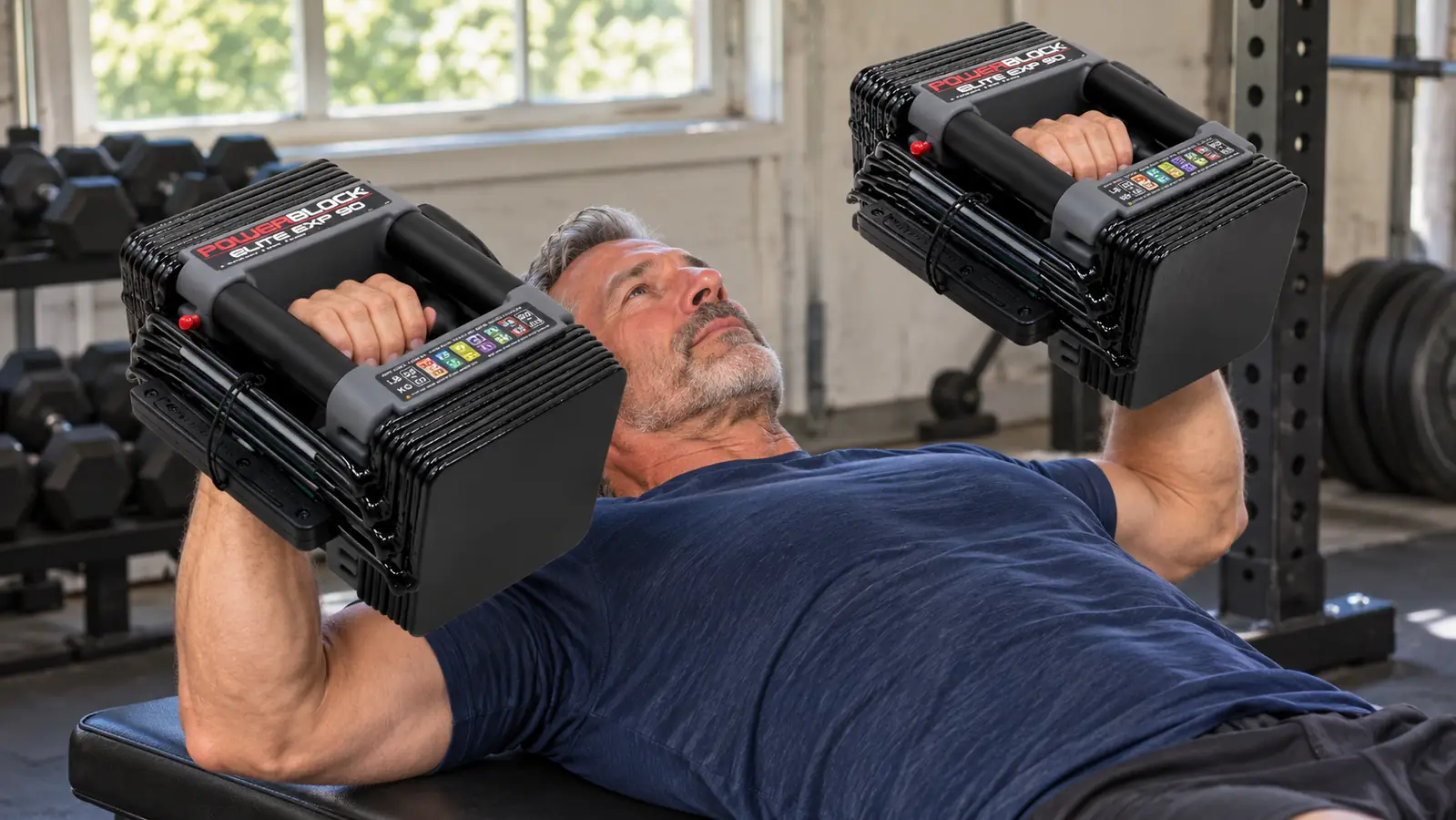
The habit I lost was picking one weight and staying there. Loading a bar is a chore, so at home you tend to load it once and live with it. With the PowerBlock, I move the pin between every set, which is what a coach would tell you to do and what almost nobody does in a garage. Press at one setting, drop it for the next set, climb back up. My shoulders have been happier for it, because a warm-up set is now a fifteen second decision instead of a five minute one.
My knee dictates most of what I do. Goblet squats, step-ups on the bottom stair, Romanian deadlifts, and a lot of slow split squats. All of those want a weight I can hold at my chest or hang at my side, and all of them want me to be able to drop ten pounds the moment the joint speaks up. That is the actual test of an adjustable set, and this one passes it. The change takes seconds. I have never once skipped a set because changing the weight was too much trouble.
One practical note for a house with kids in it. Sofia is 10 and Mateo is 7, and they come over most weekends. The dumbbells live under the bench with a folded towel over them, and the rule is that they are not toys and not to be moved. That is not a product flaw, it is a household with weights in it. Any pair this heavy needs a home and a rule, and the small footprint makes both easier to keep.
The Increment Chart Is the Thing to Study First
Forty-five pounds of range spread across sixteen settings means the gaps cannot all be the same size. That is arithmetic, not a criticism. The early jumps are small, which is what you want for warm-ups and for the small muscles around a cranky shoulder. The later jumps get wider. If your program calls for a small increase at 40 pounds per hand, this set cannot give it to you. You take the next setting or you add reps.
I do not think that is a flaw. It is the trade you make for a set that fits under a bench and stands in for sixteen dumbbells. But it is the most important thing to check before you buy, and it is the thing the product photos never show. Find the weight ladder, find where your working sets sit, and ask whether the jump across that spot is small enough for what you actually do. If you live near the bottom and the middle of the range, you will be fine. If you live near the top, look closely before you order.
Forty-five pounds of range across sixteen settings means the gaps cannot all be the same size. That is arithmetic. Find where your working weight sits, then decide.
The other half of that trade is speed. Changing the weight is not instant. It takes a few seconds, and you do it between sets, never in the middle of one. If you are used to a spring collar and two plates, this feels faster. If you are used to a selector pin on a machine at the gym, it feels about the same. Either way, a few seconds is not what makes a person skip sets. Setup is. And setup is the thing this set removes.
Seven Inches of Dumbbell Is a Lot of Dumbbell
Each one is listed at 12 inches long and about 7 inches wide and 7 inches tall. That is compact for what it replaces. It is not small in the hand. A hex dumbbell is a narrow head on a straight handle. This is a much wider body, and the width shows up wherever the weight travels close to you: curls, lateral raises, anything where the dumbbell passes your thigh or your hip.
My first two weeks were clumsy. I clinked them together at the top of a press, which is harmless and embarrassing. I had to widen my stance on curls. I turned my wrists a few degrees on lateral raises. None of that is a defect, and all of it is worth knowing before your first session, because a person who expects a narrow dumbbell and gets a wide one tends to blame the product instead of the setup.
The upside is the reason I put up with it. When you are finished, they go under the bench. Not in a corner, not on a rack you have to assemble, not stacked in a pile by the door. Under the bench. In a one-car garage that also holds a truck, that is the difference between owning weights and owning a gym.
The Handle, Honestly
The listing gives a 1.5 inch handle diameter and a 1.265 inch grip in polypropylene over steel. That is thicker than a standard barbell and closer to a fat grip. If your hands are on the small side, the first few sessions will feel like grip work whether you planned grip work or not. Mine are average for a man my size and I stopped noticing after a couple of weeks. Elena picked one up, curled it once, and handed it back with a look.
It is worth being honest about who that excludes. A person with genuinely small hands, or anyone with arthritis at the base of the thumb, should handle a thick grip before committing to one. The grip is not slippery and it does not spin, which I prefer for pressing. It is simply a lot to close around. That is a real consideration and not a footnote.
The Finish, the Warranty, and the Marketing
The dumbbells are powder-coat painted steel. Powder coat is durable, but it is still a coating over steel, and a drop on a concrete driveway will leave a mark. I set mine down. That is a habit rather than a hardship, and it is the same habit you should have with any weight you plan to keep for a decade.
The warranty is a 5 year limited warranty. Limited is the word that matters. Read the terms before you assume they cover what you think they cover. In my experience with training gear, five years on a steel product is a fair signal that the maker expects it to hold up, and it is not a promise that nothing will ever go wrong.
The listing also says the design is trusted by professional athletic training staff, or words close to that. Ignore that line. Every product page has one. What matters more is that 2,696 buyers have rated the set 4.6 out of 5, which tells you most people are not sending them back. That number is worth more than a claim about professionals nobody can check.
Two Things I'd Change
If I could change two things, neither would be hardware. The first is the increment ladder. I would like the jumps near 40 and 45 pounds to be finer, because that is where a lot of accessory work lives for a man my age and a knee that needs small steps. The second is the handle. A slightly thinner grip would open the set up to more people without costing anything for the rest of us.
Neither of those stops me from using the PowerBlock almost every morning, and neither would stop me from buying it again. They are the kind of complaints you make about a tool you intend to keep. A set that is perfect on paper usually turns out to have been designed by someone who has never trained in a garage.
What I Liked
- Sixteen settings from 5 to 50 pounds per hand, changed with a magnetic pin in seconds between sets
- 12 inches long and about 7 inches wide, so the pair stores under a bench
- Powder-coat painted steel with a 5 year limited warranty
- Changing weight between every set becomes normal, which is the real training benefit
- Rated 4.6 out of 5 by 2,696 buyers, so returns are clearly not the story
Where It Falls Short
- The weight jumps widen near the top, so fine increases at 40 pounds and up are not possible
- About 7 inches of width makes some curls and raises feel different from a hex dumbbell
- The 1.5 inch handle diameter is thicker than a standard bar and takes getting used to
- Stage 1 stops at 50 pounds per hand, so heavier lifters run out of room
- The painted finish will mark if you drop it on concrete
The Question I Get Most
The question I get from friends is whether the compact size is worth giving up a rack. My answer is that it depends on whether you actually use the rack. Most home gyms I have seen, including mine, hold a lot of equipment that gets used twice a month. A set that lives under the bench and adjusts in seconds gets used on a Tuesday when you have twenty minutes. I would rather own the thing I use than the thing that looks like a gym.
The follow-up is always about the park. Three blocks over there is a court and a grass field, and on Saturdays I am there with a whistle and a bunch of men my age pretending we are 25. The dumbbells live in the garage and stay there, and that is fine. They are 12 inches long and easy to carry, but the point of this set is that it never has to be carried anywhere. It is already where the training happens.
Who This Is For
This set suits the person who trains at home in a corner, a spare room, or half a garage, and who wants to stop choosing exercises based on which plates happen to be loaded. It fits a lifter working between 5 and 50 pounds per hand, which covers most general strength work, all of the accessory work, and enough ceiling for a respectable goblet squat. It suits anyone with a joint that flares, because dropping weight mid-session takes seconds. And it suits a household where two people of different strength levels share one set, since the pin moves the same way for both of them.
Who Should Skip It
Skip it if you already press or row more than 50 pounds per hand for reps. Stage 1 stops there, and no amount of clever programming changes the number. Skip it if your program depends on small jumps at the very top of your range, or if a 1.5 inch handle sounds like a chore for your hands. Skip it if you want to drop the weights from the top of a rep, because this is painted steel and not a rubber bumper. And if you are weighing it against a dial-based set like the Bowflex SelectTech, the difference that matters is how the weight is selected and how much body sits in your hand, not how either one looks on a shelf.
If you take one thing from this review, take the increment chart. Everything else about the PowerBlock Elite EXP 90 is either a small adjustment or a matter of taste. The weight ladder is the part that decides whether the set fits your training or fights it, and it is the part you can check in two minutes before you spend anything.
If the weight ladder fits your working range, this set earns its space
Sixteen settings from 5 to 50 pounds per hand, a magnetic pin, and a 5 year limited warranty. Check the current listing and today's price, and put your own working weights against the increment chart before you order.
Amazon Check Today's Price on Amazon →