
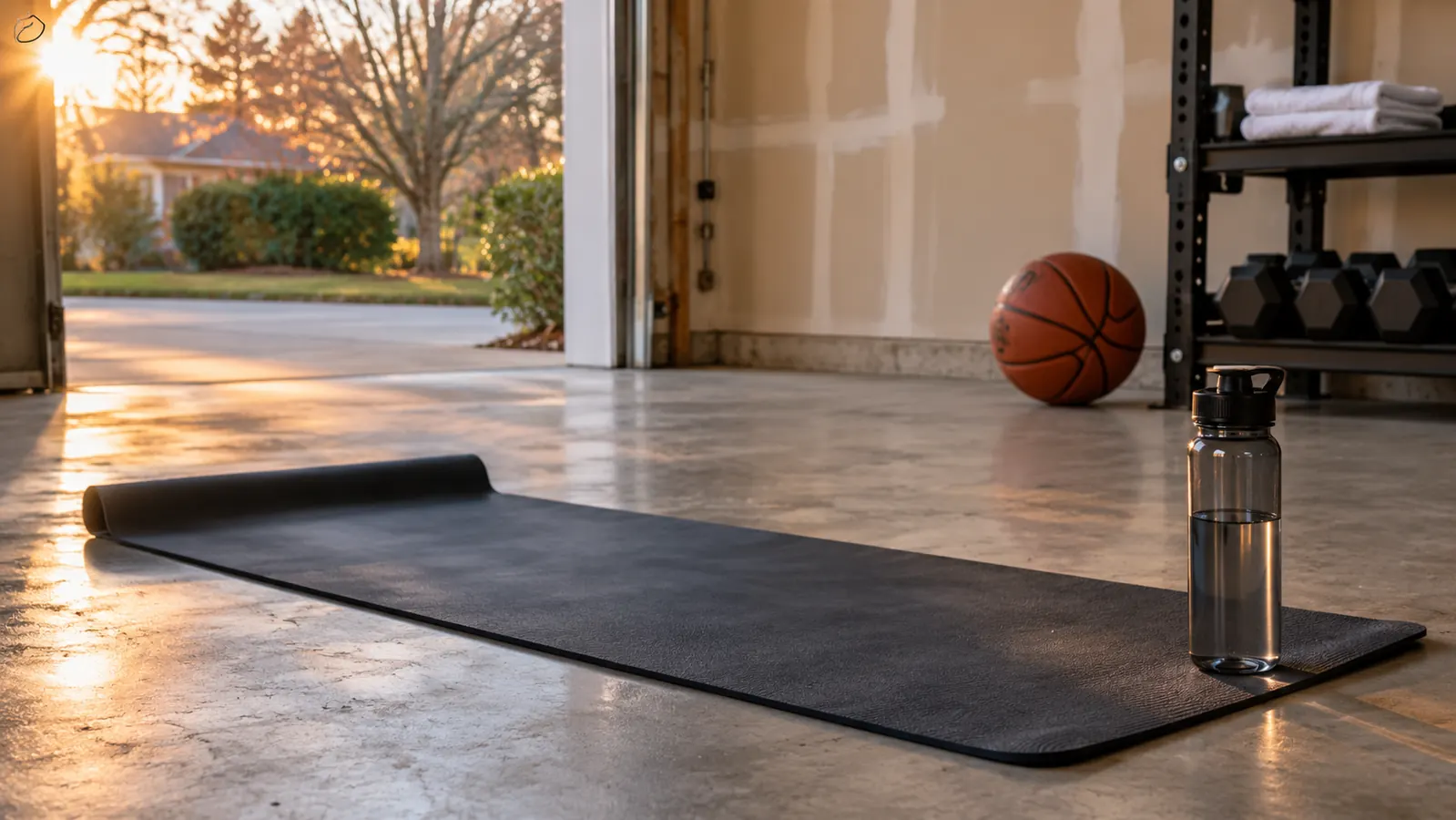
The last thing anybody wants to do after a Saturday morning at the park is lie down on the ground and hold a stretch for thirty seconds. I know that feeling well. For about fifteen years I told myself I would stretch when I got home, and for about fifteen years I got in the car, drove three blocks, took a shower, and sat down instead. The stretching never happened. Not once.
I am Marcus Delgado. I taught high school PE for twenty-six years, coached youth basketball and soccer on the side, and I still play pickup at the neighborhood park most Saturdays. My left knee has been sore since my playing days, so recovery stopped being optional for me somewhere around forty-five. Here is what I finally figured out: post-game stretching is not a discipline problem. It is a logistics problem. If the mat is rolled up in a closet, I do not stretch. If it is already open on the garage floor, I do. The mat on my floor is the Gaiam thick yoga mat, the 10mm one, and it earns its spot for a simple reason. It is thick enough that my hips and my tailbone stop arguing with the concrete long enough for me to actually finish the routine. The Gaiam mat is not the interesting part of this article. It is the part that makes the rest of it possible.
The reason you stopped stretching is the floor
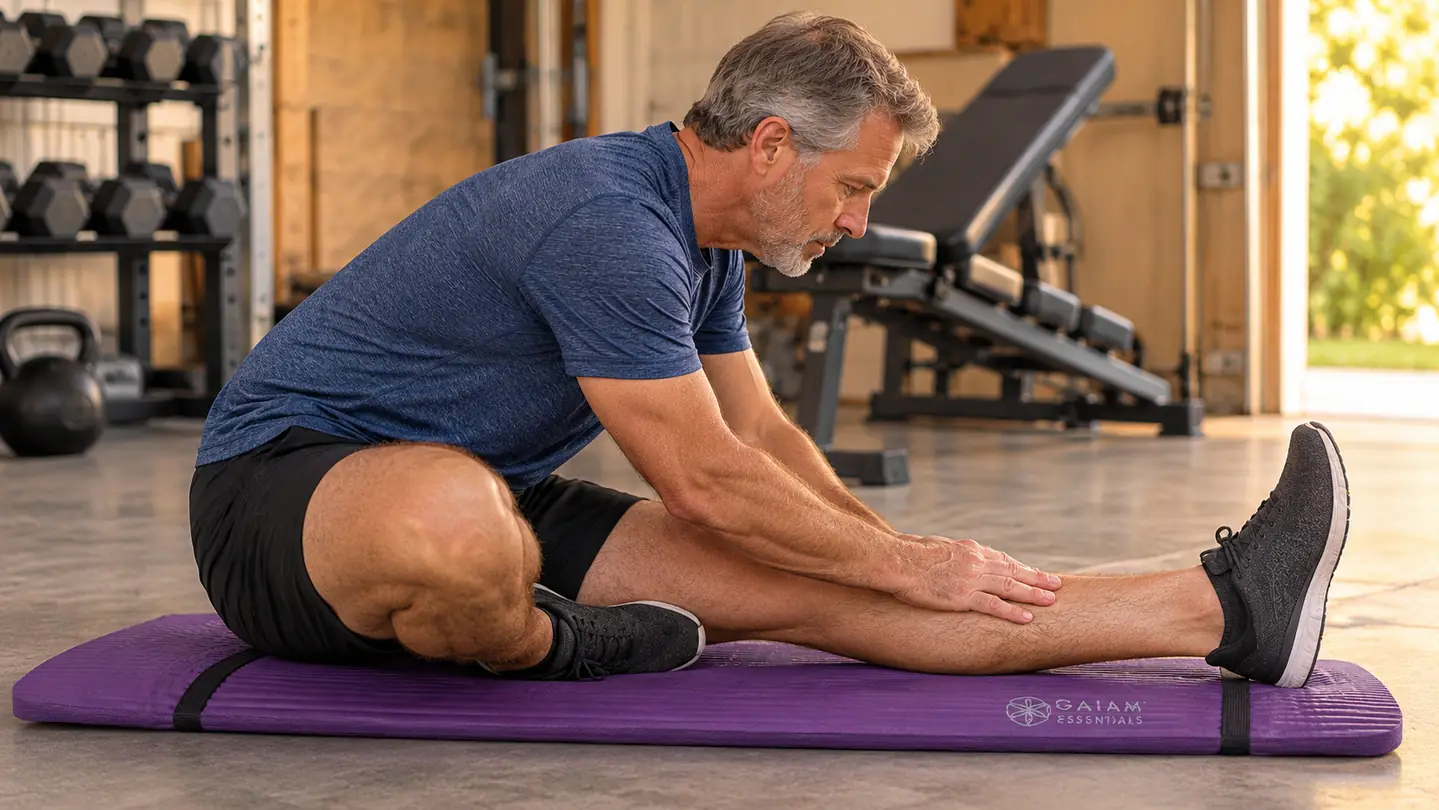
Ten millimeters of high-density NBR foam between your hip bones and a concrete slab. Rolls up with an adjustable strap if you would rather stretch at the park. Hand wash only, and it wants a day or two of air when it first arrives.
Amazon Check Today's Price on Amazon →What follows is the exact order I use, and it runs about twelve minutes if I do not dawdle. Nothing in it requires flexibility you do not already have. It requires a floor you are willing to sit on.
Step 1: Walk It Off Before You Get Down There
Cold tissue does not stretch. It resists. After forty minutes of pickup, your calves and hamstrings are shortened and your hips are locked forward from all the crouching, and dropping straight into a deep hamstring reach is how a man pulls something on a Saturday and feels it on Wednesday. So I walk first. One slow lap around the park, or if I am at home, down the driveway to the sidewalk and back four times. Three to five minutes, no pace goal, no watch.
By the time I get back, my breathing has dropped and my heart is not pounding in my ears. That is the signal to start. If I am still panting, I keep walking. There is no prize for rushing this part.
There is a second reason for the walk and it is an honest one. It delays the moment where I have to get down on the floor. Once I am down there, I stay down. So I want to arrive at the mat already cooled off, not climbing back up every two minutes to catch my breath or answer my phone.
Step 2: Roll Out the Mat and Check Your Setup
In my garage the mat lives unrolled and leaning against the wall between sessions, or rolled with the strap around it if I have been carrying it to the park. Either way, setup takes about ten seconds. That sounds trivial. It is the whole ballgame. A stretching routine with a setup step is a routine that gets skipped on the days you need it most.
Three numbers on this mat are the reason it works on a garage floor. The thickness is 10mm, which is roughly two fifths of an inch. The surface is 72 inches long and 24 inches wide. The whole thing weighs 930 grams, a little over two pounds. Of those, the 10mm is the one that counts for me. I have tried a thin mat on that slab and my hip bones found every bit of grit in the concrete. The 72 inch length means I can lie flat with my arms overhead and my heels still on the mat, which a shorter mat will not do for a man over six feet. The 24 inch width is enough to work shoulder width without hanging off the edge.
The strap is not a gimmick if you stretch away from home. I keep it cinched for the walk to the park and use it as a handle on the way back.
Two honest notes. It is NBR foam and it smells like new foam when you unroll it the first time. Mine aired out on the back porch for a couple of days before it went into the garage, which is about what the listing tells you to expect. And it is hand wash only, so it does not go in the machine. A damp cloth and a few minutes of air after a sweaty session is what I do, and it has held up fine.
Step 3: Hips First, Because Basketball Shortens Them
Pickup basketball is forty minutes of crouching, and the hip flexors take the worst of it. Everything else in the routine goes easier once the hips let go, so this is where I start. Skip it and the hamstring stretch feels like dragging a stuck door.
First, a half-kneeling hip flexor stretch. Left knee down on the mat, right foot forward, tailbone tucked under before I lean. Twenty to thirty seconds, two rounds per side. This is where the mat stops being a nice-to-have. My left knee is the sore one and it is the knee that spends the most time on the floor. Ten millimeters of foam is the difference between a stretch I hold for the full count and one I cut short because the joint underneath is complaining.
Second, a 90/90 seated position. Both legs bent at ninety degrees, front shin across, back shin behind, sitting tall. I rock gently forward over the front leg for a few breaths, then switch. This is the position that tells me how the game actually went. Some Saturdays I can sit upright with no hands on the floor. Some Saturdays I am propped on both palms and gritting my teeth, and those are the Saturdays I take a second round.
I never quit stretching because I did not know the stretches. I quit because the mat was in the closet and the floor was concrete.
Step 4: Hamstrings, Calves, and the Ankles Nobody Stretches
Seated hamstring stretch. One leg out, the other knee bent, and hinge from the hip with a flat back rather than rounding over to reach your toes. Twenty to thirty seconds per side, twice. The target is the back of the thigh, not your shoe. I see guys in the park yanking at their feet with a rounded spine and I want to tell them the toe touch is not the point.
Calves next, and this one changes depending on where I am. At the park I put the ball of my foot on the curb or a bench edge, heel down, and lean in until I feel it behind the knee. At home I use the bottom step of the stairs going into the garage. Two holds per leg, thirty seconds each, one with the knee straight and one with it slightly bent so the lower part of the calf gets a turn.
Then ankles. Nobody stretches them and everybody rolls them. Thirty seconds of slow circles in each direction per foot, then ten gentle alphabet reps if I am being thorough. It takes about a minute and it is the cheapest insurance in the routine. My knee is a lot happier when my ankle moves properly, and it took me years to connect those two things.
Step 5: Low Back and a Slow Finish
Knees to chest first. Both knees hugged in, thirty seconds, rocking a little side to side. Then a supine twist. Arms out wide, knees fall to one side, hold for five slow breaths, switch sides. The twist is the one that makes the drive home comfortable, and on a day when the park benches were full and I sat on the ground between games, it is the one my lower back votes for.
The last minute is the part almost everybody skips. I lie flat, arms at my sides, and breathe until a full minute has gone by. No phone. Just the garage ceiling and the sound of the neighborhood. That minute is what tells my body the game is over. Without it I walk into the house still wired and I am restless until dinner.
Then get up the way an old coach gets up. Roll to one side, push up with the hands, stand slowly. Trying to sit straight up out of a supine twist at fifty-four is how the room starts spinning and how you end up back on the floor for reasons you did not plan.
What Else Helps
Water and a warm shower, in that order. I am not going to sell you a recovery powder. What has actually made a difference for me is drinking something before I get in the car instead of two hours later, and not standing in a hot shower for twenty minutes thinking it is therapy. Ten minutes of warm water to loosen up, then move on with your day.
Sleep is the real recovery tool and it is the one nobody wants to hear about. The Saturdays when I sleep badly on Friday night are the Saturdays my knee is loud on Sunday. No stretch on a mat fixes that. It just makes the next morning less unpleasant.
Know when to stop. A stretch should feel like tension and it should ease as you breathe. If it is sharp, if it is hot, if a joint catches or gives, you are done and you should get it looked at. I spent two decades watching teenagers ignore that rule and I have ignored it myself. It has never once turned out to be nothing.
And one more thing about the mat that has nothing to do with foam density. It marks the spot. When it is open on the garage floor, I stretch. When it is rolled and strapped and leaning in the corner, I do not. That is not a metaphor. That is just how a habit works at my house, and it is the reason the Gaiam mat stays where I can see it rather than in the closet with the holiday boxes.
Twelve minutes, one mat, and the rest of your Saturday back
72 inches long, 24 inches wide, 10mm of NBR foam, a little over two pounds with a strap for the park. The setup takes ten seconds, which is the only reason the routine happens.
Amazon Check Today's Price on Amazon →