
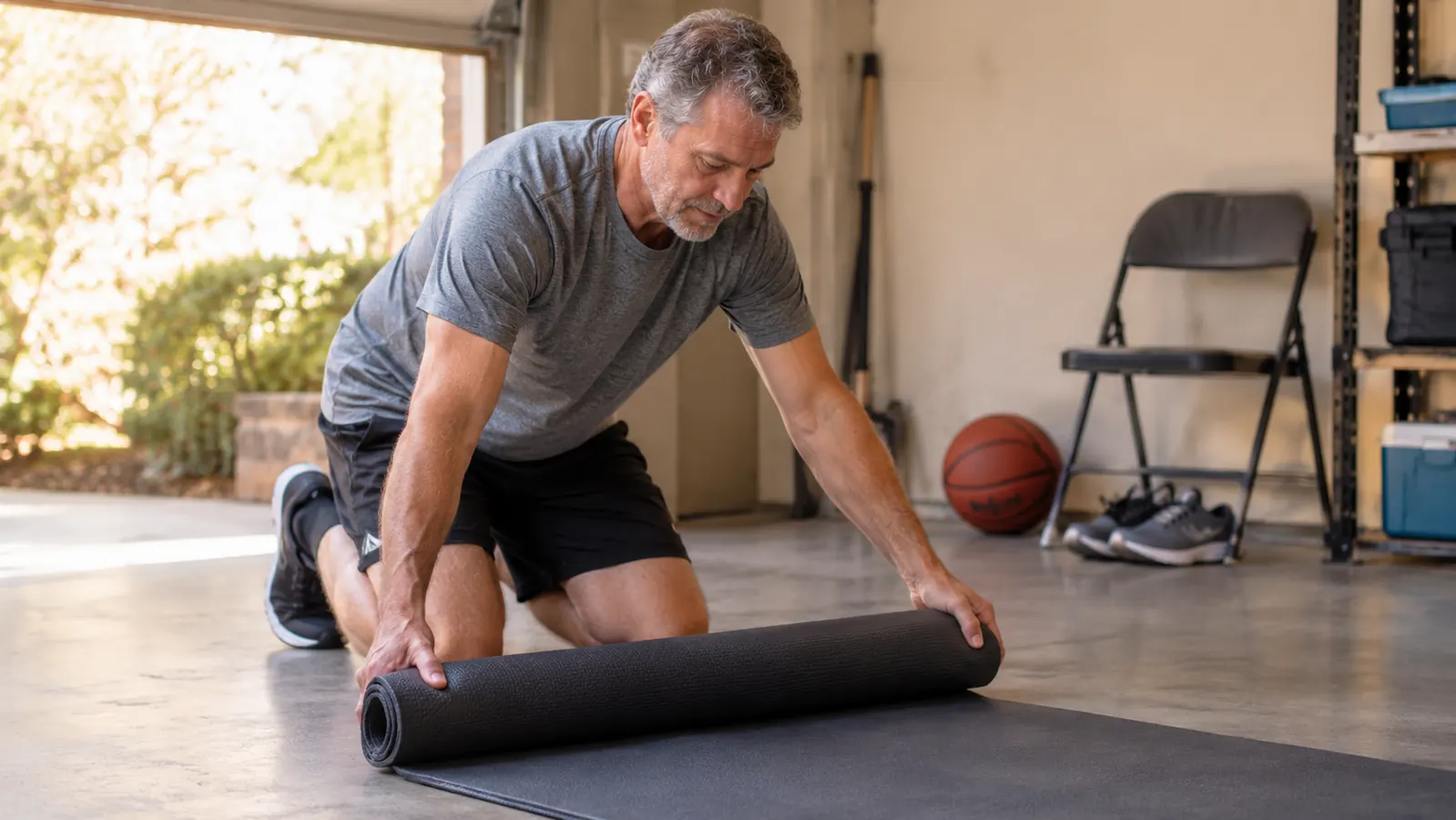
Two mats, two jobs, and the marketing on both of them pretends otherwise. The Gaiam Thick Yoga Mat is 10mm of NBR foam, 72 inches long, 24 inches wide, and it weighs 930 grams. A thin travel mat is a millimeter or two of rubber that folds small enough to forget in a backpack. Lay them side by side and there is no winner. There is only the question of what you are actually doing on a Tuesday morning.
So here is the short answer. If your knees complain on a hard floor, if you do floor work in a garage or on a driveway, or if you are past fifty and tired of feeling concrete through a towel, buy the Gaiam. If you carry a mat to a studio, to a park, or onto a plane, buy the thin one, and it is not close. I own the Gaiam. I have borrowed more thin mats than I can count. I am 54, my left knee has been sore since my playing days, and that knee is the whole reason I have an opinion.
| Gaiam Thick Yoga Mat | A Thin Travel Mat | |
|---|---|---|
| Cushioning | 10mm (2/5 inch) high-density NBR foam, 0.39 inch thick | 1 to 2mm of rubber, you feel the floor through it |
| Knees and wrists on a hard floor | Enough foam that kneeling and tabletop work stop hurting | Fine on a sprung wood studio floor, rough on concrete |
| Size | 72 by 24 inches | Usually trimmed shorter and narrower to save weight |
| Packed size | Rolls into a cylinder, carried in the included adjustable strap | Folds to the size of a paperback, disappears into a backpack |
| Weight | 930 grams | Often half that or less |
| Grip once your hands get damp | Foam surface gets slick in a warm room | Textured rubber holds better |
| Standing balance poses | Soft enough that your standing foot shifts | Firm base, the floor does not move |
| Care | Hand wash only, air dry | Wipes down with a damp cloth |
| Best for | Floor work at home where the floor is hard | Travel, studio classes, carrying it any distance |
Where the Gaiam Mat Wins
Start with the number that decides the whole argument: 10mm. Gaiam lists it as 2/5 inch, which shows up as 0.39 inch of thickness on the spec sheet. On a garage slab that is not a spec. That is the difference between kneeling and quietly deciding you will kneel tomorrow. Before I bought mine I worked through two cheaper answers. The first was a folded beach towel, which bunched under my knees and slid every time I shifted weight, and by the third week I was folding it three layers deep and still feeling the slab through my shin. The second was a thin closed-cell mat I picked up at a big-box store, maybe four millimeters, and it was worse than the towel because at least the towel would give. I did bird dogs, dead bugs and tabletop work on those two things for the better part of two years, and I spent every one of those mornings feeling it in my wrists.
The foam is high-density NBR, which is not the soft white packing material the word foam brings to mind. It gives under a knee and comes back. Mine has sat unrolled on my concrete floor through two Jacksonville summers and it has not flattened into a permanent dent the way cheap foam does by August. That matters more than the thickness number, honestly. A soft 10mm mat becomes a 3mm mat by the end of the year, and you buy it twice. I checked the rolled edge of mine with a ruler this spring, mostly out of suspicion, and it still measured the same 0.39 inch it did the day it came out of the box. That is not a laboratory test. It is enough to tell me the foam is not collapsing under a grown man doing tabletop work four mornings a week.
Size is the second win. 72 by 24 inches is enough that I can lie down, reach overhead, and keep my heels and my hands off bare concrete. It is enough that Sofia, who is ten, can land on it mid-somersault without half of her ending up on the slab. Mateo, who is seven, uses it as the starting line for races he invents. Neither of them has ever asked whether it is a yoga mat.
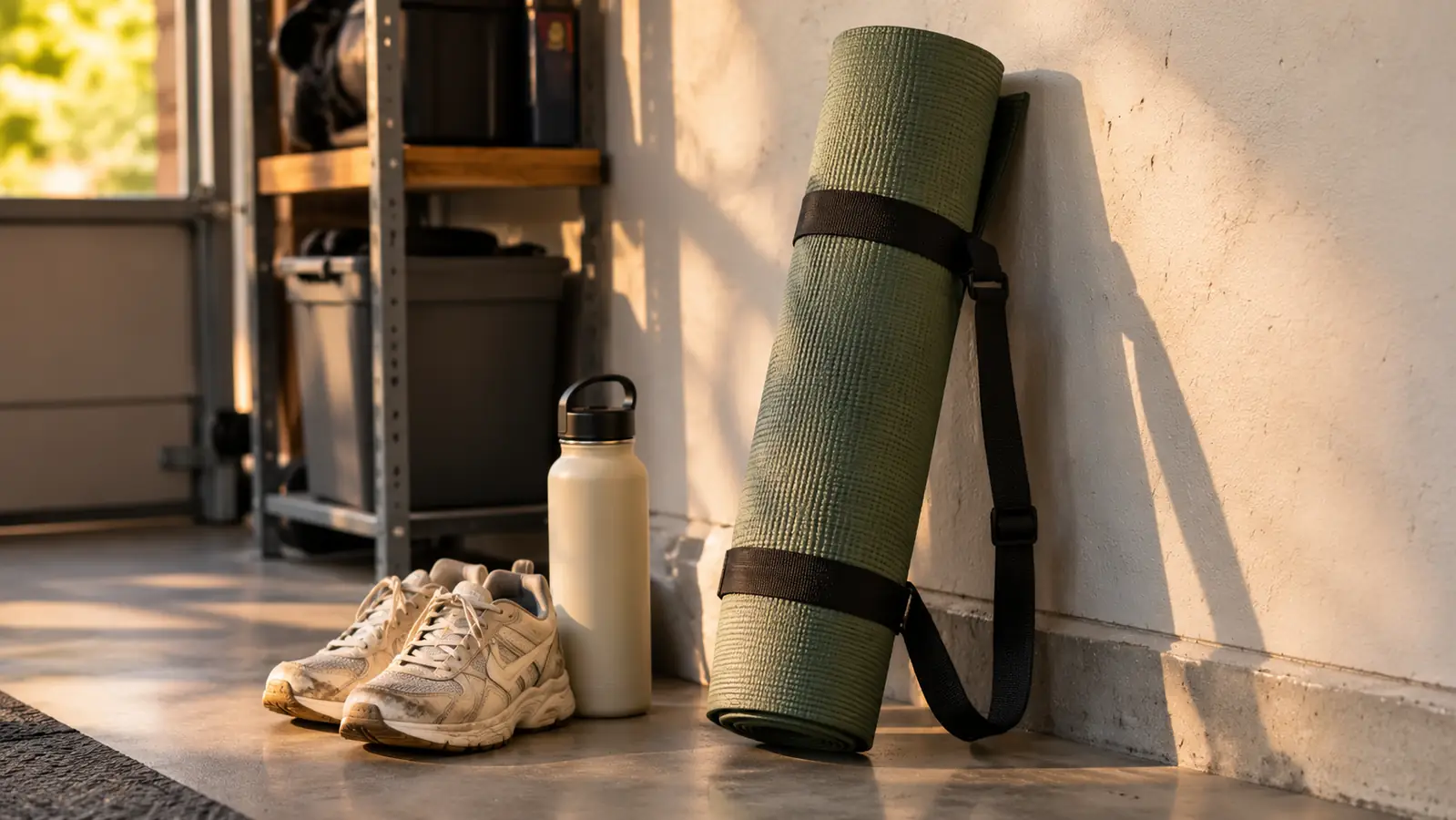
Third, it is light for what it is. 930 grams, a hair over two pounds. I walk it three blocks to the park most weeks and I have never once thought about the weight. The adjustable carrying strap comes in the box, which sounds like a small thing until you have carried a rolled mat under one arm for half a mile while it slowly telescopes out from under your elbow.
The last one is quieter and harder to put on a spec sheet. A thick mat absorbs small movements. Setting a knee down, rolling to your side, sitting up after a set. On a thin mat every one of those lands on the floor and travels up into the joint. On 10mm it lands on the mat. If your knees are the reason you stopped doing floor work at home, that is the entire argument, and I made it at more length in my piece on why a thick yoga mat helps sore knees.
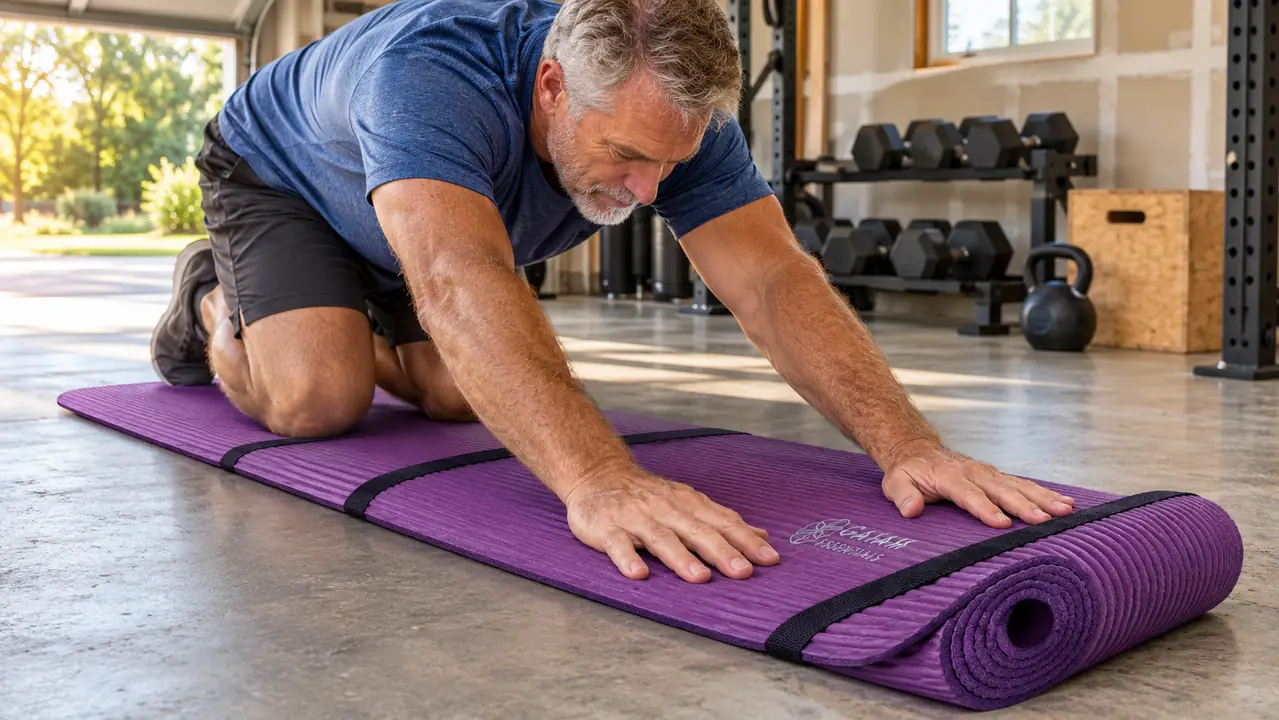
Where a Thin Travel Mat Wins
Portability, and this is not a small category. A thin mat folds into a square the size of a paperback and drops into a backpack next to a laptop. The Gaiam rolls into a cylinder about as long as my arm and rides in its strap. Rolled is fine for a walk to the park. It is not fine for a carry-on, a crowded subway car, or a gym locker with a shoebox footprint.
Grip is second, and it surprises people who assume thicker means better. NBR foam is comfortable, but foam gets slick once your hands get damp. Twenty minutes into a warm room my palms start to wander on the Gaiam, and I have to reset my hands between poses. A thin rubber mat with a textured top holds. I first noticed it on a humid June morning in the garage with the door open, no class, no hot room, just Jacksonville in summer. Half an hour in, my hands were sliding an inch or so on every movement that loaded them, and I stopped twice to dry my palms on my shirt. A towel laid over the top bunched instead of helping. Wiping the surface down mid-session bought me about five minutes. The thin rubber mat I borrowed the same week held the same sequence without a single reset. If you sweat hard and your class lives on your hands, the thin mat is simply the better surface, and no amount of cushioning changes that.
Balance is third. Ten millimeters of foam is soft enough that your standing foot shifts while you hold a single-leg pose, so you end up correcting with your ankle instead of your hip. A thin mat puts you almost on the floor, and the floor does not move. When I want to work on balance, I step off the Gaiam and stand on the concrete. That is not a knock on the mat. It is what the mat is for.
And a thin mat goes places a rolled mat cannot. It lives in the car. It comes out in a hotel room. It handles a park lawn or a living room rug without a second thought, and it airs out in an hour on the porch.
The Floor Matters More Than the Mat
Before you pick a mat, look at what is under it. A thin mat on a sprung wood studio floor is comfortable, because the floor already has give. That same thin mat on a garage slab is a sheet of rubber over rock. Half the complaints people have about thin mats are really complaints about concrete, and the mat takes the blame. The gym where I taught had a floor built over sleepers, and you could do a full floor routine on a bath towel there and never think about your knees. My garage is a poured slab with a thin coat of epoxy over it, and the gap between those two surfaces is wider than the gap between any two mats I have used. Get down on the floor of wherever you plan to practice and put a flat hand on it. If it is cold and unyielding, the mat is doing all of the work. If it gives a little under your knuckles, a thin mat will do fine.
The Gaiam works in reverse too. On deep carpet, 10mm of foam on top of that pile is too much and your standing poses go mushy. I tried it in the living room once and gave up inside a week. It wants a hard, flat surface: concrete, tile, hardwood, a driveway. That is where the foam earns its keep.
Outside is its own case. At the park three blocks from my house there is a grass field and a basketball court. The mat does fine on dry grass. On the court, the thick mat is the only one of the two I would kneel on. A thin mat on asphalt is a formality, not a cushion.
Two Things Neither Box Tells You
The Gaiam smells like a tire for the first day or two. Gaiam says as much in the listing: initial foam odor may be present and typically fades after airing out for 24 to 48 hours. Mine did exactly that. I unrolled it in the garage on a Saturday morning and left it there with the door cracked, and by Sunday afternoon you could stand over it and smell nothing at all. Roll it tight and stuff it in a closet the hour it arrives, and you will be writing a review about the smell. That is a fair thing to be annoyed by and an easy thing to avoid.
The care instruction is hand wash only. No machine, no dryer. Mine gets wiped with a damp cloth, aired on the driveway, and rolled back up. That is the closest I get to a hand wash, and it has held up without cracking or going tacky. Do not leave it sitting in a closed car in July, mostly because everything left in a closed car in July comes back changed.
One more, since nobody mentions it: if you store it rolled tight for months, the ends curl for a day after you unroll it. Mine settles by the second morning. Roll it a little looser if you have the shelf space and it barely happens at all.
Ten millimeters of foam is the difference between kneeling on a garage floor and quietly deciding you will do it tomorrow.
Ten millimeters between your knee and the concrete
72 by 24 inches, 10mm of high-density NBR foam, and the adjustable strap comes in the box. This is the one I leave unrolled in the garage.
Amazon Check Today's Price on Amazon →Who Should Buy Which
Buy the Gaiam if your training happens in one place and that place has a hard floor. A garage, a basement, a lanai, a living room over a slab. Buy it if your knees, wrists or hips are the reason you avoid floor work, or if a physical therapist handed you homework you keep skipping because the floor hurts. Buy it if you are past fifty and you have stopped pretending that discomfort is part of the program.
Buy the thin travel mat if the mat has to go somewhere. If you practice in a studio, if you fly, if you commute, if your gym locker is the width of a shoebox. Buy it if you sweat hard and your class is mostly standing work. Skip the Gaiam entirely if you practice in one studio and walk there, because you would be carrying two pounds you never use.
If you are in both camps, and most of us get there eventually, two mats is the accurate answer rather than an indulgence. The thick one stays where your floor is hard. The thin one lives in the bag by the door so you stop finding reasons to leave it behind.
The mat that stays where the floor is hard
10mm of high-density NBR foam, 72 by 24 inches, adjustable strap included. If concrete is what keeps you off the floor at home, this is the piece of gear that changes it.
Amazon Check Today's Price on Amazon →