
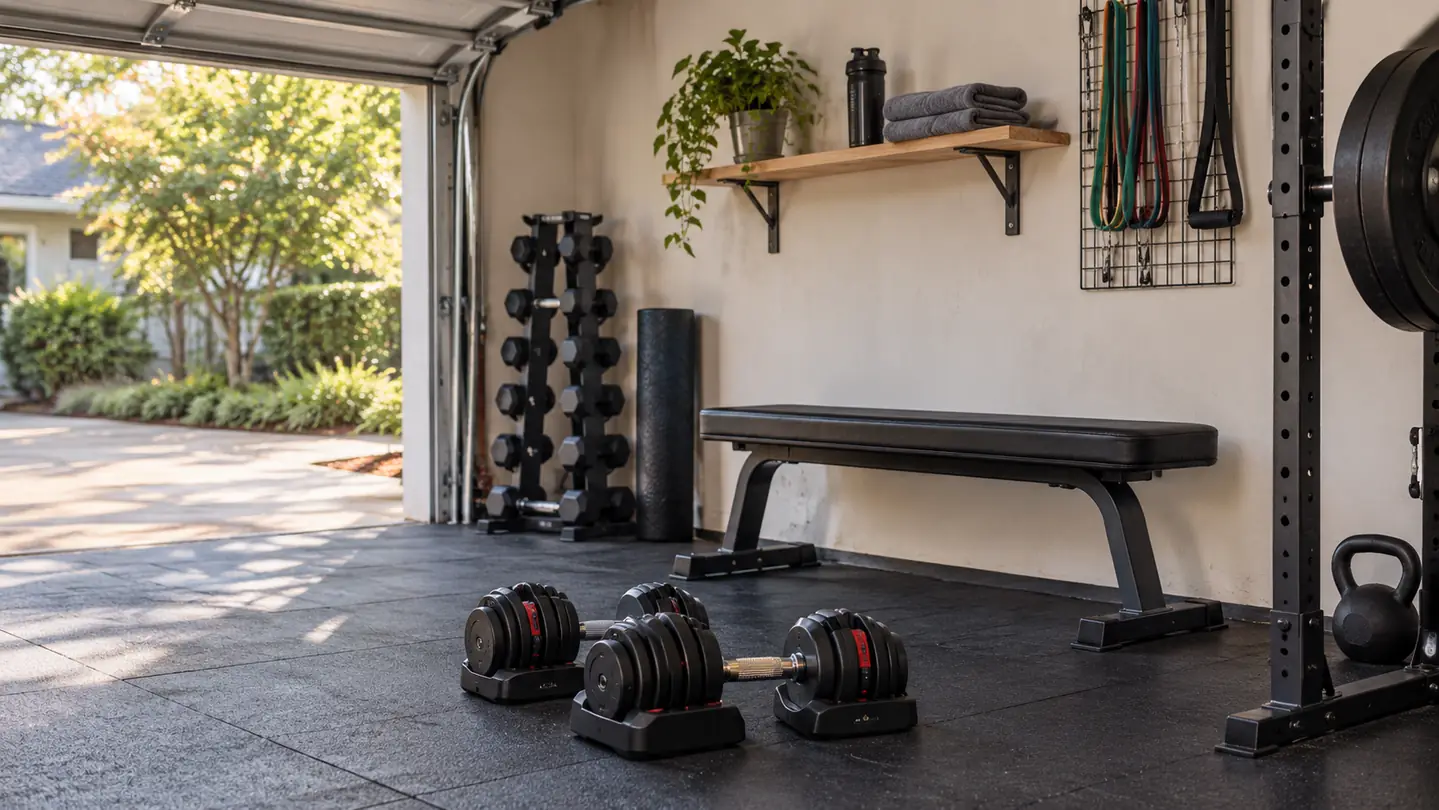
Every January, three or four people ask me how to set up a gym at home. They ask about racks, benches, mirrors, flooring and a sound system, roughly in that order. The dumbbells come last, like an afterthought. I tell them to flip the list. The weights you can adjust with one hand decide how much floor you need, what kind of bench makes sense, and whether you are still walking into that garage in March. In my own garage, the whole project got simpler the day I stopped collecting fixed dumbbells and put a pair of PowerBlock Elite EXP 90s against the wall. What follows is the order I would do it again.
Some context on who is writing this. I am 54, a retired high school PE teacher in Jacksonville, Florida, and my gym is a one-car garage that Elena has officially given up on. The car lives in the driveway now. My left knee has been sore since my playing days, so I care about two things more than I care about having a wall of iron: small jumps in weight, and a floor that forgives a clumsy set-down. Sofia and Mateo, my grandkids, are in that garage on weekends, which is one more argument for a setup that stays neat and out of the way.
A pair that covers the whole wall of fixed dumbbells you were about to buy
The PowerBlock Elite EXP 90 runs 5 to 50 lb per hand across 16 increments, changed with a magnetic pin instead of a walk to the rack. Powder-coat painted steel, a 5 year limited warranty, and a footprint of 12 inches long, so the whole set lives against one wall.
Amazon Check Today's Price on Amazon →Step 1: Measure the Bay Before You Buy Anything
The mistake I made the first time was buying the weights before deciding where they would live. They spent two months under the workbench, which meant two months of moving a bench to get to them, which meant two months of not training. So walk into the garage and pick the wall first. You want the weights within arm's reach of where you will actually stand, not across the room behind the lawnmower. A pair of PowerBlock Elite EXP 90s is 12 inches long per dumbbell, so the two of them together claim less floor than a folding chair parked against the wall.
Here is the version of that mistake I actually made, in case it saves you a Saturday. I carried both dumbbells out and set them on the workbench, then found the bench was 14 inches deep and the two of them wanted more than that once the housing was counted. So I measured the wall instead. Thirty-eight inches of clear space between the water heater and the shelf, which turned out to be plenty. I taped the footprint on the floor with painter's tape and walked past it for a week before I committed to anything permanent. That week is the reason the shelf ended up in the right place.
Then decide the height. Mine sit on a low, wide shelf I built from a couple of two-by-tens, because bending to the floor with a sore knee gets old by the third set. Any sturdy bench or a clear patch of mat works just as well. What I would not do is store them above shoulder height. Lifting 50 lb off a high shelf with a bad knee is how a good Tuesday turns into a bad month.
Leave a lane. You need roughly the length of your body plus a step on each end to lie down for a floor press, and enough room to step back into a split squat without clipping the water heater. In a one-car bay that usually means the bench runs parallel to the garage door, not perpendicular to it. I learned that one by knocking over a shelf twice.
Step 2: Fix the Floor Before Anything Heavy Lands On It
Bare concrete in a Florida garage is fine for a car and less fine for a dumbbell that gets set down harder than intended on the last rep of the last set. I bought four rubber horse-stall mats from the feed store and butted them together under the working area. They are thick enough that a dropped weight does not ring off the slab, and they grip even when the humidity turns the garage into a sauna in July.
Four mats, each about four feet by six, made a rectangle that runs from the front edge of the bench to a foot past where my feet land in a split squat. A utility knife and a straight edge trim them to the wall if you need a clean line. Then leave them in the driveway for two days before they come inside. New rubber smells like a tire store, and a closed garage holds that smell for a week. After the two days they lie flat and stop curling at the corners, which is the whole reason I did not skip that part.
Put the mat where the weights land, not where the bench sits. That sounds obvious and almost nobody does it. The bench has feet and can live on concrete. The dumbbells get dropped, set down, and occasionally rolled, so the mat goes under your stance and extends a foot past it in each direction.
The mat also matters for my knee. Standing on rubber instead of concrete for forty minutes takes some of the sting out of a split squat, and it means I am not thinking about my joints while I am supposed to be thinking about my form. Sweep it once a week. Garage floors collect grit, and grit under a bare foot is its own small misery.
Step 3: Pick the Dumbbells and Learn the Adjustment
This is the decision the rest of the room hangs on. Fixed dumbbells from 5 to 50 lb would be ten pairs and a rack the length of the garage, which is not happening in a one-car bay. Adjustable is the only version of this that fits. The PowerBlock Elite EXP 90 goes from 5 to 50 lb per hand across 16 weight stops, and the listing says the pair replaces 16 traditional dumbbells. That is the trade: one compact set instead of a rack you would have to walk around.
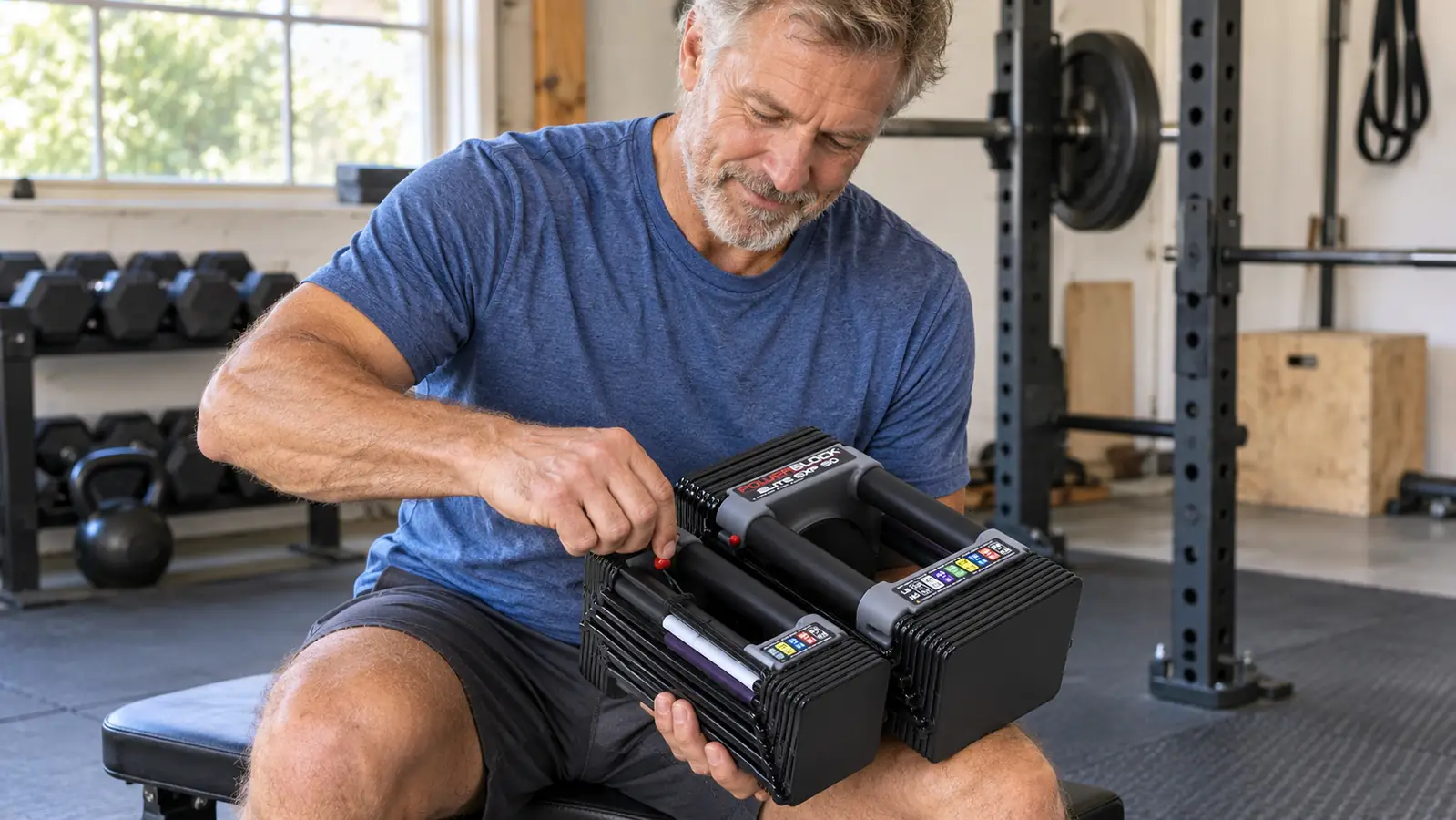
The adjustment itself is a magnetic polypropylene pin. You pull it, slide the handle to the number you want, and push it back until it seats. It is a pin, not a dial, and there is nothing to count in the dark. I change weight between sets in the time it takes to drink some water. That sounds like a small thing until you have spent a winter spinning a dial with cold hands and wondering whether it clicked into the right groove.
The first week I owned them I did something dumb. I picked one weight and left it there for an entire session, telling myself I would learn the adjustment later. Two weeks of that and my shoulders stopped being sore in the way that means progress. The pin wants to be used between sets, not admired. Now the sequence is habit: set the dumbbell on the bench, pull the pin, slide to the next number, feel it seat, pick it back up. If it does not seat, it does not lift, which is a safety feature I have come to appreciate more as my attention span for detail has shortened.
The rest of the build is plain. Powder-coat painted steel, a 1.5 inch handle diameter, and a 5 year limited warranty. The handle is thick enough that my grip is doing real work on a row but not so thick that a set of ten becomes a grip contest. I have had a pair of PowerBlock dumbbells in this garage long enough to stop thinking about them, which is the highest compliment I can pay a piece of equipment.
Sixteen stops between 5 and 50 lb per hand means the jump is small enough that a sore knee can take one more step this week than it could last month. That is the whole argument for adjustable weight.
Step 4: Add the Three Pieces That Do the Work
Once the weights and the floor are settled, most people go shopping for a room full of equipment. I would buy three things and stop. A flat bench that also inclines, because a floor press is fine and an incline press is better for the way I actually train. A set of resistance bands for warm-ups and for the days my knee wants a lighter load. And a mirror you can see your own knees in, hung low, not at chest height where it only shows you your face.
The bench is the one item I would spend a little more on rather than a little less. Mine measures about 17 inches at the pad, which suits my height, and the back locks at a few fixed positions instead of sliding on a smooth ramp that creeps down mid-set. The mirror went up at 30 inches off the floor so I can watch a knee track over a toe during a split squat. At chest height it shows you nothing useful, which is how most garage mirrors end up behind a bicycle.
Everything else can wait a year. A rack, a cable tower, a treadmill, a rowing machine: all fine purchases once you have proven to yourself that you use the space four days a week. Buying them first is how garages end up as storage units with a bench in the middle. I have watched it happen to three neighbors, and one of them is still moving a treadmill to get to his golf clubs.
Step 5: Write the Week Down Before You Train It
A room is not a program. The first month I had the garage set up, I wandered in, did whatever felt reasonable, and made no progress I could name. Then I wrote a week on an index card and taped it to the wall. Monday is a push day: floor press, one-arm overhead press, and a set of lateral raises with a light pin. Wednesday is pull: bent-over rows, Romanian deadlifts, and a couple of sets of curls. Friday is legs: goblet squats and split squats with one hand on the shelf for balance.
Tuesday, Thursday and Sunday are walking mornings, either the neighborhood loop or the park three blocks over, which has a basketball court and a grass field and is where I still play pickup on Saturdays. That is the whole week. Sixteen weight stops means I never have to guess at a jump: I start at a weight that leaves two good reps in the tank, and when I hit the top of my rep range on both sets, I move up one stop the following week.
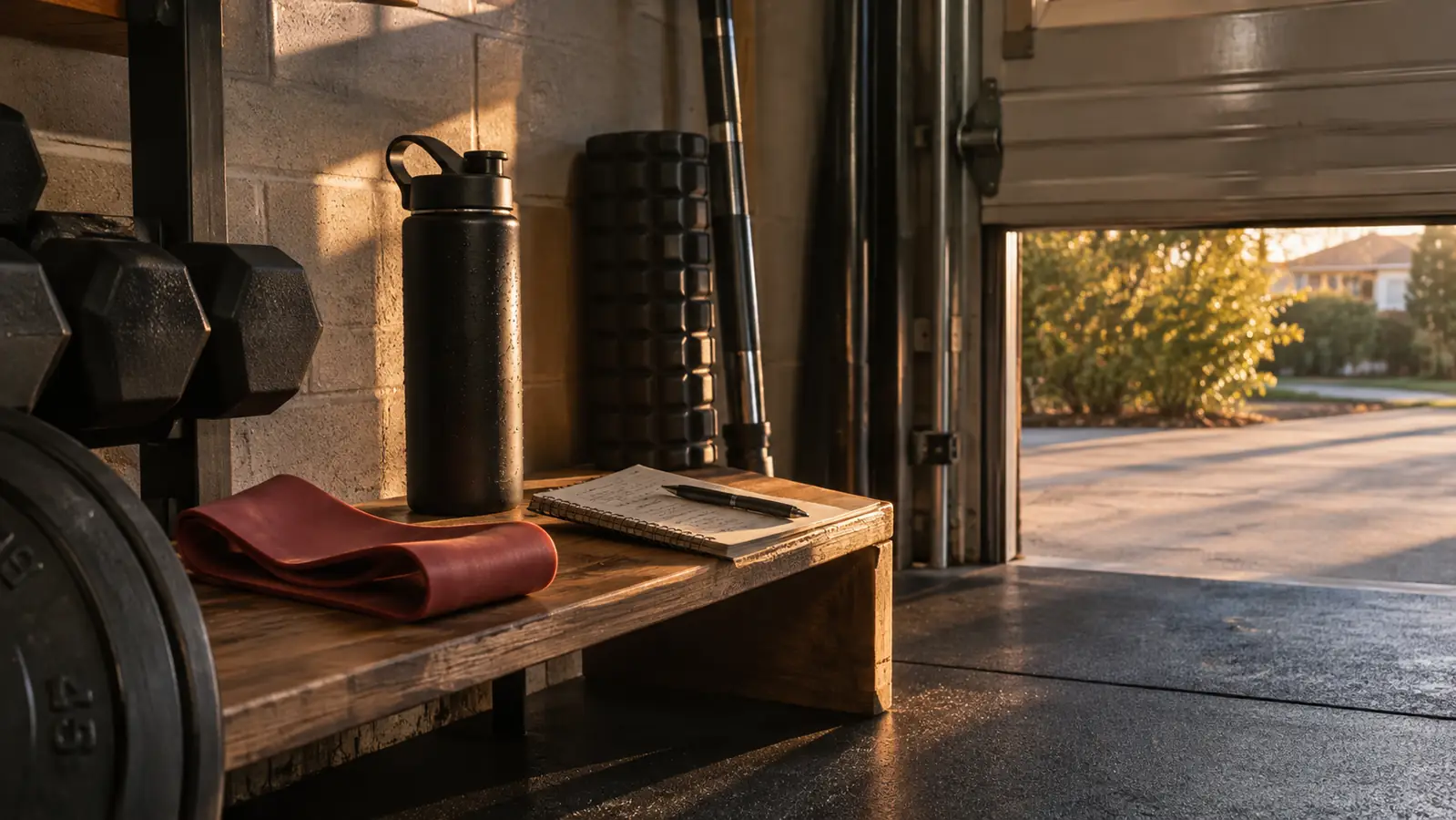
I keep a small notebook on the shelf and write the pin number next to each exercise. Numbers on paper beat memory every time, especially in month three when the weights start to feel different and you cannot remember whether the row was at the sixth stop or the seventh. It also makes a bad week visible as a bad week instead of a bad month.
What Else Helps
A fan. I am serious. A garage in Jacksonville in August is a punishment, and a cheap box fan pointed at the bench is the difference between finishing a set and quitting the session. Add a clock you can see without picking up your phone, because the phone is where workouts go to die. Mine is stuck to the shelf with velcro. Add water, a real chair for between sets, and a cheap foam roller for the days my knee and calf are both complaining.
Two things that did not help, so you can skip them. Hanging a mirror too high, which showed me my shoulders and nothing I needed to see. And buying a second, heavier set of fixed dumbbells for the exercises I thought I had outgrown, which sat in the corner for a year and then got sold. The adjustable pair covers the range I actually use. When I want more work, I add a rep or slow the lowering instead of adding another object to the garage.
Start with the pair, then build the room around it
5 to 50 lb per hand, 16 increments, one magnetic pin, 12 inches of floor per dumbbell. The PowerBlock Elite EXP 90 is the piece I would buy first if I were setting up my garage again from an empty slab, and a 5 year limited warranty covers the part that matters.
Amazon Check Today's Price on Amazon →