
The first thing I noticed about the Gaiam mat was not the cushion. It was that I could not feel my garage floor.
I am 54, retired from teaching high school PE, and my left knee has been sore since my playing days. A thin mat on a concrete slab is not something I can do anymore. So I bought the Gaiam thick yoga mat for one reason: 10mm of NBR foam between me and the floor. That is about two fifths of an inch, and it is the whole story of this mat, both the good half and the half that never makes it into the listing photos.
This is the honest version. Not the version where a piece of foam fixes a body. The version where a mat has three jobs, does two of them well, and asks you to accept a real tradeoff on the third. I have used it in the one-car garage I converted into a gym, on the driveway, and on the grass at the park three blocks from my house. I have rolled it, carried it, wiped it down, aired it out, and formed opinions about all of it.
The Quick Verdict
A genuinely comfortable 10mm mat for stiff joints and hard floors. Soft enough to kneel on, soft enough to feel a little unsteady in balance work, and it needs a day or two to air out before you use it indoors.
Amazon Check Today's Price →If your knees decide where you can stretch, this is the mat that argues with them
10mm of NBR foam, 72 inches long, 24 inches wide, and a cinch strap in the box. That is the whole pitch, and it is enough.
Amazon Check Today's Price on Amazon →What Nobody Tells You About a 10mm Mat
The listing says extra thick. It does not say what thick costs you, and it costs you something.
Every millimeter of foam between your foot and the floor is a millimeter of distance between your foot and the ground. Standing on one leg on this mat feels a little like standing on a mattress pad. Not unstable exactly, but not planted either. The first week I did balance work on it I wobbled in a way I never wobble on hardwood. That is not a defect. That is physics, and you cannot buy your way out of it at this thickness.
So here is the honest framing. A 10mm mat is a comfort tool, not a performance tool. If your practice is built on feeling the floor and finding balance from the ground up, this is the wrong mat, and getting used to it will not change that. If your practice has been shrinking for years because kneeling hurts, this mat will hand it back to you. Those two people should buy different things.
I also want to clear up what the reviews get wrong in both directions. The people who love this mat call it supportive. The people who hate it call it mushy. Both are describing the same property. It holds you up where your body presses down hard, like a knee or a hip, and it gives way where you need feedback, like a standing foot. Whether that reads as support or mush depends entirely on what you were doing when you noticed it.
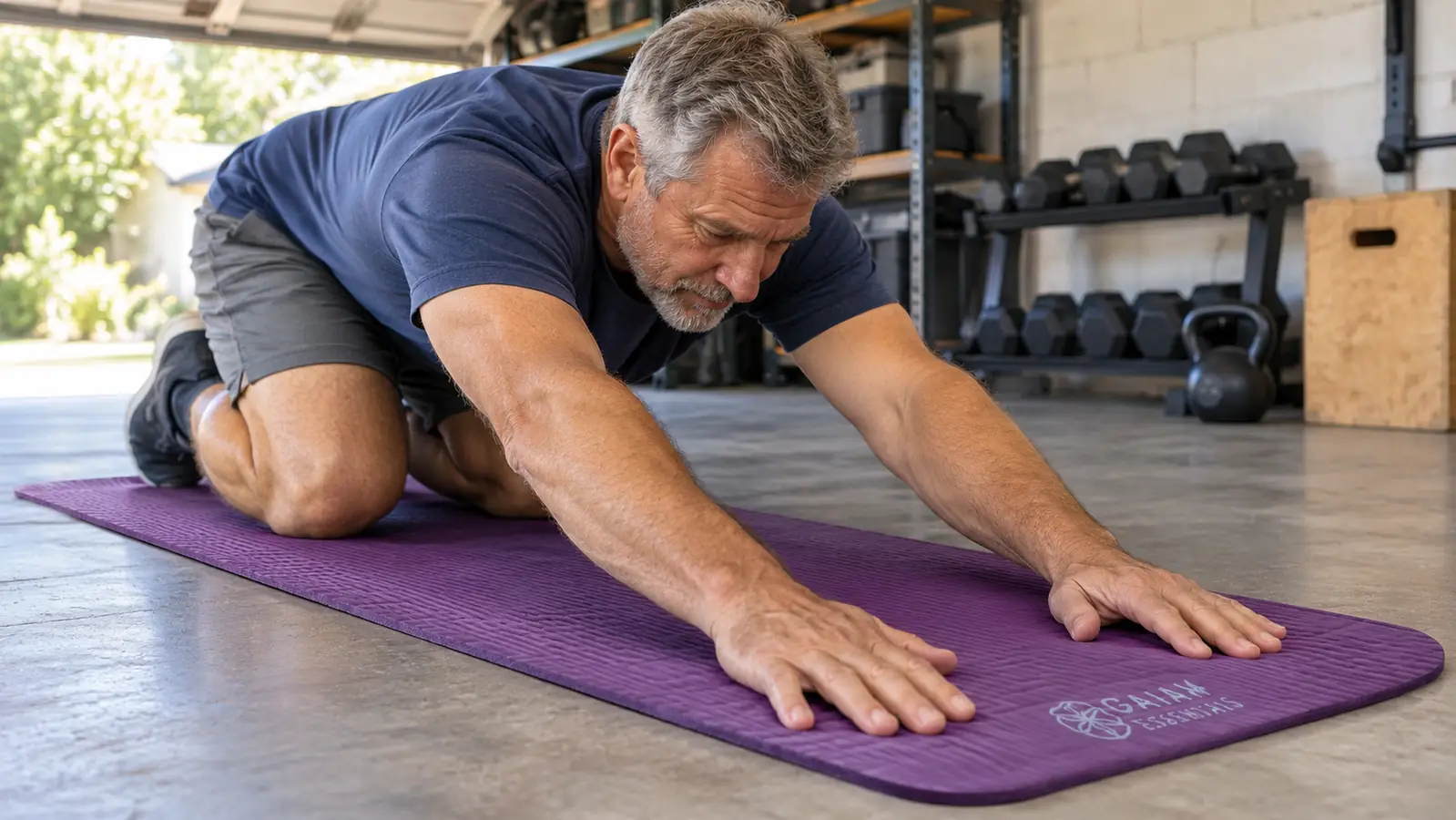
I measured it against the floor before I trusted it. The mat is 0.39 inches thick, which is what the listing says and what my tape measure said back to me. What that means in practice: when I set my hand down in a plank, my wrist sits almost a centimeter higher than it does on bare slab, and the angle through my forearm changes. It took me about a week to stop noticing. The first two sessions my wrists complained more, not less, and I nearly rolled the mat back up and went back to a folded towel. What actually helped was moving my hands an inch forward, a thing I would never have thought to do on a thin mat because I never had to.
How I Actually Used It
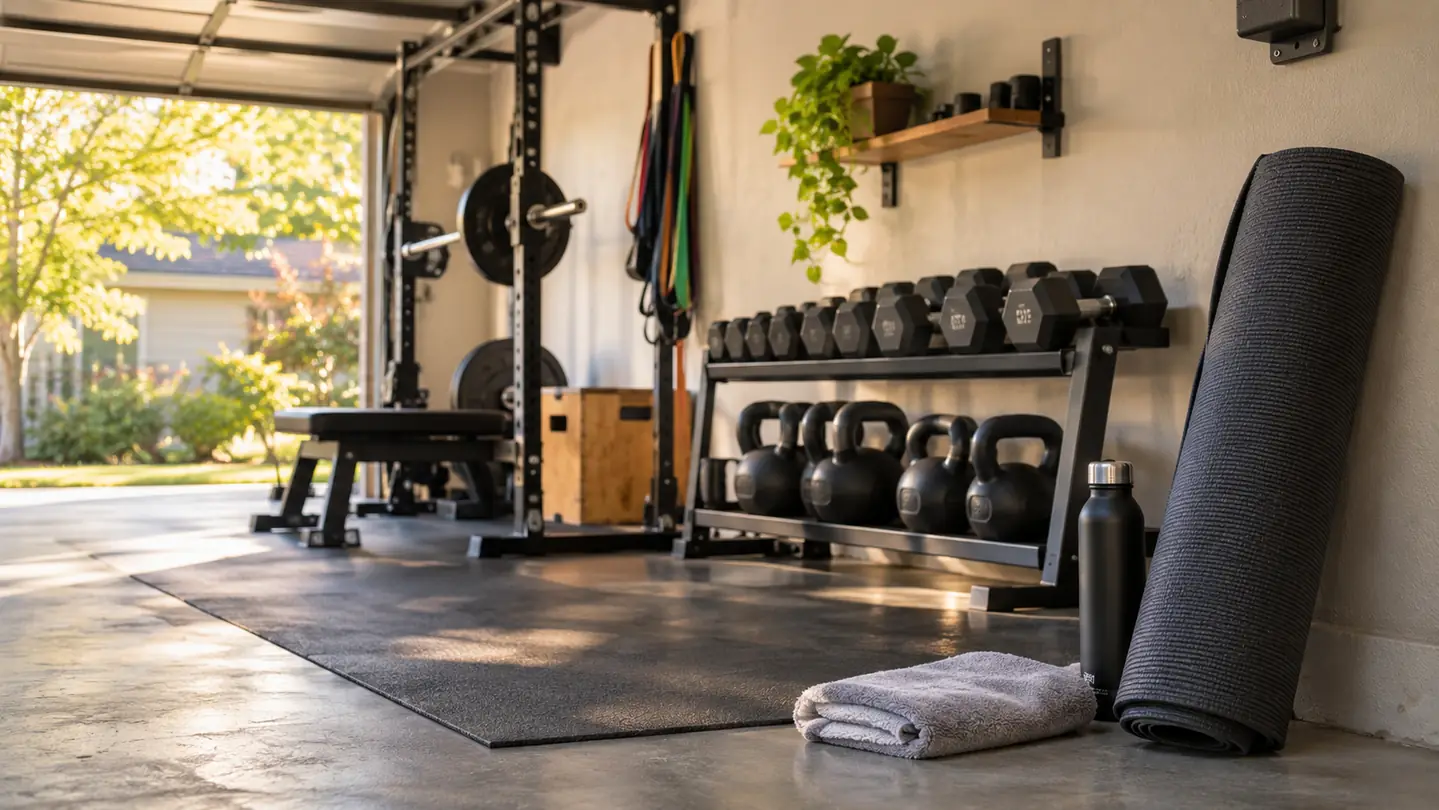
My garage is one car wide. The floor is concrete with a rubber stall mat over part of it and bare slab over the rest. Before this mat, the bare part was where stretching went to die. Now it is where my morning routine happens, because the Gaiam mat turns that slab into something my knees will tolerate at 6:30 in the morning.
The driveway gets used when the weather is decent and I want sun on my back. Same concrete, same problem, same fix. The mat is 72 inches long and 24 inches wide, so my heels and my head are both on it when I lie down, and I am not a small man.
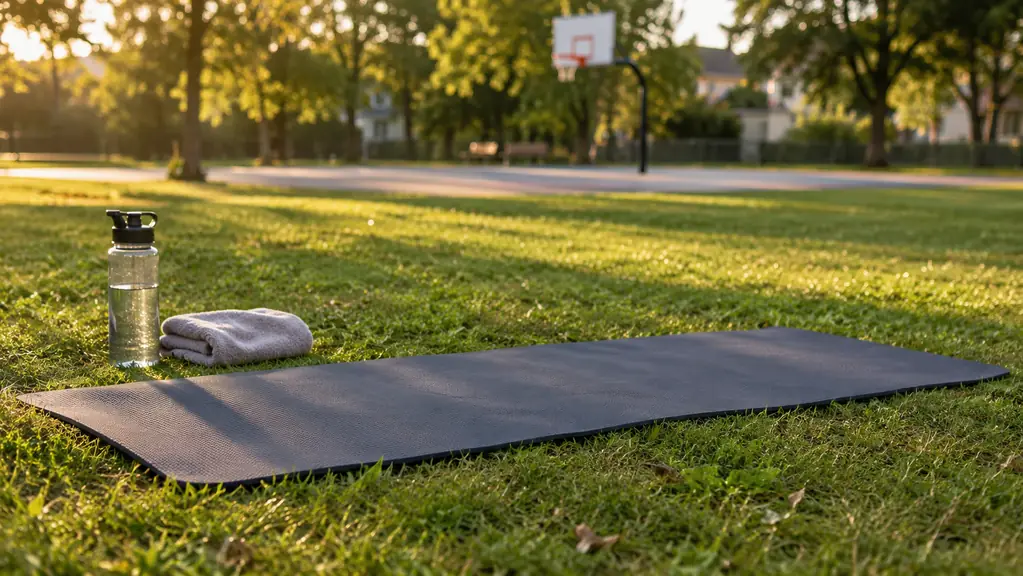
The park is where the grandkids come in. Sofia is 10 and Mateo is 7, and they will treat any flat surface as a gymnasium. The mat goes on the grass and becomes a wrestling mat, a picnic blanket, and a place to sit while I stretch. It has survived all three jobs. The grass wiped off. The corners have not curled the way cheap foam does.
The first Saturday I carried it out there was the last weekend in September, still hot enough that the grass was dry and scratchy underfoot. I unrolled it under the oak beside the court, sat down cross-legged to watch Mateo shoot, and stayed put for forty minutes. On a thin mat I would have been up in ten, shifting my weight, finding reasons to stand.
One thing I did not expect: the mat is quiet. Some foam mats squeak against a hard floor when you shift your weight. Mine does not, and in a garage at 6:30 in the morning with Elena still asleep in the house, that matters more than it should.
The Cushion Earns Its Keep
I want to be specific about where 10mm matters, because it does not matter everywhere. It matters in child's pose, where my knees and my forehead are both on the ground. It matters in any kneeling lunge, where the back knee is the whole story. It matters most in the slow supine work at the end, where you lie on your back and the floor decides whether your spine relaxes or braces against it.
What it does not do is make standing poses more comfortable in any way I can detect. Standing on foam is not a comfort problem, it is a stability problem. So the cushion is doing its real work across maybe a third of the mat, and that third is worth the whole thing to me.
There is a limit to it, though. Ten millimeters is generous for a yoga mat and thin for a mattress. If the problem is a hip pointer or a bruised tailbone, the mat will help and will not solve it. I folded mine double for one stretch in the first month, and that is not a thing you want to be doing forever.
I timed the difference once, out of curiosity. On the bare slab I could hold a kneeling lunge for about twenty seconds before the front of my back knee started talking to me. On the Gaiam mat I got to a minute and a half before I stopped for reasons that had nothing to do with pain. That is not a study. It is one man with one knee on one Tuesday, but it is the number that made me keep the mat and stop shopping.
Weight is 930 grams, about two pounds. That is not nothing to carry, but it is light for a mat this thick, and the strap in the box makes the walk to the park reasonable. I sling it over one shoulder with a water bottle in the other hand and I am fine for three blocks.
Ten millimeters is not a gimmick. It is the difference between kneeling on concrete for a minute and not kneeling at all.
Grip, Honestly
Here is where I have to be careful, because grip depends enormously on the person. Jacksonville in August is a wet towel. My hands sweat. Dry, my palms stay put through a flow. Twenty minutes in, with sweat running down my forearms, they start to slide a little in a downward dog and I reset once or twice. On a thin mat over hardwood I do not have that problem, because there is no foam compressing and rebounding under my palms.
Feet are better than hands. My feet stayed put in every standing pose I tried, sweat or no sweat. If your practice is mostly standing, you may never notice the hand issue at all.
The other variable is what you put between your hand and the foam. I do not use gloves. Luis lent me a plain hand towel for a week and it solved the slipping completely, which tells me the problem is the sweat and not the mat. If you already own a towel, you already own the fix.
One more honest note: the surface is soft enough that a sharp toenail leaves a mark. Mateo's sneakers have left dents. They flatten back out overnight. A deep gouge would not, and I would not let a cat near it.
The Smell Is Real and It Is Temporary
The listing mentions it, which I appreciate, because most do not. When I unrolled the mat the first time there was a distinct rubber and foam smell in the garage. Not overpowering, but present, and I would not have wanted it in a small bedroom. I left it unrolled on the driveway for two afternoons and by the end of the second day it was gone. Gaiam says 24 to 48 hours. That matched what I found.
The practical version: do not unroll it for the first time an hour before you plan to use it. Give it a day.
Care, Edges and How It Holds Up
Hand wash only. That is the instruction and it is worth respecting. I wipe mine down with a damp cloth and a little mild soap after a sweaty session, then hang it over the garage door track to dry before rolling it up. I have not submerged it and I do not plan to. Foam that stays wet is foam that starts to smell like the inside of a gym bag.
After a few months of steady use it still rolls the way it did on day one. The strap has held. The area where my hands go feels slightly smoother than the rest, which is normal for foam and not a defect. There is no cracking along the fold lines, which is the failure I expected, because cheap foam usually splits there first.
The Strap, the Roll and the Small Annoyances
The carrying strap is an adjustable cinch strap with a clip. It is not fancy. It holds the rolled mat together and lets you carry it over a shoulder. Mine has not slipped once.
Rolling it takes a little care. Roll with steady tension and it comes out even. Roll it sloppy and it comes out with a lump in the middle that you will feel under your spine. That is true of every foam mat I have owned, so it is not a knock on this one, but it is the kind of thing nobody mentions and everybody experiences.
The edges are the other small thing. They are cut clean, but they are foam, and dragging the mat across concrete will scuff them. Mine has scuffed. It still works. It just does not look new anymore, and after a few months nothing does.
How It Compares to What I Had Before
Before this I was using a thin mat, the kind that rolls up to the size of a newspaper. On carpet it was fine. On concrete it might as well have been a beach towel. The difference is not subtle. It is the difference between lying down and lying down without bracing.
The tradeoff is everything I described above. The thin mat gave me feedback and packed into a bag. The Gaiam gives me cushion and takes up real space in the garage. I kept both. The thin one stays rolled in the corner for the rare trip where space actually matters, and the thick one lives on the garage floor where the concrete is worst.
What I Liked
- 10mm of NBR foam makes kneeling, floor work and slow supine stretching possible on concrete
- 72 inches long, so tall people stay on the mat from heels to head
- 930 grams, light for how thick it is, and the cinch strap comes in the box
- Foam odor faded in about two days, which matches what the listing says
- Handles grass, carpet and concrete without the corners curling up
Where It Falls Short
- Too soft for balance work and fast standing transitions
- Hands can slip once sweat builds up
- Hand wash only, and it has to dry fully before you roll it
- The soft surface takes marks from toenails and sneakers
- Rolls bigger than a travel mat, so it is not a class commute mat
Who This Is For
If you are over 40 and your knees or hips have opinions about hard floors, this is your mat. If you do floor work, stretching, rehab exercises, or anything else that puts you on your knees, this is your mat. If you have a concrete floor in a basement or a garage and you have been avoiding it, this mat makes it usable again.
It is also a good mat for kids. Sofia and Mateo use it more than I do on weekends, and the thickness that keeps my knee happy also means a 7 year old landing on it does not yelp.
Who Should Skip It
If you move quickly between standing poses and you care about feeling grounded, skip it. The foam is too soft for that and you will spend the whole session fighting it.
If you are carrying a mat a mile or more to a class, skip it. Two pounds is two pounds and it rolls bigger than a travel mat. The thin travel mat comparison covers that tradeoff more directly than I can here.
And if your practice happens on polished hardwood, know that this mat is light enough to shift a little when you push off it. On carpet, grass and concrete it stays put. On smooth hardwood mine walked an inch or two over a session.
What Actually Changed for Me
The change is small and it is not inspirational. I stretch more days than I used to, because the barrier was never motivation, it was discomfort. When the floor stopped hurting, the excuses ran out. That is the whole transformation. No new body, no new discipline, just one less reason to skip it.
My knee still has opinions. The mat did not fix it and I would not trust a review that claimed it did. What the Gaiam mat did was remove one hard surface from a long list of things that hurt, and at 54 with a knee that has been grumpy since my playing days, that is enough to be worth writing about.
Buy it for the third of the mat where you are on your knees
The standing poses will still be your standing poses. The floor work stops being a negotiation. 72 by 24 inches, 10mm thick, strap included.
Amazon Check Today's Price on Amazon →