
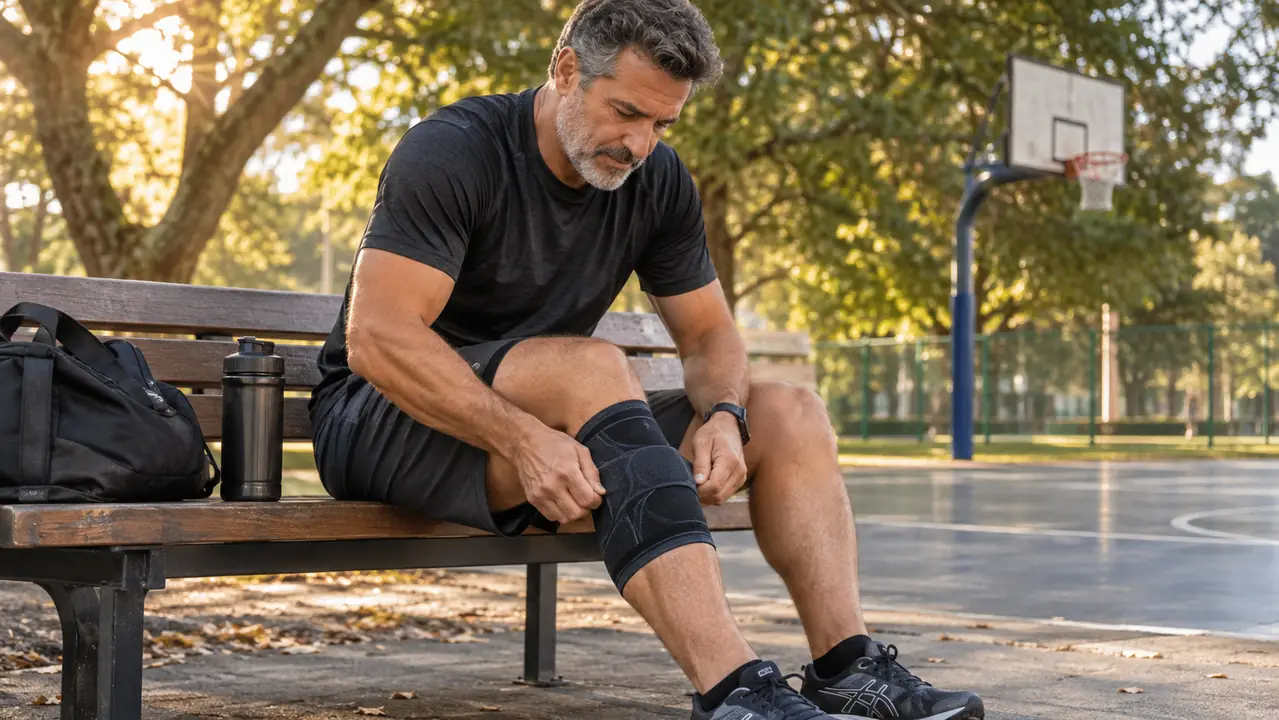
The first thing nobody tells you about the Bauerfeind Sports Knee Support is that it does not fix your knee. I want that on the table early, because I spent my first two weeks in it waiting for something to be repaired, and nothing was. What it actually does is narrower and more useful than repair. It holds the kneecap steady while the leg underneath does the work, and it holds it steadier than any sleeve I have worn. I am 54. I taught high school PE for 27 years before I retired, and my left knee has grumbled since a pickup game in my thirties. I have a converted one-car garage, a driveway with a hoop, and a park three blocks from the house with a court and a grass field. I have tried a lot of knee gear in all three places.
I paid for the Bauerfeind myself, out of my own pocket, and nobody sent me a sample to be nice about. That matters here, because I had no reason to be gentle with it and every reason to want it to disappoint me so I could go back to the drugstore sleeve I had been using. It is the most expensive thing in my gym bag by a stretch. The honest question was never whether it is well made. It is clearly well made. The honest question is whether a person with an ordinary sore knee gets enough back from it to justify the money, and the answer to that turns on details that do not appear anywhere on the box.
The Quick Verdict
A genuinely well-built patellar support that steadies the kneecap better than anything else I have worn, and the fit chart is the entire ballgame. Buy it for the hold and the fit, not for repair, and measure your thigh before you order.
Amazon Check Today's Price →The fit chart decides whether this works. Start there, not with the photos.
Measure your thigh circumference 14 cm above the center of the kneecap, knee slightly bent, before you order anything. That number is the one that matters.
Amazon Check Today's Price on Amazon →How I Actually Used It
I started with the small stuff, which is how I test everything. Morning walks first, three blocks to the park and back, maybe 25 minutes at a pace Elena calls my thinking pace. Then the driveway, where I keep a hoop for Mateo and Sofia when they come over on weekends, and where I shoot by myself on Saturday mornings before the heat turns serious. I did not wear it for a full game for the first three weeks. I wanted to know how it behaved when I was not paying attention to it, because that is when a brace either works or gets on your nerves. The first Tuesday I wore it, I did the three blocks to the park and back and then spent twenty minutes on the court with Mateo's ball, just walking through shooting form. Nothing slid. The top edge stayed where I put it. That was the whole test, and it passed it, which is a lower bar than it sounds and one that two previous sleeves had already failed.
What I found is that the support disappears. It weighs 138 grams, roughly the weight of a phone without the case, and once it is on and warm it stops being a thing on my leg. The pull-on closure means there is nothing to adjust mid-activity. No straps to re-tighten at the foul line, no hook and loop that goes fuzzy after twenty washes, no tab that catches on the inside of a pair of shorts. You pull it on, you line the pad up, you go. For a man who spent years yanking straps back into place between possessions, that is a real improvement. It is also a limitation, and I will get to that.
The Omega pad is the part I did not expect to care about. It surrounds the kneecap rather than sitting on top of it, and on my second Saturday back at pickup basketball I noticed the difference without looking for it. When I plant and change direction, the kneecap has somewhere to go, and that somewhere is inside the ring instead of out to the side. I am not going to tell you it made me faster or that it added years to my game. It made me less cautious, which is a different thing and probably the more honest one.
The Fit Is the Whole Thing
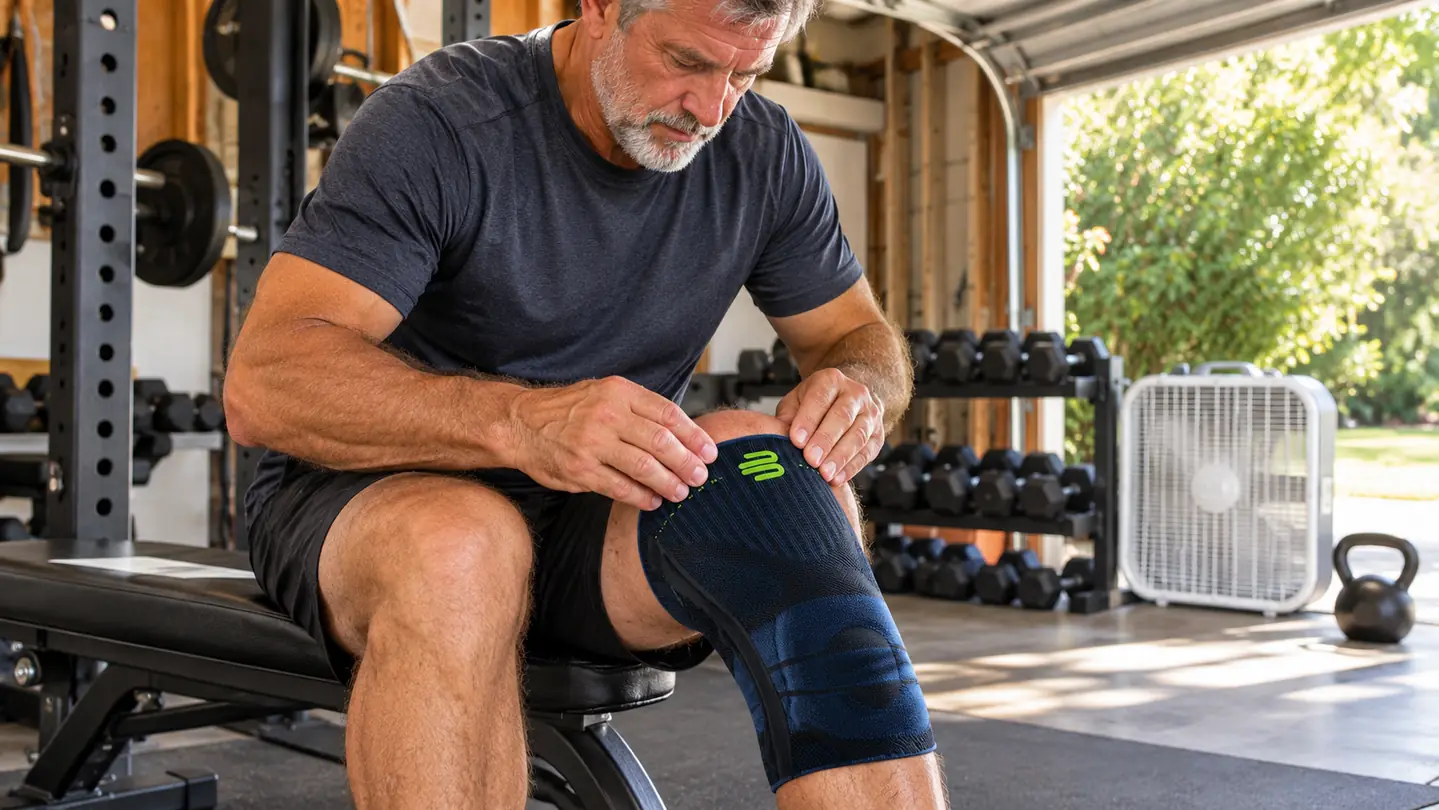
Bauerfeind tells you to measure your thigh circumference 14 cm above the center of the kneecap, with the knee slightly bent. That is roughly a hand's width above the kneecap. I measured three times across two days and wrote the number on the back of an envelope, which is what I do with anything I do not want to get wrong. I landed in a Large. If you take one thing from this review, take that one, and take the measurement with a soft tape rather than the metal tape from your garage.
I got it wrong the first time. I used the metal tape from the toolbox, pulled it snug, and read 47 cm. A soft tailor's tape on the same leg, same spot, same morning, read closer to 49, because the metal tape does not follow the curve of the thigh and the snug pull costs you a centimeter. I ordered a Medium on the 47, wore it once in the driveway, felt the top edge start to creep, and sent it back inside the thirty-day window. The Large, ordered on the honest number, has not moved once.
A knee support that is too small does not simply feel tight. It rolls at the top edge, and the rolling is what makes people give up on pull-on braces and go back to a strap rig. A support that is too loose slides down once you sweat, and the pad drifts off the kneecap, at which point you are wearing an expensive sock on your leg. There is no strap here to rescue a bad fit. That is the trade you make for the clean profile and the nothing-to-adjust convenience. If your measurement puts you between two sizes, the measurement is not a suggestion.
The knee-slightly-bent instruction matters more than it sounds. Straighten the leg and the circumference comes out different, and pulling the support on over a straight leg is how people tear a seam at the top. I bend to about 30 degrees, step in, and work it up in stages. The first few times it took both hands and the better part of a minute. Now it takes about ten seconds and I can do it standing in the driveway without thinking.
What It Does on a Bad Knee Day
There are mornings when my left knee tells me before I get out of bed that it is going to be a long one. Not sharp pain, just a thickness, as though the joint has been packed with something that does not belong there. On those mornings the support earns more of its keep than on the good ones. The compression is steady and even, and the pad gives the kneecap a boundary to work against instead of letting it wander. That is the difference between walking carefully and walking normally, and it shows up before I have left the driveway. One morning in February I got up, felt the thickness, and seriously considered skipping the walk. I put the support on anyway and did the short loop, the one that cuts through the park instead of around it. I walked it in about the same time I walk it on a good day. That is not nothing. A year ago I would have sat down with ice and lost the morning.
It does not take the thickness away. It does not make stairs free. I still take the handrail on the steps up to the park pavilion, and I still do the warm-up I have done since I was coaching, which is five minutes of easy movement before anything fast. What the support does is keep a bad day from turning into a bad week, because I move in a normal pattern instead of guarding the joint, and moving in a normal pattern is most of the treatment for a grumpy knee. Gear that changes how you move is doing something. Gear that only feels good in the moment is not.
The 3D Airknit material is the other thing that shows up in July. Jacksonville summer is a wet towel with a breeze. The knit is breathable in a way a plain neoprene sleeve is not, and it wicks enough that I am not peeling it off in the driveway twenty minutes into a session. I want to be clear that breathable is not the same as cool. It is still a knitted sleeve wrapped around your leg in Florida heat. It is just not a sauna, and after a season of wearing it I would not go back to the heavier sleeve I used before.
It does not repair anything. What it does is keep a bad day from becoming a bad week, because I move normally instead of guarding the knee.
The Parts I Don't Love
Even with the Airknit, an hour of pickup basketball in August is an hour with a warm sleeve on my knee. The worst one came on a Saturday late in the month, a full hour of half-court with men half my age, and by the end the sleeve was heavy with sweat and I could feel the top edge against the back of my knee on every step. I took it off in the driveway and stood in front of the box fan for five minutes before I went inside, and I would not wear it in the house. If you run hot, or if you are wearing this through a full two-hour practice rather than a walk, expect to want it off the moment you stop moving.
It is machine washable, which is the only reason I still own it. My habit is a cold cycle and air dry, and I wash it every third or fourth wear rather than after every single one, because knit and heat are not friends and I want two seasons out of it. Twenty minutes of hand-wringing after each use is how good gear ends up in the back of a drawer. This is easy enough that I actually do it.
The pull-on closure is both the best and the worst thing about the design. There is nothing to loosen when the knee swells at the end of a long day. On a bad afternoon, when my knee is up half a size and the top edge makes itself known, I take it off earlier than I would with a strap brace I could back off two notches. That is the cost of having nothing to fiddle with, and I would make the same trade again tomorrow. I just want you to know the trade exists before you are standing in the driveway deciding whether to go back inside.
Where the Money Goes
Here is the part that separates people. A compression sleeve from the pharmacy does one thing, which is squeeze. The Bauerfeind does that, plus the Omega pad around the kneecap, plus a knit that does not turn into a wet rag by the second quarter, plus a fit that is measured instead of guessed. Whether that bundle is worth the difference is not a question I can answer for your budget, and I am not going to pretend it is. It comes down to how many hours a week your knee is actually limiting you right now.
My own arithmetic went like this. I play Saturday basketball, I walk most mornings, and I chase a 7-year-old grandson around a park without thinking about it. If a support keeps me doing those three things for another five years instead of another two, it was money well spent and I would do it again without hesitating. If I had bought it to wear around the grocery store, I would have overbought, and I would tell you so. The support is priced for people who are going to use it hard. Buy it like that or do not buy it.
What I Liked
- Omega pad surrounds the kneecap and holds it steady on cuts and direction changes
- Lightweight at 138 grams, so it stops being noticeable once it is warm
- No straps to re-tighten and nothing to adjust in the middle of a game
- 3D Airknit breathes far better than the plain neoprene sleeves I have worn
- Machine washable, which means it actually gets washed instead of retired
Where It Falls Short
- The fit is unforgiving, and with no straps there is no rescue for a wrong size
- Still warm on a summer afternoon in Florida, whatever the knit does
- Nothing to loosen on the days the knee swells late
- Costs far more than most people expect to spend on a knee sleeve
- Does nothing for the joint itself, only for how the joint moves
Who This Is For
This is for the person whose knee is limiting real activity and who has already tried a drugstore sleeve and found that it either rolled down the leg or never held the kneecap in the first place. It is for pull-on people, the ones who do not want to think about their gear in the middle of a game. It is also for anyone whose physical therapist or orthopedist has suggested a patellar support and who wants one that will survive a full season of actual use rather than a month of light wear. If that is you, take the measurement seriously and the rest takes care of itself.
The honest version is this. I wish I had bought it three years earlier, not because it is remarkable, but because I spent those three years buying three separate sleeves that did not fit, did not hold, and did not last. The Bauerfeind replaced all of them with one item that does its job quietly. That is a boring endorsement and it is the true one.
Who Should Skip It
This is not for you if your knee problem is undiagnosed. Get it looked at first. A support that holds the kneecap steady is not a diagnosis, and wearing one can mask something a professional should see. Skip it if you need to change compression during activity, because there is nothing to adjust and you will resent that by the second week. Skip it if a pharmacy sleeve has genuinely worked well enough for your knee, because the improvement here is real but incremental, not a different category of thing.
And skip it if you are hoping the gear will do the work for you. I have watched a hundred teenagers and a fair number of adults buy equipment expecting the equipment to show up on their behalf. The support holds the knee steady. The warm-up, the strengthening, the rest days, and the decision to stop when something hurts are still yours to make. No sleeve has ever made that decision for anybody.
Measure once, order once, then get back out to the park.
If your thigh measurement lands you in a size, buy that size. Between two sizes, this is the one item in my bag where I would trust the tape over the hope.
Amazon Check Today's Price on Amazon →